 Add to Chrome
 Add to Firefox
 Add to Edge
@skills: Attention is all you have
Aug 12, 2026
There are 56,804 public agent skills today, and teams write many more privately. The dominant delivery model is installation: once installed, a skill's description remains in the system prompt, competing for fewer than 100 reliable trigger slots. This leaves the long tail with no practical path to use and forces teams' own playbooks to compete for the same scarce space. We observe that installation bundles three separable functions: content, persistence, and automatic triggering. Only the last requires prompt residency. We therefore propose @skills, an open protocol that separates them. A path addresses any skill, subtree, or collection, and reading a skill is sufficient to use it, so nothing is installed or made resident. The operation vendors a copy at the same path into a project's Git-tracked tree for adaptation and ownership. The operation adds one .gitignore-style line, the only element that costs prompt residency. A directory is a menu, making bundles ordinary directories rather than all-or-nothing units. The protocol requires no manifest, lockfile, or registration, and SKILL.md remains unchanged. @skills is additive, ships as an installable package, and turns any agent that can read files and run commands into a client through a single instruction file. Its open specification is at https://github.com/SylphAI-Inc/atskills and it is implemented in the AdaL CLI at https://adalagent.ai . Because paths address skills well but cannot find them, the protocol is paired with a free hub at https://atskills.one for corpus-wide search and ranking, repository-free hosting, private and team collections, and one-screen authoring. The hub is optional: gh: and local paths resolve without it, and indexed GitHub skills retain their gh: identities. Install less, use more.

An adversarial learning framework for preserving users' anonymity in face-based emotion recognition
Jan 16, 2020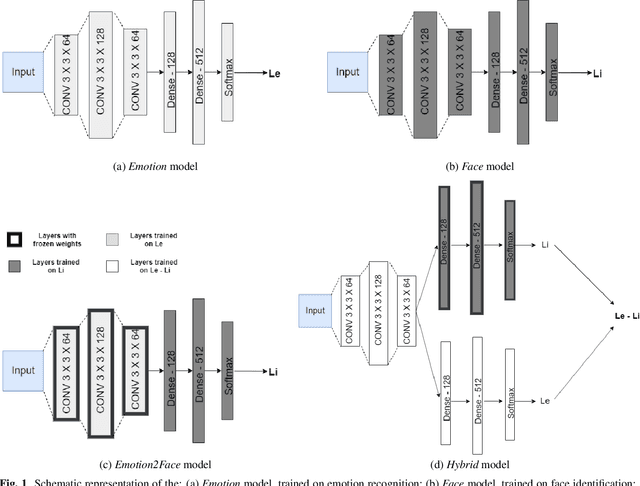
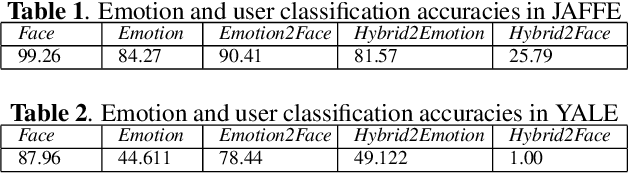
Image and video-capturing technologies have permeated our every-day life. Such technologies can continuously monitor individuals' expressions in real-life settings, affording us new insights into their emotional states and transitions, thus paving the way to novel well-being and healthcare applications. Yet, due to the strong privacy concerns, the use of such technologies is met with strong skepticism, since current face-based emotion recognition systems relying on deep learning techniques tend to preserve substantial information related to the identity of the user, apart from the emotion-specific information. This paper proposes an adversarial learning framework which relies on a convolutional neural network (CNN) architecture trained through an iterative procedure for minimizing identity-specific information and maximizing emotion-dependent information. The proposed approach is evaluated through emotion classification and face identification metrics, and is compared against two CNNs, one trained solely for emotion recognition and the other trained solely for face identification. Experiments are performed using the Yale Face Dataset and Japanese Female Facial Expression Database. Results indicate that the proposed approach can learn a convolutional transformation for preserving emotion recognition accuracy and degrading face identity recognition, providing a foundation toward privacy-aware emotion recognition technologies.