 Add to Chrome
 Add to Firefox
 Add to Edge
Prompt Generation Technical Report
Jul 13, 2026
Generative retrieval has become an increasingly adopted paradigm for industrial search, recommendation, and advertising systems, delivering significant online gains. Most existing work combines user behavior sequences with large language models (LLMs) to model user preferences. In practice, feature engineering remains critical to model effectiveness, yet its complexity slows offline iteration and makes online deployment heavy and hard to reuse, all under tight online latency budgets. The root cause is a tight coupling between feature-processing logic and model architecture, where every feature change touches the training and serving code and resists reuse across scenarios. To break this coupling, we present Prompt Generation (PG), a high-level tokenizer and configuration-driven framework that decouples feature-processing logic from model architecture through two declarative JSON files, which serve as the single source of truth for both offline training and online serving, ensuring feature consistency across the two stages. Organizing features under four types with three composable processing components to assemble and compress heterogeneous features, PG delivers acceleration at three levels: (1)fast training iteration: feature experiments require only configuration changes, with built-in token compression for ultra-long sequences; (2)fast deployment: a new scenario only needs to conform to the PG schema and plug into a universal pipeline, with no scenario-specific engineering; (3)fast online inference: engine applies unified optimizations over the standardized configuration, reducing PG's overhead to a negligible level. PG has been deployed on Taobao Search with statistically significant online A/B uplifts of +0.47% in transaction count and +0.51% in GMV, and has been applied across multiple Taobao search and recommendation teams as the iteration framework for generative retrieval.

One Token, Two Fates: A Unified Framework via Vision Token Manipulation Against MLLMs Hallucination
Mar 11, 2026Current training-free methods tackle MLLM hallucination with separate strategies: either enhancing visual signals or suppressing text inertia. However, these separate methods are insufficient due to critical trade-offs: simply enhancing vision often fails against strong language prior, while suppressing language can introduce extra image-irrelevant noise. Moreover, we find their naive combination is also ineffective, necessitating a unified framework. We propose such a framework by focusing on the core asset: the vision token. Our design leverages two key insights: (1) augmented images offer complementary visual semantics, and (2) removing vision tokens (information-gap) isolates hallucination tendencies more precisely than distorting images (modality-gap). Based on these, our framework uses vision tokens in two distinct ways, both operating on latent representations: our Synergistic Visual Calibration (SVC) module incorporates augmented tokens to strengthen visual representations, while our Causal Representation Calibration (CRC) module uses pruned tokens to create latent-space negative samples for correcting internal model biases. By harmonizing these two roles, our framework effectively restores the vision-language balance, significantly reducing object hallucinations, improving POPE accuracy by an average of 2% absolute on LLaVA-1.5 across multiple benchmarks with only a 1.06x inference latency overhead.
Decomposing and Composing: Towards Efficient Vision-Language Continual Learning via Rank-1 Expert Pool in a Single LoRA
Jan 30, 2026Continual learning (CL) in vision-language models (VLMs) faces significant challenges in improving task adaptation and avoiding catastrophic forgetting. Existing methods usually have heavy inference burden or rely on external knowledge, while Low-Rank Adaptation (LoRA) has shown potential in reducing these issues by enabling parameter-efficient tuning. However, considering directly using LoRA to alleviate the catastrophic forgetting problem is non-trivial, we introduce a novel framework that restructures a single LoRA module as a decomposable Rank-1 Expert Pool. Our method learns to dynamically compose a sparse, task-specific update by selecting from this expert pool, guided by the semantics of the [CLS] token. In addition, we propose an Activation-Guided Orthogonal (AGO) loss that orthogonalizes critical parts of LoRA weights across tasks. This sparse composition and orthogonalization enable fewer parameter updates, resulting in domain-aware learning while minimizing inter-task interference and maintaining downstream task performance. Extensive experiments across multiple settings demonstrate state-of-the-art results in all metrics, surpassing zero-shot upper bounds in generalization. Notably, it reduces trainable parameters by 96.7% compared to the baseline method, eliminating reliance on external datasets or task-ID discriminators. The merged LoRAs retain less weights and incur no inference latency, making our method computationally lightweight.
Dual-Teacher Ensemble Models with Double-Copy-Paste for 3D Semi-Supervised Medical Image Segmentation
Oct 15, 2024
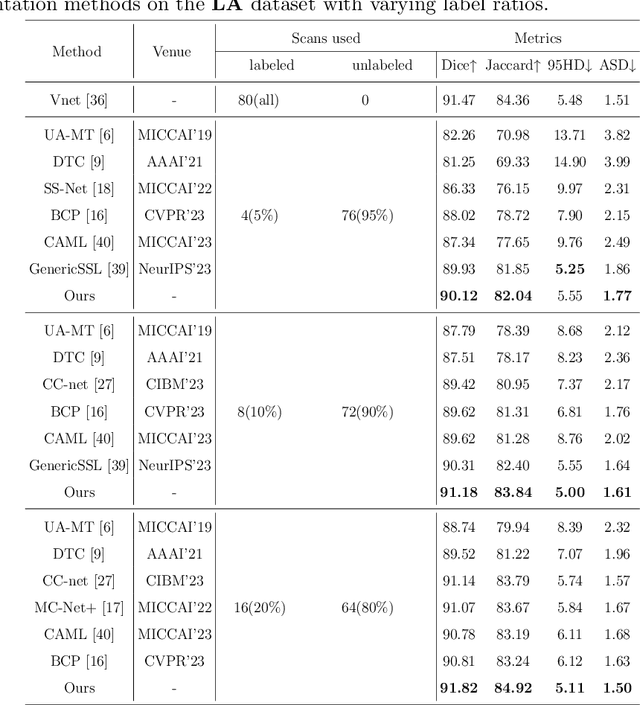
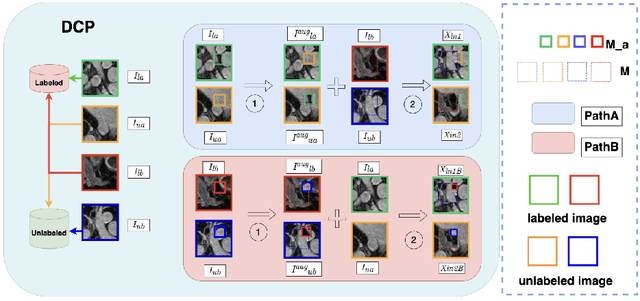

Semi-supervised learning (SSL) techniques address the high labeling costs in 3D medical image segmentation, with the teacher-student model being a common approach. However, using an exponential moving average (EMA) in single-teacher models may cause coupling issues, where the weights of the student and teacher models become similar, limiting the teacher's ability to provide additional knowledge for the student. Dual-teacher models were introduced to address this problem but often neglected the importance of maintaining teacher model diversity, leading to coupling issues among teachers. To address the coupling issue, we incorporate a double-copy-paste (DCP) technique to enhance the diversity among the teachers. Additionally, we introduce the Staged Selective Ensemble (SSE) module, which selects different ensemble methods based on the characteristics of the samples and enables more accurate segmentation of label boundaries, thereby improving the quality of pseudo-labels. Experimental results demonstrate the effectiveness of our proposed method in 3D medical image segmentation tasks. Here is the code link: https://github.com/Fazhan-cs/DCP.