 Add to Chrome
 Add to Firefox
 Add to Edge
CAVA: Canonical Action Verification and Attestation for Runtime Governance of Agentic AI Systems
Jul 15, 2026
Agentic AI systems increasingly act through heterogeneous runtimes: local coding hooks, SDK tools, browser automation, managed-agent traces, API gateways, and workflow engines. A single operational act such as publishing code, changing identity state, moving money, or exporting data may therefore be represented by many incompatible runtime records. This makes a basic governance question difficult to answer: what action was actually approved, what evidence binds the approval to execution, and can an independent verifier reproduce the same action identity later? This paper presents Canonical Action Verification and Attestation (CAVA), a runtime-semantics layer for converting heterogeneous agent activity into canonical runtime action objects. CAVA is positioned below Proof-Carrying Agent Actions (PCAA): PCAA defines the deployer-owned route-review-prove governance process, while CAVA defines the stable action object that process governs. The paper formalizes canonical action identity, semantic pattern detection, approval binding, receipt integrity, runtime-portable projection, and optional attestation substrates. We study a reference implementation through a 96-seed, 384-variant benchmark covering semantic equivalence, semantic separation, wrapper bypass, false-positive control, approval binding, receipt reproducibility, attestation tamper detection, runtime portability, semantic pattern detection, policy degradation, and Azure deployment drills. The contribution is a systems formulation of action-level canonicalization and policy-addressable semantic patterns as a necessary substrate for deployer-side AI governance.

Proof-Carrying Agent Actions: Model-Agnostic Runtime Governance for Heterogeneous Agent Systems
Jun 02, 2026Agent systems execute through runtimes with very different control points: local coding tools, framework SDKs, managed agent platforms, API gateways, and observer-only integrations. A high-risk action such as publishing data externally may therefore appear as a shell command in one runtime, a tool call in another, and a hosted session transition in a third. This makes it difficult to answer a basic governance question consistently: what action was authorized, under whose authority, with what approval semantics, and with what evidence after execution? This paper presents Proof-Carrying Agent Actions (PCAA), a runtime-neutral governance model centered on an action certificate rather than on a vendor-native session record. PCAA organizes control around five checkpoints: pre-action admissibility, action open, assumption capture, approval, and outcome closure. It binds these checkpoints to a portable action envelope, runtime and approval receipts, and replay-ready proof. The model is extended in two practical ways: the certificate is externality-aware, carrying boundary facts such as destination visibility and account provenance, and approval is described by explicit enforceability classes rather than by a single reviewed or unreviewed bit. We study the model through a reference implementation in a heterogeneous agent control plane and a disclosure-bounded evaluation protocol. On a protected benchmark expanded from 24 executable seeds to 96 traces across four runtime families, PCAA preserves route quality while exposing distinct failure modes under ablation. The paper contributes a systems formulation of runtime governance around certificate-bearing actions and an implementation-grounded account of how that formulation can remain portable under runtime churn without collapsing into vendor-specific control surfaces.
Building Robust Spoken Language Understanding by Cross Attention between Phoneme Sequence and ASR Hypothesis
Mar 22, 2022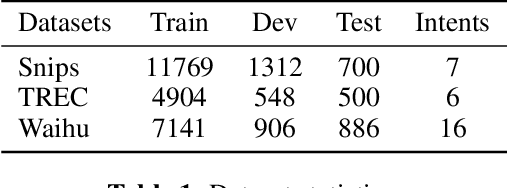
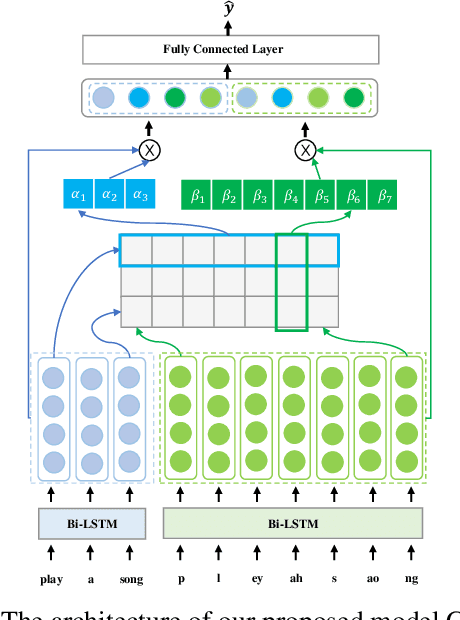
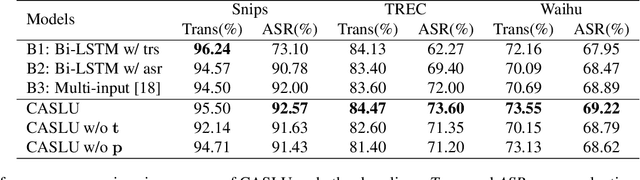
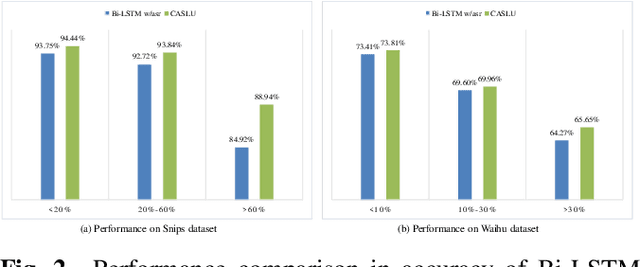
Building Spoken Language Understanding (SLU) robust to Automatic Speech Recognition (ASR) errors is an essential issue for various voice-enabled virtual assistants. Considering that most ASR errors are caused by phonetic confusion between similar-sounding expressions, intuitively, leveraging the phoneme sequence of speech can complement ASR hypothesis and enhance the robustness of SLU. This paper proposes a novel model with Cross Attention for SLU (denoted as CASLU). The cross attention block is devised to catch the fine-grained interactions between phoneme and word embeddings in order to make the joint representations catch the phonetic and semantic features of input simultaneously and for overcoming the ASR errors in downstream natural language understanding (NLU) tasks. Extensive experiments are conducted on three datasets, showing the effectiveness and competitiveness of our approach. Additionally, We also validate the universality of CASLU and prove its complementarity when combining with other robust SLU techniques.