 Add to Chrome
 Add to Firefox
 Add to Edge
A Cloud-Edge System for Multimodal Clinical Screening in Resource-Constrained Rural Settings
Aug 13, 2026
Medical AI has demonstrated specialist-level diagnostic accuracy, yet these capabilities remain largely inaccessible in resource-constrained rural settings where bandwidth is scarce, compute is limited, and clinical decision-making requires integrating heterogeneous modalities. We introduce a cloud--edge collaborative architecture that addresses these constraints: lightweight, domain-specific models on the edge transform raw medical data into compact structured outputs, while a cloud LLM synthesizes these outputs into clinical summaries. An LLM-based orchestrator dynamically selects diagnostic tools based on patient context, promoting comprehensive modality coverage without processing irrelevant inputs. We evaluate on 20 multimodal clinical cases spanning cardiac, obstetric, trauma, and screening scenarios under three simulated network profiles (500,kbps--5,Mbps). The hybrid system achieves 98--99% diagnostic tool recall with 92--96% precision, matches or exceeds cloud-only baselines on clinical accuracy, and maintains bandwidth-invariant latency (25--35,s) at 4--15x lower token cost. These results highlight the role of architectural design in enabling efficient multimodal integration and improving factual grounding compared to cloud-only approaches under deployment constraints.

Test-Time Scaling for World Action Models via Zero-Shot Geometric Evaluation
Jul 20, 2026Test-time scaling improves foundation-model inference by spending additional computation, but robot control requires deciding whether extra compute is useful before executing an action. World Action Models (WAMs) make this decision natural: each rollout exposes both an action chunk and predicted future observations. We propose \methodgated, a training-free selective test-time scaling framework for WAMs. We first instantiate \method, a fixed-budget Best-of-$N$ selector that ranks sampled rollouts by cross-view depth reprojection consistency of their predicted futures, computed with a frozen geometry foundation model. \methodgated\ adds a lightweight action--future consistency gate that invokes \method\ only when the initial rollout appears internally inconsistent. Across five benchmark--backbone settings on RoboCasa, LIBERO Long, and RoboTwin~2.0, fixed-budget \method\ improves $N{=}8$ task success in every setting, e.g., raising the RoboCasa group average from $66.3\%$ to $68.4\%$ with Cosmos Policy and from $80.8\%$ to $82.5\%$ with X-WAM. With gating enabled, \methodgated\ recovers on average $74.8\%$ of the always-on success gain while triggering additional sampling on only $26.2\%$ of decision points. Offline diagnostics show that cross-view reprojection is a strong task-label-free selector, and we identify false low-score selections as a failure mode that helps explain why performance can saturate or degrade as $N$ increases.
Dynamic Linear Attention
Jun 09, 2026The scalability of Large Language Models (LLMs) to long contexts is fundamentally constrained by the quadratic complexity of standard attention, motivating the adoption of linear attention mechanisms with sub-quadratic cost. To improve representation capacity under long contexts, recent approaches organize memory in a multi-state manner. However, existing multi-state linear attention methods rely on fixed state merging policies that cannot adapt to dynamically varying token importance, irreversibly obscuring critical tokens and causing severe error accumulation over long sequences. To address this limitation, we propose DLA, a dynamic memory modeling framework for multi-state linear attention. DLA introduces (i) Information-Aware Dynamic State Merging, which adaptively determines state boundaries based on token-level information variation, preserving high-resolution representations around semantic transitions while aggressively summarizing stable regions, and (ii) Capacity-Bounded Memory Modeling, which maintains a fixed-size, chronologically ordered state cache by selectively merging adjacent low-information states to control memory growth with minimal information loss. We pre-train DLA on two different linear attention models and evaluate on 16 datasets across three categories. Experimental results demonstrate the superiority of DLA over state-of-the-art.
MARS: Harmonizing Multimodal Convergence via Adaptive Rank Search
Feb 28, 2026Fine-tuning Multimodal Large Language Models (MLLMs) with parameter-efficient methods like Low-Rank Adaptation (LoRA) is crucial for task adaptation. However, imbalanced training dynamics across modalities often lead to suboptimal accuracy due to negative interference, a challenge typically addressed with inefficient heuristic methods such as manually tuning separate learning rates. To overcome this, we introduce MARS (Multimodal Adaptive Rank Search), an approach to discover optimal rank pairs that balance training dynamics while maximizing performance. Our key innovation, a proposed framework of dual scaling laws, enables this search: one law models module-specific convergence time to prune the search space to candidates with aligned dynamics, while the other predicts final task performance to select the optimal pair from the pruned set. By re-purposing the LoRA rank as a controller for modality-specific convergence speed, MARS outperforms baseline methods and provides a robust, automated strategy for optimizing MLLM fine-tuning.
Unfolding Videos Dynamics via Taylor Expansion
Sep 04, 2024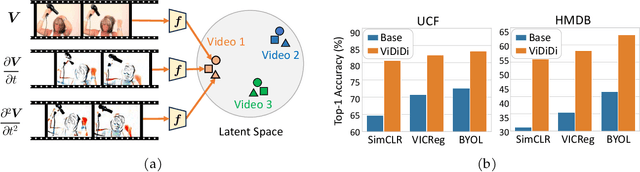

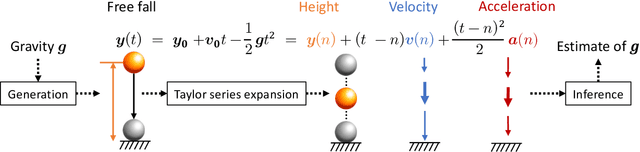

Taking inspiration from physical motion, we present a new self-supervised dynamics learning strategy for videos: Video Time-Differentiation for Instance Discrimination (ViDiDi). ViDiDi is a simple and data-efficient strategy, readily applicable to existing self-supervised video representation learning frameworks based on instance discrimination. At its core, ViDiDi observes different aspects of a video through various orders of temporal derivatives of its frame sequence. These derivatives, along with the original frames, support the Taylor series expansion of the underlying continuous dynamics at discrete times, where higher-order derivatives emphasize higher-order motion features. ViDiDi learns a single neural network that encodes a video and its temporal derivatives into consistent embeddings following a balanced alternating learning algorithm. By learning consistent representations for original frames and derivatives, the encoder is steered to emphasize motion features over static backgrounds and uncover the hidden dynamics in original frames. Hence, video representations are better separated by dynamic features. We integrate ViDiDi into existing instance discrimination frameworks (VICReg, BYOL, and SimCLR) for pretraining on UCF101 or Kinetics and test on standard benchmarks including video retrieval, action recognition, and action detection. The performances are enhanced by a significant margin without the need for large models or extensive datasets.