 Add to Chrome
 Add to Firefox
 Add to Edge
The First Challenge on Remote Sensing Infrared Image Super-Resolution at NTIRE 2026: Benchmark Results and Method Overview
Apr 23, 2026
This paper presents the NTIRE 2026 Remote Sensing Infrared Image Super-Resolution (x4) Challenge, one of the associated challenges of NTIRE 2026. The challenge aims to recover high-resolution (HR) infrared images from low-resolution (LR) inputs generated through bicubic downsampling with a x4 scaling factor. The objective is to develop effective models or solutions that achieve state-of-the-art performance for infrared image SR in remote sensing scenarios. To reflect the characteristics of infrared data and practical application needs, the challenge adopts a single-track setting. A total of 115 participants registered for the competition, with 13 teams submitting valid entries. This report summarizes the challenge design, dataset, evaluation protocol, main results, and the representative methods of each team. The challenge serves as a benchmark to advance research in infrared image super-resolution and promote the development of effective solutions for real-world remote sensing applications.

UDPNet: Unleashing Depth-based Priors for Robust Image Dehazing
Jan 11, 2026Image dehazing has witnessed significant advancements with the development of deep learning models. However, a few methods predominantly focus on single-modal RGB features, neglecting the inherent correlation between scene depth and haze distribution. Even those that jointly optimize depth estimation and image dehazing often suffer from suboptimal performance due to inadequate utilization of accurate depth information. In this paper, we present UDPNet, a general framework that leverages depth-based priors from large-scale pretrained depth estimation model DepthAnything V2 to boost existing image dehazing models. Specifically, our architecture comprises two typical components: the Depth-Guided Attention Module (DGAM) adaptively modulates features via lightweight depth-guided channel attention, and the Depth Prior Fusion Module (DPFM) enables hierarchical fusion of multi-scale depth map features by dual sliding-window multi-head cross-attention mechanism. These modules ensure both computational efficiency and effective integration of depth priors. Moreover, the intrinsic robustness of depth priors empowers the network to dynamically adapt to varying haze densities, illumination conditions, and domain gaps across synthetic and real-world data. Extensive experimental results demonstrate the effectiveness of our UDPNet, outperforming the state-of-the-art methods on popular dehazing datasets, such as 0.85 dB PSNR improvement on the SOTS dataset, 1.19 dB on the Haze4K dataset and 1.79 dB PSNR on the NHR dataset. Our proposed solution establishes a new benchmark for depth-aware dehazing across various scenarios. Pretrained models and codes will be released at our project https://github.com/Harbinzzy/UDPNet.
A Survey on All-in-One Image Restoration: Taxonomy, Evaluation and Future Trends
Oct 19, 2024

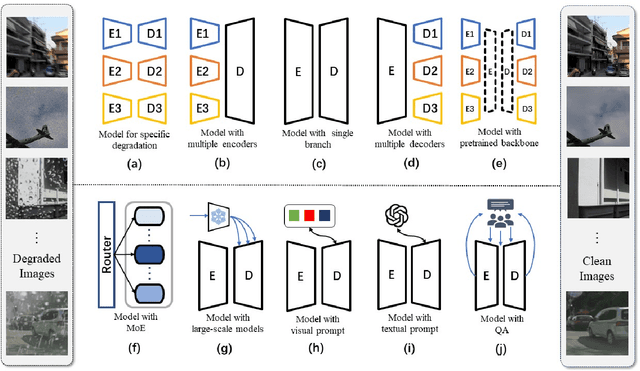
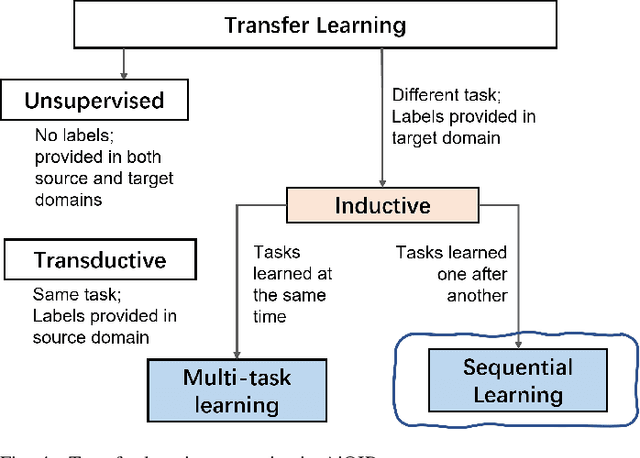
Image restoration (IR) refers to the process of improving visual quality of images while removing degradation, such as noise, blur, weather effects, and so on. Traditional IR methods typically target specific types of degradation, which limits their effectiveness in real-world scenarios with complex distortions. In response to this challenge, the all-in-one image restoration (AiOIR) paradigm has emerged, offering a unified framework that adeptly addresses multiple degradation types. These innovative models enhance both convenience and versatility by adaptively learning degradation-specific features while simultaneously leveraging shared knowledge across diverse corruptions. In this review, we delve into the AiOIR methodologies, emphasizing their architecture innovations and learning paradigm and offering a systematic review of prevalent approaches. We systematically categorize prevalent approaches and critically assess the challenges these models encounter, proposing future research directions to advance this dynamic field. Our paper begins with an introduction to the foundational concepts of AiOIR models, followed by a categorization of cutting-edge designs based on factors such as prior knowledge and generalization capability. Next, we highlight key advancements in AiOIR, aiming to inspire further inquiry and innovation within the community. To facilitate a robust evaluation of existing methods, we collate and summarize commonly used datasets, implementation details, and evaluation metrics. Additionally, we present an objective comparison of open-sourced methods, providing valuable insights for researchers and practitioners alike. This paper stands as the first comprehensive and insightful review of AiOIR. A related repository is available at https://github.com/Harbinzzy/All-in-One-Image-Restoration-Survey.