 Add to Chrome
 Add to Firefox
 Add to Edge
Robust Smart Contract Vulnerability Detection via Contrastive Learning-Enhanced Granular-ball Training
Mar 29, 2026
Deep neural networks (DNNs) have emerged as a prominent approach for detecting smart contract vulnerabilities, driven by the growing contract datasets and advanced deep learning techniques. However, DNNs typically require large-scale labeled datasets to model the relationships between contract features and vulnerability labels. In practice, the labeling process often depends on existing open-sourced tools, whose accuracy cannot be guaranteed. Consequently, label noise poses a significant challenge for the accuracy and robustness of the smart contract, which is rarely explored in the literature. To this end, we propose Contrastive learning-enhanced Granular-Ball smart Contracts training, CGBC, to enhance the robustness of contract vulnerability detection. Specifically, CGBC first introduces a Granular-ball computing layer between the encoder layer and the classifier layer, to group similar contracts into Granular-Balls (GBs) and generate new coarse-grained representations (i.e., the center and the label of GBs) for them, which can correct noisy labels based on the most correct samples. An inter-GB compactness loss and an intra-GB looseness loss are combined to enhance the effectiveness of clustering. Then, to improve the accuracy of GBs, we pretrain the model through unsupervised contrastive learning supported by our novel semantic-consistent smart contract augmentation method. This procedure can discriminate contracts with different labels by dragging the representation of similar contracts closer, assisting CGBC in clustering. Subsequently, we leverage the symmetric cross-entropy loss function to measure the model quality, which can combat the label noise in gradient computations. Finally, extensive experiments show that the proposed CGBC can significantly improve the robustness and effectiveness of the smart contract vulnerability detection when contrasted with baselines.

PSNE: Efficient Spectral Sparsification Algorithms for Scaling Network Embedding
Aug 05, 2024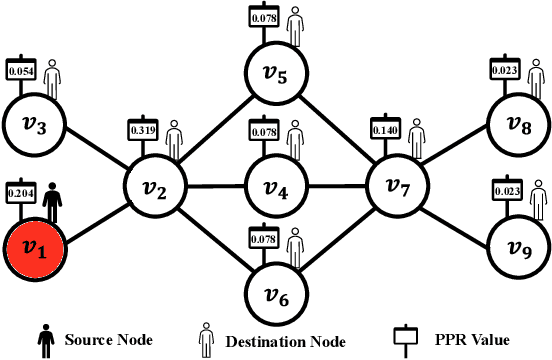


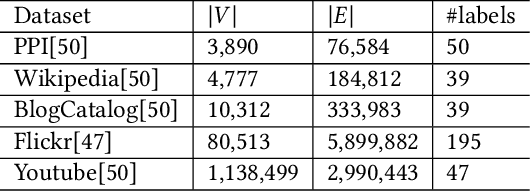
Network embedding has numerous practical applications and has received extensive attention in graph learning, which aims at mapping vertices into a low-dimensional and continuous dense vector space by preserving the underlying structural properties of the graph. Many network embedding methods have been proposed, among which factorization of the Personalized PageRank (PPR for short) matrix has been empirically and theoretically well supported recently. However, several fundamental issues cannot be addressed. (1) Existing methods invoke a seminal Local Push subroutine to approximate \textit{a single} row or column of the PPR matrix. Thus, they have to execute $n$ ($n$ is the number of nodes) Local Push subroutines to obtain a provable PPR matrix, resulting in prohibitively high computational costs for large $n$. (2) The PPR matrix has limited power in capturing the structural similarity between vertices, leading to performance degradation. To overcome these dilemmas, we propose PSNE, an efficient spectral s\textbf{P}arsification method for \textbf{S}caling \textbf{N}etwork \textbf{E}mbedding, which can fast obtain the embedding vectors that retain strong structural similarities. Specifically, PSNE first designs a matrix polynomial sparser to accelerate the calculation of the PPR matrix, which has a theoretical guarantee in terms of the Frobenius norm. Subsequently, PSNE proposes a simple but effective multiple-perspective strategy to enhance further the representation power of the obtained approximate PPR matrix. Finally, PSNE applies a randomized singular value decomposition algorithm on the sparse and multiple-perspective PPR matrix to get the target embedding vectors. Experimental evaluation of real-world and synthetic datasets shows that our solutions are indeed more efficient, effective, and scalable compared with ten competitors.