 Add to Chrome
 Add to Firefox
 Add to Edge
READY: Reward Discovery for Meta-Black-Box Optimization
Jan 29, 2026
Meta-Black-Box Optimization (MetaBBO) is an emerging avenue within Optimization community, where algorithm design policy could be meta-learned by reinforcement learning to enhance optimization performance. So far, the reward functions in existing MetaBBO works are designed by human experts, introducing certain design bias and risks of reward hacking. In this paper, we use Large Language Model~(LLM) as an automated reward discovery tool for MetaBBO. Specifically, we consider both effectiveness and efficiency sides. On effectiveness side, we borrow the idea of evolution of heuristics, introducing tailored evolution paradigm in the iterative LLM-based program search process, which ensures continuous improvement. On efficiency side, we additionally introduce multi-task evolution architecture to support parallel reward discovery for diverse MetaBBO approaches. Such parallel process also benefits from knowledge sharing across tasks to accelerate convergence. Empirical results demonstrate that the reward functions discovered by our approach could be helpful for boosting existing MetaBBO works, underscoring the importance of reward design in MetaBBO. We provide READY's project at https://anonymous.4open.science/r/ICML_READY-747F.

MetaBox-v2: A Unified Benchmark Platform for Meta-Black-Box Optimization
May 23, 2025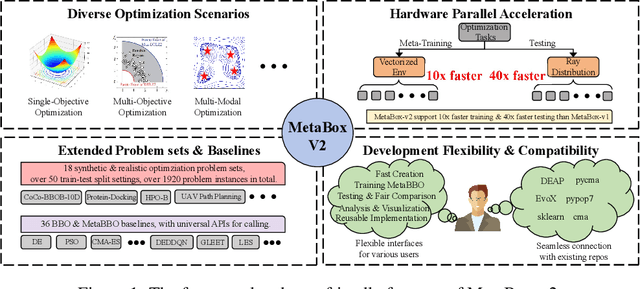
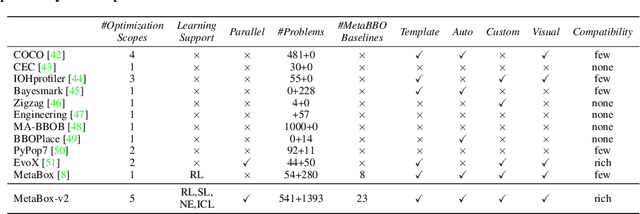
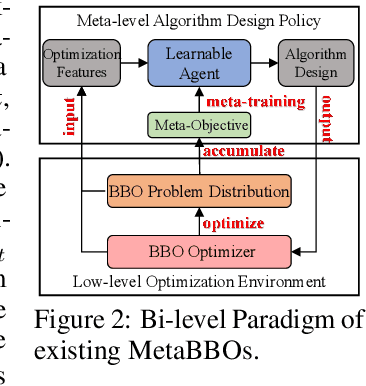
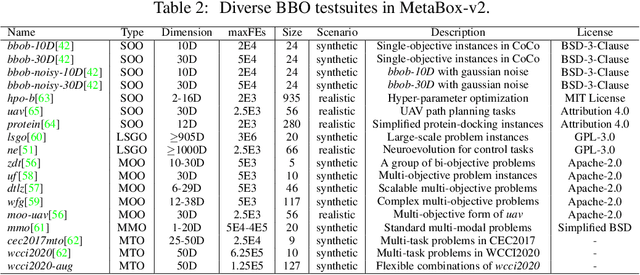
Meta-Black-Box Optimization (MetaBBO) streamlines the automation of optimization algorithm design through meta-learning. It typically employs a bi-level structure: the meta-level policy undergoes meta-training to reduce the manual effort required in developing algorithms for low-level optimization tasks. The original MetaBox (2023) provided the first open-source framework for reinforcement learning-based single-objective MetaBBO. However, its relatively narrow scope no longer keep pace with the swift advancement in this field. In this paper, we introduce MetaBox-v2 (https://github.com/MetaEvo/MetaBox) as a milestone upgrade with four novel features: 1) a unified architecture supporting RL, evolutionary, and gradient-based approaches, by which we reproduce 23 up-to-date baselines; 2) efficient parallelization schemes, which reduce the training/testing time by 10-40x; 3) a comprehensive benchmark suite of 18 synthetic/realistic tasks (1900+ instances) spanning single-objective, multi-objective, multi-model, and multi-task optimization scenarios; 4) plentiful and extensible interfaces for custom analysis/visualization and integrating to external optimization tools/benchmarks. To show the utility of MetaBox-v2, we carry out a systematic case study that evaluates the built-in baselines in terms of the optimization performance, generalization ability and learning efficiency. Valuable insights are concluded from thorough and detailed analysis for practitioners and those new to the field.