 Add to Chrome
 Add to Firefox
 Add to Edge
Reinforcement Learning-assisted Constraint Relaxation for Constrained Expensive Optimization
Jan 31, 2026
Constraint handling plays a key role in solving realistic complex optimization problems. Though intensively discussed in the last few decades, existing constraint handling techniques predominantly rely on human experts' designs, which more or less fall short in utility towards general cases. Motivated by recent progress in Meta-Black-Box Optimization where automated algorithm design can be learned to boost optimization performance, in this paper, we propose learning effective, adaptive and generalizable constraint handling policy through reinforcement learning. Specifically, a tailored Markov Decision Process is first formulated, where given optimization dynamics features, a deep Q-network-based policy controls the constraint relaxation level along the underlying optimization process. Such adaptive constraint handling provides flexible tradeoff between objective-oriented exploitation and feasible-region-oriented exploration, and hence leads to promising optimization performance. We train our approach on CEC 2017 Constrained Optimization benchmark with limited evaluation budget condition (expensive cases) and compare the trained constraint handling policy to strong baselines such as recent winners in CEC/GECCO competitions. Extensive experimental results show that our approach performs competitively or even surpasses the compared baselines under either Leave-one-out cross-validation or ordinary train-test split validation. Further analysis and ablation studies reveal key insights in our designs.

Evolution of Benchmark: Black-Box Optimization Benchmark Design through Large Language Model
Jan 29, 2026Benchmark Design in Black-Box Optimization (BBO) is a fundamental yet open-ended topic. Early BBO benchmarks are predominantly human-crafted, introducing expert bias and constraining diversity. Automating this design process can relieve the human-in-the-loop burden while enhancing diversity and objectivity. We propose Evolution of Benchmark (EoB), an automated BBO benchmark designer empowered by the large language model (LLM) and its program evolution capability. Specifically, we formulate benchmark design as a bi-objective optimization problem towards maximizing (i) landscape diversity and (ii) algorithm-differentiation ability across a portfolio of BBO solvers. Under this paradigm, EoB iteratively prompts LLM to evolve a population of benchmark programs and employs a reflection-based scheme to co-evolve the landscape and its corresponding program. Comprehensive experiments validate our EoB is a competitive candidate in multi-dimensional usages: 1) Benchmarking BBO algorithms; 2) Training and testing learning-assisted BBO algorithms; 3) Extending proxy for expensive real-world problems.
MetaBox-v2: A Unified Benchmark Platform for Meta-Black-Box Optimization
May 23, 2025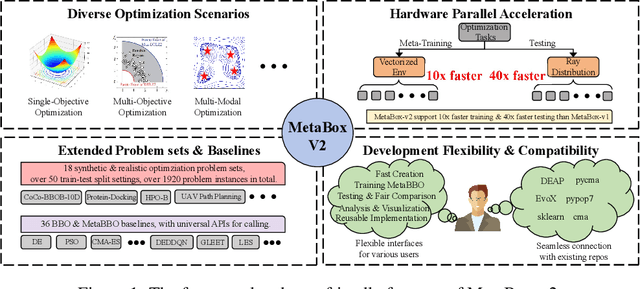
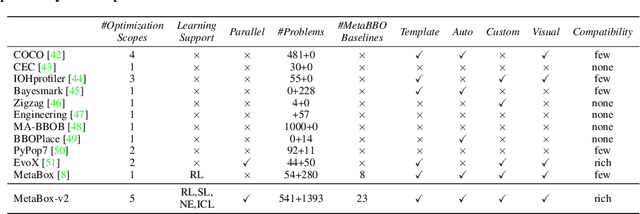
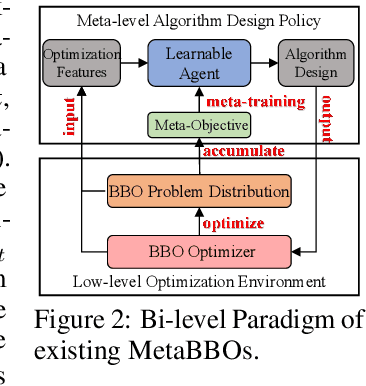
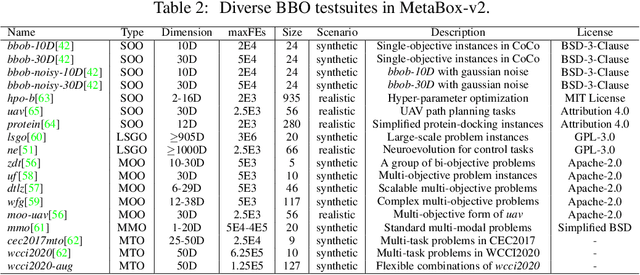
Meta-Black-Box Optimization (MetaBBO) streamlines the automation of optimization algorithm design through meta-learning. It typically employs a bi-level structure: the meta-level policy undergoes meta-training to reduce the manual effort required in developing algorithms for low-level optimization tasks. The original MetaBox (2023) provided the first open-source framework for reinforcement learning-based single-objective MetaBBO. However, its relatively narrow scope no longer keep pace with the swift advancement in this field. In this paper, we introduce MetaBox-v2 (https://github.com/MetaEvo/MetaBox) as a milestone upgrade with four novel features: 1) a unified architecture supporting RL, evolutionary, and gradient-based approaches, by which we reproduce 23 up-to-date baselines; 2) efficient parallelization schemes, which reduce the training/testing time by 10-40x; 3) a comprehensive benchmark suite of 18 synthetic/realistic tasks (1900+ instances) spanning single-objective, multi-objective, multi-model, and multi-task optimization scenarios; 4) plentiful and extensible interfaces for custom analysis/visualization and integrating to external optimization tools/benchmarks. To show the utility of MetaBox-v2, we carry out a systematic case study that evaluates the built-in baselines in terms of the optimization performance, generalization ability and learning efficiency. Valuable insights are concluded from thorough and detailed analysis for practitioners and those new to the field.