 Add to Chrome
 Add to Firefox
 Add to Edge
Graph Neural ODE Digital Twins for Control-Oriented Reactor Thermal-Hydraulic Forecasting Under Partial Observability
Apr 08, 2026
Real-time supervisory control of advanced reactors requires accurate forecasting of plant-wide thermal-hydraulic states, including locations where physical sensors are unavailable. Meeting this need calls for surrogate models that combine predictive fidelity, millisecond-scale inference, and robustness to partial observability. In this work, we present a physics-informed message-passing Graph Neural Network coupled with a Neural Ordinary Differential Equation (GNN-ODE) to addresses all three requirements simultaneously. We represent the whole system as a directed sensor graph whose edges encode hydraulic connectivity through flow/heat transfer-aware message passing, and we advance the latent dynamics in continuous time via a controlled Neural ODE. A topology-guided missing-node initializer reconstructs uninstrumented states at rollout start; prediction then proceeds fully autoregressively. The GNN-ODE surrogate achieves satisfactory results for the system dynamics prediction. On held-out simulation transients, the surrogate achieves an average MAE of 0.91 K at 60 s and 2.18 K at 300 s for uninstrumented nodes, with $R^2$ up to 0.995 for missing-node state reconstruction. Inference runs at approximately 105 times faster than simulated time on a single GPU, enabling 64-member ensemble rollouts for uncertainty quantification. To assess sim-to-real transfer, we adapt the pretrained surrogate to experimental facility data using layerwise discriminative fine-tuning with only 30 training sequences. The learned flow-dependent heat-transfer scaling recovers a Reynolds-number exponent consistent with established correlations, indicating constitutive learning beyond trajectory fitting. The model tracks a steep power change transient and produces accurate trajectories at uninstrumented locations.

Automating Data-Driven Modeling and Analysis for Engineering Applications using Large Language Model Agents
Oct 01, 2025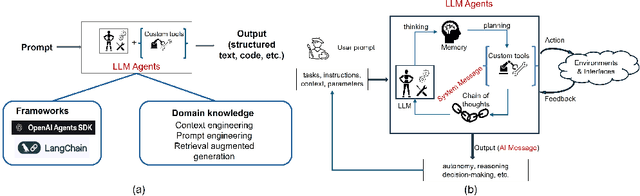
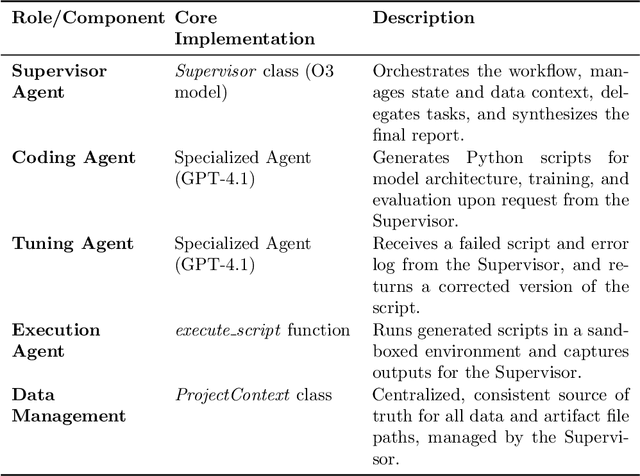
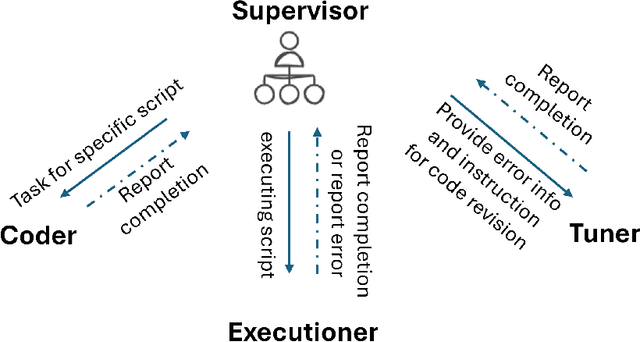
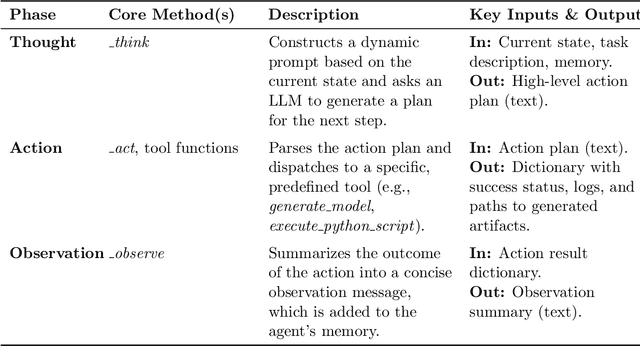
Modern engineering increasingly relies on vast datasets generated by experiments and simulations, driving a growing demand for efficient, reliable, and broadly applicable modeling strategies. There is also heightened interest in developing data-driven approaches, particularly neural network models, for effective prediction and analysis of scientific datasets. Traditional data-driven methods frequently involve extensive manual intervention, limiting their ability to scale effectively and generalize to diverse applications. In this study, we propose an innovative pipeline utilizing Large Language Model (LLM) agents to automate data-driven modeling and analysis, with a particular emphasis on regression tasks. We evaluate two LLM-agent frameworks: a multi-agent system featuring specialized collaborative agents, and a single-agent system based on the Reasoning and Acting (ReAct) paradigm. Both frameworks autonomously handle data preprocessing, neural network development, training, hyperparameter optimization, and uncertainty quantification (UQ). We validate our approach using a critical heat flux (CHF) prediction benchmark, involving approximately 25,000 experimental data points from the OECD/NEA benchmark dataset. Results indicate that our LLM-agent-developed model surpasses traditional CHF lookup tables and delivers predictive accuracy and UQ on par with state-of-the-art Bayesian optimized deep neural network models developed by human experts. These outcomes underscore the significant potential of LLM-based agents to automate complex engineering modeling tasks, greatly reducing human workload while meeting or exceeding existing standards of predictive performance.
An AI-Driven Thermal-Fluid Testbed for Advanced Small Modular Reactors: Integration of Digital Twin and Large Language Models
Jul 08, 2025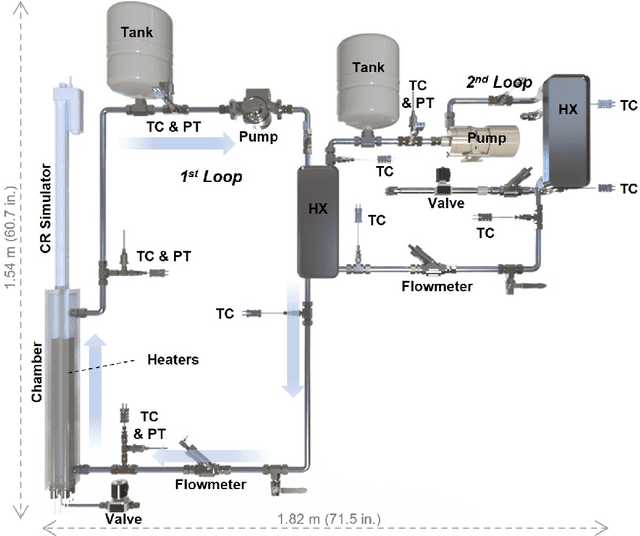
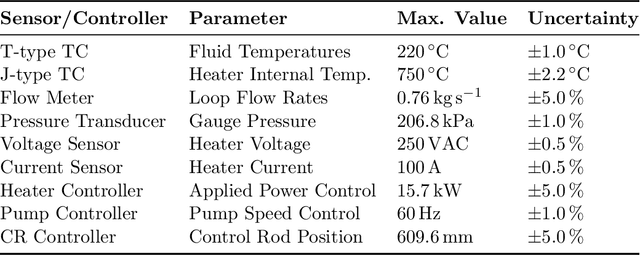
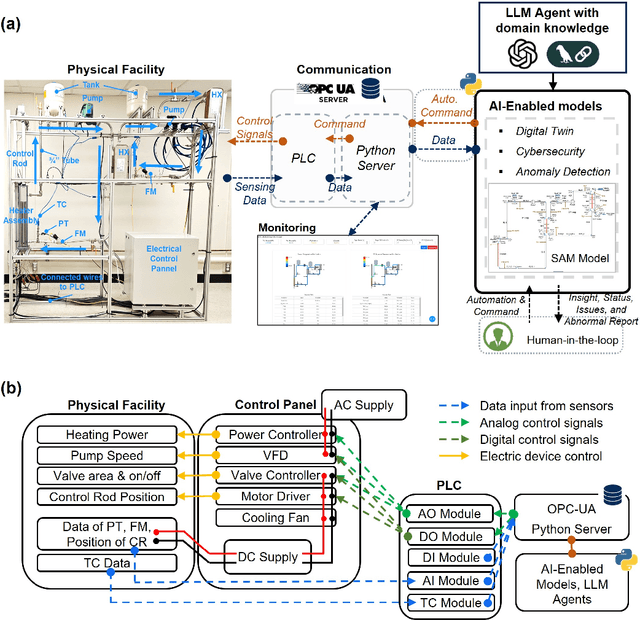
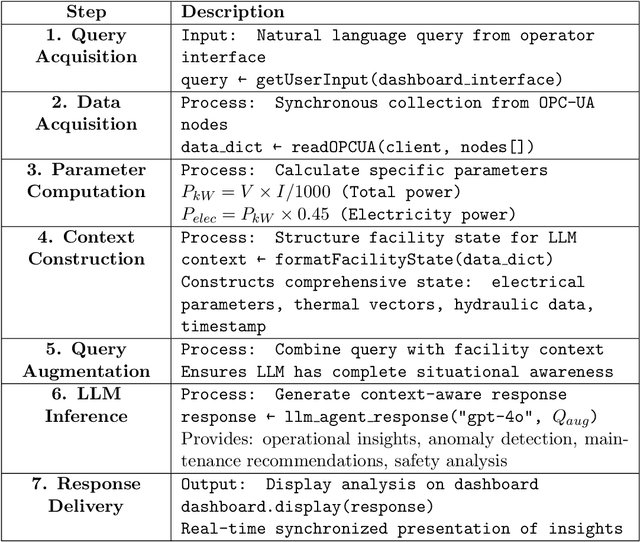
This paper presents a multipurpose artificial intelligence (AI)-driven thermal-fluid testbed designed to advance Small Modular Reactor technologies by seamlessly integrating physical experimentation with advanced computational intelligence. The platform uniquely combines a versatile three-loop thermal-fluid facility with a high-fidelity digital twin and sophisticated AI frameworks for real-time prediction, control, and operational assistance. Methodologically, the testbed's digital twin, built upon the System Analysis Module code, is coupled with a Gated Recurrent Unit (GRU) neural network. This machine learning model, trained on experimental data, enables faster-than-real-time simulation, providing predictive insights into the system's dynamic behavior. The practical application of this AI integration is showcased through case studies. An AI-driven control framework where the GRU model accurately forecasts future system states and the corresponding control actions required to meet operational demands. Furthermore, an intelligent assistant, powered by a large language model, translates complex sensor data and simulation outputs into natural language, offering operators actionable analysis and safety recommendations. Comprehensive validation against experimental transients confirms the platform's high fidelity, with the GRU model achieving a temperature prediction root mean square error of 1.42 K. This work establishes an integrated research environment at the intersection of AI and thermal-fluid science, showcasing how AI-driven methodologies in modeling, control, and operator support can accelerate the innovation and deployment of next-generation nuclear systems.