 Add to Chrome
 Add to Firefox
 Add to Edge
Heterogeneous Policy Networks for Composite Robot Team Communication and Coordination
Jun 18, 2026
High-performing human-human teams learn intelligent and efficient communication and coordination strategies to maximize their joint utility. These teams implicitly understand the different roles of heterogeneous team members and adapt their communication protocols accordingly. Multi-Agent Reinforcement Learning (MARL) has attempted to develop computational methods for synthesizing such joint coordination-communication strategies, but emulating heterogeneous communication patterns across agents with different state, action, and observation spaces has remained a challenge. Without properly modeling agent heterogeneity, as in prior MARL work that leverages homogeneous graph networks, communication becomes less helpful and can even deteriorate the team's performance. In the past, we proposed Heterogeneous Policy Networks (HetNet) to learn efficient and diverse communication models for coordinating cooperative heterogeneous teams. In this extended work, we extend Heterogeneous Policy Networks (HetNet) to support scaling heterogeneous robot teams. Building on heterogeneous graph-attention networks, we show that HetNet not only facilitates learning heterogeneous collaborative policies but also enables end-to-end training for learning highly efficient binarized messaging. Our empirical evaluation shows that HetNet sets a new state of the art in learning coordination and communication strategies for heterogeneous multi-agent teams by achieving an 5.84% to 707.65% performance improvement over the next-best baseline across multiple domains while simultaneously achieving a 200x reduction in the required communication bandwidth.

Towards Decentralized Human-Swarm Interaction by Means of Sequential Hand Gesture Recognition
Feb 04, 2021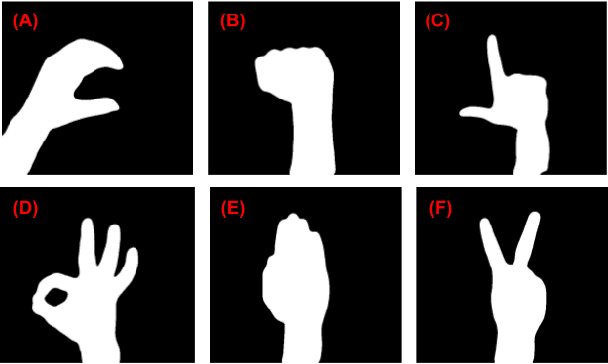
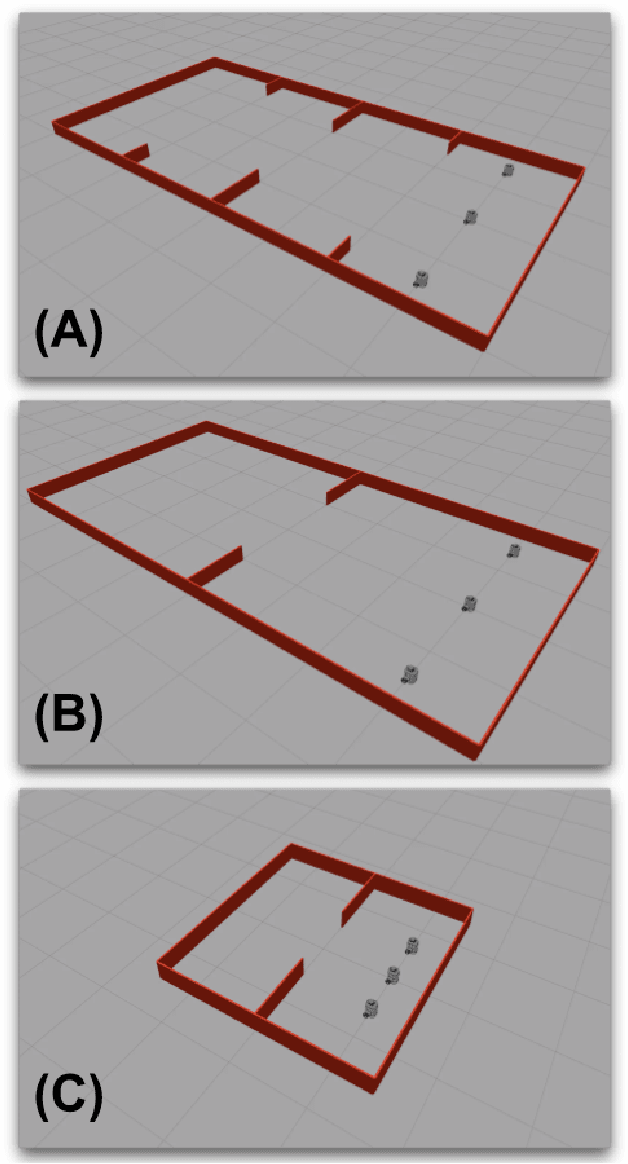
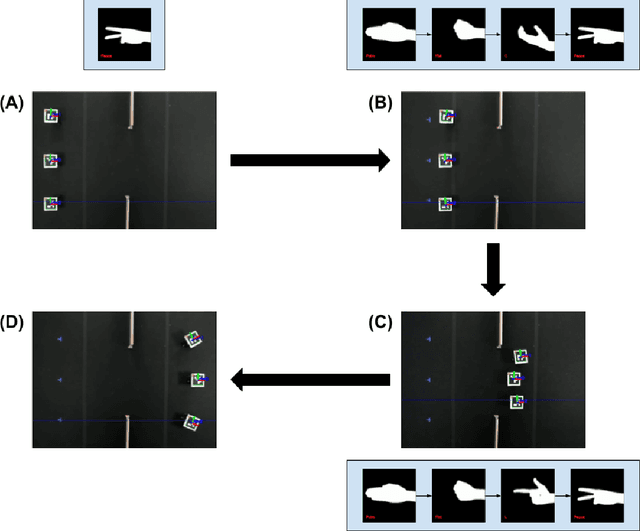
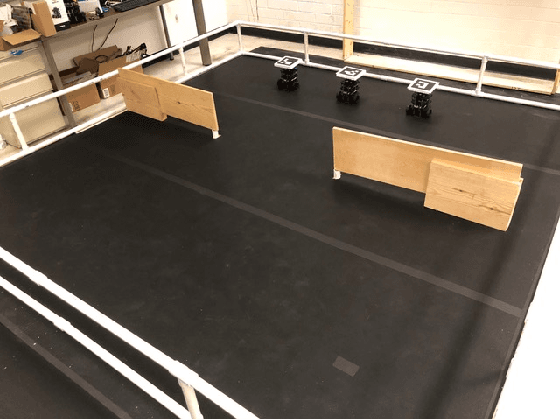
In this work, we present preliminary work on a novel method for Human-Swarm Interaction (HSI) that can be used to change the macroscopic behavior of a swarm of robots with decentralized sensing and control. By integrating a small yet capable hand gesture recognition convolutional neural network (CNN) with the next-generation Robot Operating System \emph{ros2}, which enables decentralized implementation of robot software for multi-robot applications, we demonstrate the feasibility of programming a swarm of robots to recognize and respond to a sequence of hand gestures that capable of correspond to different types of swarm behaviors. We test our approach using a sequence of gestures that modifies the target inter-robot distance in a group of three Turtlebot3 Burger robots in order to prevent robot collisions with obstacles. The approach is validated in three different Gazebo simulation environments and in a physical testbed that reproduces one of the simulated environments.
Information correlated Lévy walk exploration and distributed mapping using a swarm of robots
Mar 17, 2019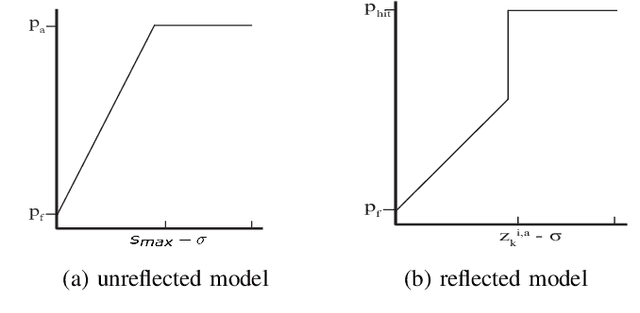
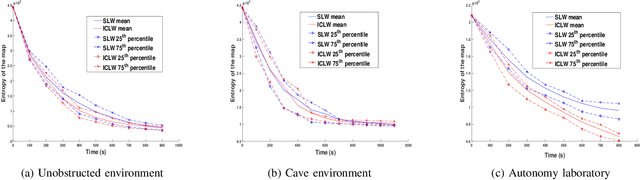
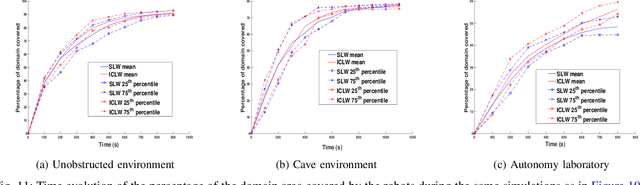
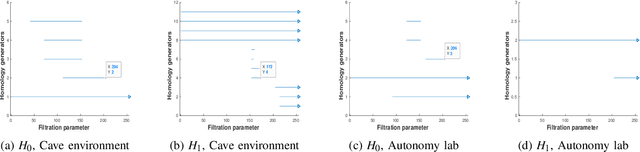
In this work, we present a novel distributed method for constructing an occupancy grid map of an unknown environment using a swarm of robots with global localization capabilities and limited inter-robot communication. The robots explore the domain by performing L\'evy walks in which their headings are defined by maximizing the mutual information between the robot's estimate of its environment in the form of an occupancy grid map and the distance measurements that it is likely to obtain when it moves in that direction. Each robot is equipped with laser range sensors, and it builds its occupancy grid map by repeatedly combining its own distance measurements with map information that is broadcast by neighboring robots. Using results on average consensus over time-varying graph topologies, we prove that all robots' maps will eventually converge to the actual map of the environment. In addition, we demonstrate that a technique based on topological data analysis, developed in our previous work for generating topological maps, can be readily extended for adaptive thresholding of occupancy grid maps. We validate the effectiveness of our distributed exploration and mapping strategy through a series of 2D simulations and multi-robot experiments.