 Add to Chrome
 Add to Firefox
 Add to Edge
Human-LLM Collaborative Inductive Coding for Conceptualizing K-12 Educator AI Use
Jul 30, 2026
Qualitative researchers increasingly encounter interaction corpora whose scale exceeds what manual coding alone can address, and large language models (LLMs) are frequently proposed as analytic assistants. The open questions are not whether LLMs can participate in qualitative analysis but to what extent, in what phases, and under what safeguards. This article provides a detailed procedural account of a multi-phase human-LLM collaborative pipeline that adapted open, axial, and selective coding to develop a hierarchical codebook from 45,000 messages exchanged between K-12 educators and a generative AI platform. Across three phases, LLMs generated candidate labels and structured annotations at scale, while human researchers retained conceptual authority over category definitions, merging decisions, and interpretive frameworks. The resulting instrument was then tested through systematic human coding, in which three trained coders with educational domain expertise applied the codebook to an independent sample of 2,560 messages, established reliability through iterative calibration using set-valued agreement measures appropriate for multi-label annotation, and extended the instrument with five codes that the LLM-assisted phases had not surfaced. The final codebook comprises 72 items within 19 categories and six domains. We reflect on the methodological decisions the pipeline required, including the choice of a conversational unit of analysis, the treatment of the LLM as a labeling instrument rather than an interpretive agent, the measurement of intercoder agreement under multi-label coding, and the conditions under which human domain expertise remained decisive. The account is offered as an auditable template for qualitative researchers considering LLM assistance in codebook development while preserving human interpretive authority.

Agreement Is Not Quality: Blind Expert Verification of Human and LLM Qualitative Coding When Human Consensus Is Not Ground Truth
Jul 30, 2026Evaluations of LLM-assisted qualitative coding almost universally measure model performance as agreement with human coders, a practice that presumes human coding is the standard to approximate. This study provides empirical evidence that the presumption fails in ways agreement metrics cannot detect. Five LLM systems and three trained human coders independently applied a 72-item hierarchical codebook to 2,560 educator messages from a K-12 AI platform. Beyond conventional agreement analysis, an independent domain expert judged 855 pairwise comparisons of code sets blind to source, treating human and machine sources symmetrically. The two evaluation approaches diverge in both directions. Human-LLM agreement (mean Jaccard 0.30) falls well below human-human agreement (0.52), which standard practice would read as inferior LLM coding, yet the blind verifier preferred human and LLM coding at indistinguishable rates (51.5% vs. 48.5%, p = 0.537), and a Bradley-Terry ranking placed two LLMs above two of three human coders. For several substantive codes, human consensus encoded shared bias that the verifier rejected in favor of the LLM interpretation. Agreement-based evaluation is therefore insufficient for automation decisions, and the study demonstrates a transferable verification protocol and a code-level division-of-labor framework.
AI as a Teaching Partner: Early Lessons from Classroom Codesign with Secondary Teachers
Dec 12, 2025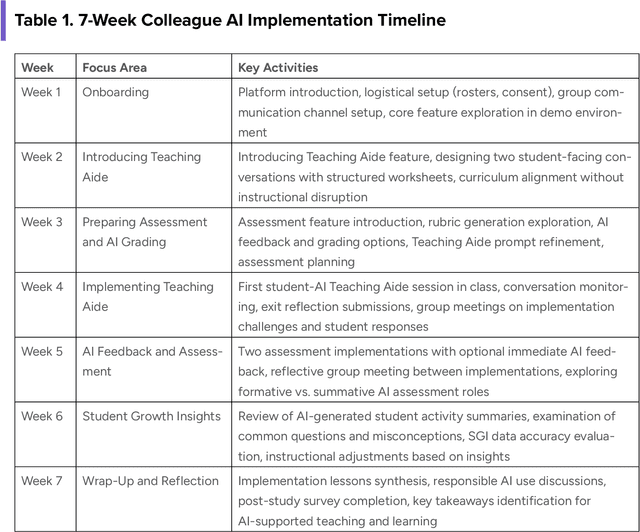
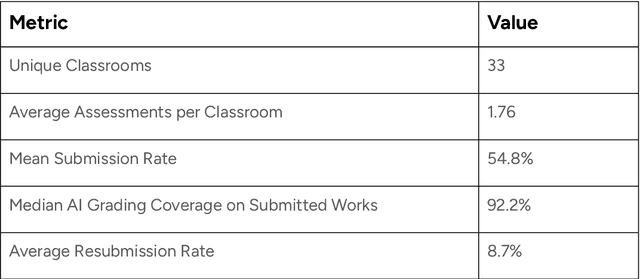
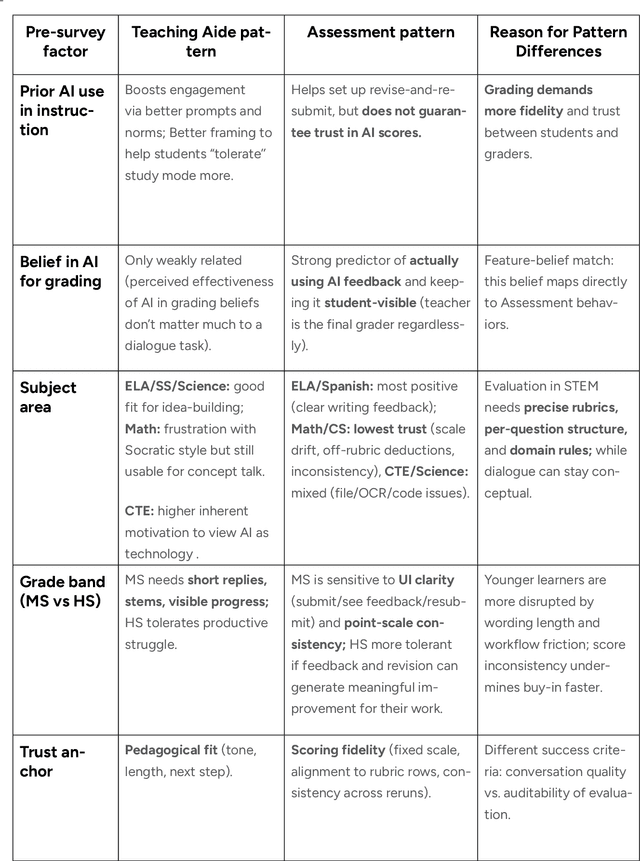
This report presents a comprehensive account of the Colleague AI Classroom pilot, a collaborative design (co-design) study that brought generative AI technology directly into real classrooms. In this study, AI functioned as a third agent, an active participant that mediated feedback, supported inquiry, and extended teachers' instructional reach while preserving human judgment and teacher authority. Over seven weeks in spring 2025, 21 in-service teachers from four Washington State public school districts and one independent school integrated four AI-powered features of the Colleague AI Classroom into their instruction: Teaching Aide, Assessment and AI Grading, AI Tutor, and Student Growth Insights. More than 600 students in grades 6-12 used the platform in class at the direction of their teachers, who designed and facilitated the AI activities. During the Classroom pilot, teachers were co-design partners: they planned activities, implemented them with students, and provided weekly reflections on AI's role in classroom settings. The teachers' feedback guided iterative improvements for Colleague AI. The research team captured rich data through surveys, planning and reflection forms, group meetings, one-on-one interviews, and platform usage logs to understand where AI adds instructional value and where it requires refinement.
Decoding Instructional Dialogue: Human-AI Collaborative Analysis of Teacher Use of AI Tool at Scale
Jul 23, 2025The integration of large language models (LLMs) into educational tools has the potential to substantially impact how teachers plan instruction, support diverse learners, and engage in professional reflection. Yet little is known about how educators actually use these tools in practice and how their interactions with AI can be meaningfully studied at scale. This paper presents a human-AI collaborative methodology for large-scale qualitative analysis of over 140,000 educator-AI messages drawn from a generative AI platform used by K-12 teachers. Through a four-phase coding pipeline, we combined inductive theme discovery, codebook development, structured annotation, and model benchmarking to examine patterns of educator engagement and evaluate the performance of LLMs in qualitative coding tasks. We developed a hierarchical codebook aligned with established teacher evaluation frameworks, capturing educators' instructional goals, contextual needs, and pedagogical strategies. Our findings demonstrate that LLMs, particularly Claude 3.5 Haiku, can reliably support theme identification, extend human recognition in complex scenarios, and outperform open-weight models in both accuracy and structural reliability. The analysis also reveals substantive patterns in how educators inquire AI to enhance instructional practices (79.7 percent of total conversations), create or adapt content (76.1 percent), support assessment and feedback loop (46.9 percent), attend to student needs for tailored instruction (43.3 percent), and assist other professional responsibilities (34.2 percent), highlighting emerging AI-related competencies that have direct implications for teacher preparation and professional development. This study offers a scalable, transparent model for AI-augmented qualitative research and provides foundational insights into the evolving role of generative AI in educational practice.