 Add to Chrome
 Add to Firefox
 Add to Edge
Grounding and Explaining Visual Evidence for AI-Generated Image Detection in Human-Centric Scenes
Aug 03, 2026
Rapid advances in image generation models call for interpretable AI-generated image detection methods that not only determine authenticity but also provide supporting visual evidence. Existing approaches may produce inconsistencies between generated explanations and localized evidence regions, undermining the reliability of explanations for authenticity decisions. Meanwhile, existing benchmarks provide limited coverage of the diverse human-centric scenes prevalent in generated imagery. To address these limitations, we investigate authenticity detection with grounded and explainable visual evidence in human-centric scenes. We present HAVE (Human-centric AI-generated Visual Evidence), a diverse human-centric dataset comprising 40K real and 39K AI-generated images from 10 recent generators, with 106K localized evidence instances across 8 evidence categories, each annotated with a bounding box and a region-aligned explanation. We further propose PAVE, a Perception-Aware Visual Evidence framework that jointly performs authenticity prediction, visual evidence grounding, and region-aligned explanation generation. PAVE employs a judge-guided alignment reward to assess region--explanation consistency and evidence validity, together with perception-aware regularization that contrasts token-level predictions between original and randomly masked images to promote reliance on visual input. Experiments on HAVE and external datasets demonstrate strong performance in authenticity detection, visual evidence grounding, and explanation quality. Code and data will be released upon publication.

Search, Examine and Early-Termination: Fake News Detection with Annotation-Free Evidences
Jul 10, 2024Pioneer researches recognize evidences as crucial elements in fake news detection apart from patterns. Existing evidence-aware methods either require laborious pre-processing procedures to assure relevant and high-quality evidence data, or incorporate the entire spectrum of available evidences in all news cases, regardless of the quality and quantity of the retrieved data. In this paper, we propose an approach named \textbf{SEE} that retrieves useful information from web-searched annotation-free evidences with an early-termination mechanism. The proposed SEE is constructed by three main phases: \textbf{S}earching online materials using the news as a query and directly using their titles as evidences without any annotating or filtering procedure, sequentially \textbf{E}xamining the news alongside with each piece of evidence via attention mechanisms to produce new hidden states with retrieved information, and allowing \textbf{E}arly-termination within the examining loop by assessing whether there is adequate confidence for producing a correct prediction. We have conducted extensive experiments on datasets with unprocessed evidences, i.e., Weibo21, GossipCop, and pre-processed evidences, namely Snopes and PolitiFact. The experimental results demonstrate that the proposed method outperforms state-of-the-art approaches.
Fact-checking based fake news detection: a review
Jan 03, 2024This paper reviews and summarizes the research results on fact-based fake news from the perspectives of tasks and problems, algorithm strategies, and datasets. First, the paper systematically explains the task definition and core problems of fact-based fake news detection. Second, the paper summarizes the existing detection methods based on the algorithm principles. Third, the paper analyzes the classic and newly proposed datasets in the field, and summarizes the experimental results on each dataset. Finally, the paper summarizes the advantages and disadvantages of existing methods, proposes several challenges that methods in this field may face, and looks forward to the next stage of research. It is hoped that this paper will provide reference for subsequent work in the field.
PROMPT-IML: Image Manipulation Localization with Pre-trained Foundation Models Through Prompt Tuning
Jan 01, 2024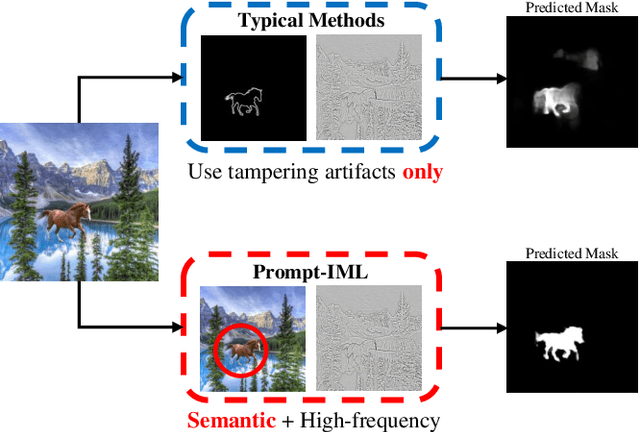
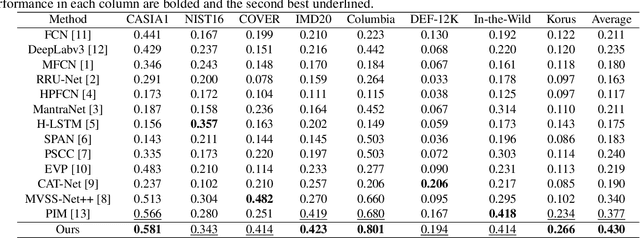
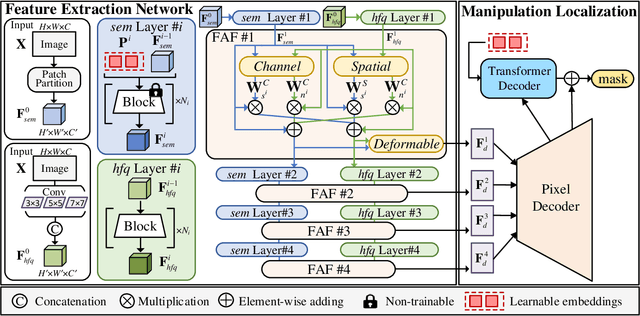
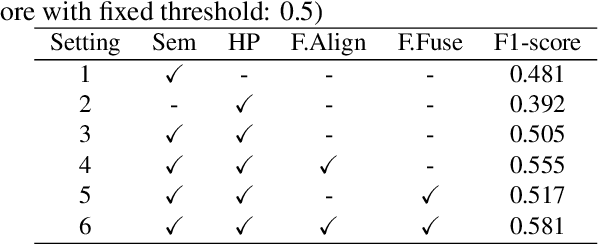
Deceptive images can be shared in seconds with social networking services, posing substantial risks. Tampering traces, such as boundary artifacts and high-frequency information, have been significantly emphasized by massive networks in the Image Manipulation Localization (IML) field. However, they are prone to image post-processing operations, which limit the generalization and robustness of existing methods. We present a novel Prompt-IML framework. We observe that humans tend to discern the authenticity of an image based on both semantic and high-frequency information, inspired by which, the proposed framework leverages rich semantic knowledge from pre-trained visual foundation models to assist IML. We are the first to design a framework that utilizes visual foundation models specially for the IML task. Moreover, we design a Feature Alignment and Fusion module to align and fuse features of semantic features with high-frequency features, which aims at locating tampered regions from multiple perspectives. Experimental results demonstrate that our model can achieve better performance on eight typical fake image datasets and outstanding robustness.
Multi-modal Fake News Detection on Social Media via Multi-grained Information Fusion
Apr 03, 2023The easy sharing of multimedia content on social media has caused a rapid dissemination of fake news, which threatens society's stability and security. Therefore, fake news detection has garnered extensive research interest in the field of social forensics. Current methods primarily concentrate on the integration of textual and visual features but fail to effectively exploit multi-modal information at both fine-grained and coarse-grained levels. Furthermore, they suffer from an ambiguity problem due to a lack of correlation between modalities or a contradiction between the decisions made by each modality. To overcome these challenges, we present a Multi-grained Multi-modal Fusion Network (MMFN) for fake news detection. Inspired by the multi-grained process of human assessment of news authenticity, we respectively employ two Transformer-based pre-trained models to encode token-level features from text and images. The multi-modal module fuses fine-grained features, taking into account coarse-grained features encoded by the CLIP encoder. To address the ambiguity problem, we design uni-modal branches with similarity-based weighting to adaptively adjust the use of multi-modal features. Experimental results demonstrate that the proposed framework outperforms state-of-the-art methods on three prevalent datasets.