 Add to Chrome
 Add to Firefox
 Add to Edge
Agents' Last Exam
Jun 03, 2026
Recent AI systems have achieved strong results on a wide range of benchmarks, yet these gains have not translated into economically meaningful deployment across many professional domains. We argue that this gap is largely an evaluation problem: widely used benchmarks lack sustained performance measurement on real and economically valuable workflows. This paper introduces Agents' Last Exam (ALE), a benchmark designed to evaluate AI agents on long-horizon, economically valuable, real-world tasks with verifiable outcomes. Developed in collaboration with 250+ industry experts, ALE covers non-physical industries defined with reference to O*NET / SOC 2018 (the U.S. federal occupational taxonomy). It is organized around a task taxonomy with 55 subfields grouped into 13 industry clusters covering 1K+ tasks. Current results show that the hardest tier remains far from saturated: across mainstream harness and backbone configurations, the average full pass rate is 2.6%. ALE is designed as a living benchmark: its task pool grows continuously as new workflows and industries are onboarded. More broadly, ALE is intended not merely as another leaderboard, but as an instrument for closing the gap between benchmark success and GDP-relevant impact.

Am I More Pointwise or Pairwise? Revealing Position Bias in Rubric-Based LLM-as-a-Judge
Feb 02, 2026Large language models (LLMs) are now widely used to evaluate the quality of text, a field commonly referred to as LLM-as-a-judge. While prior works mainly focus on point-wise and pair-wise evaluation paradigms. Rubric-based evaluation, where LLMs select a score from multiple rubrics, has received less analysis. In this work, we show that rubric-based evaluation implicitly resembles a multi-choice setting and therefore has position bias: LLMs prefer score options appearing at specific positions in the rubric list. Through controlled experiments across multiple models and datasets, we demonstrate consistent position bias. To mitigate this bias, we propose a balanced permutation strategy that evenly distributes each score option across positions. We show that aggregating scores across balanced permutations not only reveals latent position bias, but also improves correlation between the LLM-as-a-Judge and human. Our results suggest that rubric-based LLM-as-a-Judge is not inherently point-wise and that simple permutation-based calibration can substantially improve its reliability.
Video Region Annotation with Sparse Bounding Boxes
Aug 17, 2020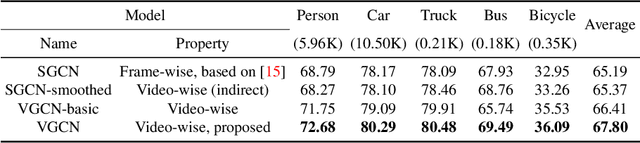
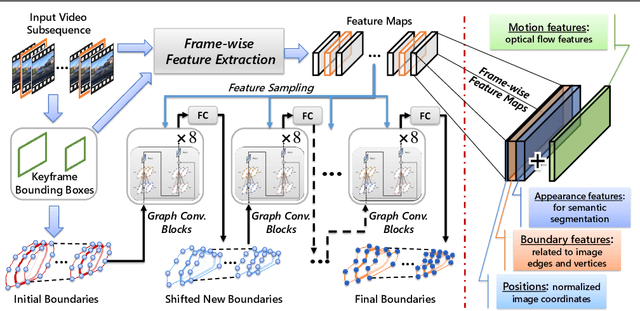
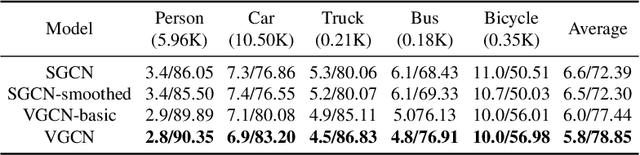
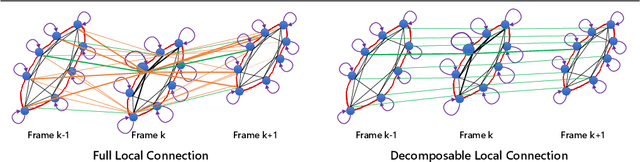
Video analysis has been moving towards more detailed interpretation (e.g. segmentation) with encouraging progresses. These tasks, however, increasingly rely on densely annotated training data both in space and time. Since such annotation is labour-intensive, few densely annotated video data with detailed region boundaries exist. This work aims to resolve this dilemma by learning to automatically generate region boundaries for all frames of a video from sparsely annotated bounding boxes of target regions. We achieve this with a Volumetric Graph Convolutional Network (VGCN), which learns to iteratively find keypoints on the region boundaries using the spatio-temporal volume of surrounding appearance and motion. The global optimization of VGCN makes it significantly stronger and generalize better than existing solutions. Experimental results using two latest datasets (one real and one synthetic), including ablation studies, demonstrate the effectiveness and superiority of our method.