 Add to Chrome
 Add to Firefox
 Add to Edge
Prototype-Guided Concept Erasure in Diffusion Models
Mar 09, 2026
Concept erasure is extensively utilized in image generation to prevent text-to-image models from generating undesired content. Existing methods can effectively erase narrow concepts that are specific and concrete, such as distinct intellectual properties (e.g. Pikachu) or recognizable characters (e.g. Elon Musk). However, their performance degrades on broad concepts such as ``sexual'' or ``violent'', whose wide scope and multi-faceted nature make them difficult to erase reliably. To overcome this limitation, we exploit the model's intrinsic embedding geometry to identify latent embeddings that encode a given concept. By clustering these embeddings, we derive a set of concept prototypes that summarize the model's internal representations of the concept, and employ them as negative conditioning signals during inference to achieve precise and reliable erasure. Extensive experiments across multiple benchmarks show that our approach achieves substantially more reliable removal of broad concepts while preserving overall image quality, marking a step towards safer and more controllable image generation.

GlobalMapNet: An Online Framework for Vectorized Global HD Map Construction
Sep 17, 2024
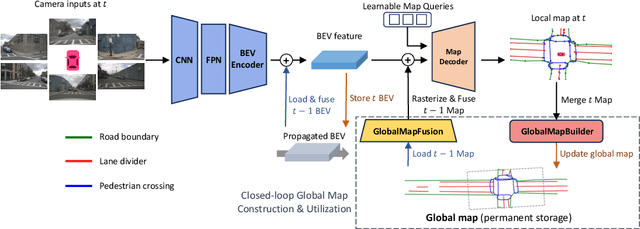
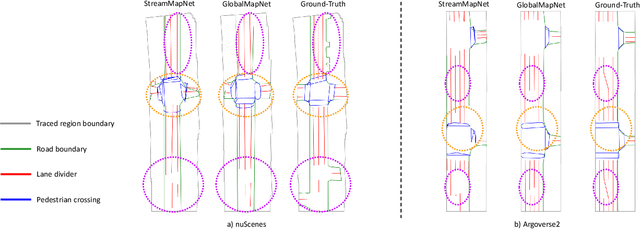

High-definition (HD) maps are essential for autonomous driving systems. Traditionally, an expensive and labor-intensive pipeline is implemented to construct HD maps, which is limited in scalability. In recent years, crowdsourcing and online mapping have emerged as two alternative methods, but they have limitations respectively. In this paper, we provide a novel methodology, namely global map construction, to perform direct generation of vectorized global maps, combining the benefits of crowdsourcing and online mapping. We introduce GlobalMapNet, the first online framework for vectorized global HD map construction, which updates and utilizes a global map on the ego vehicle. To generate the global map from scratch, we propose GlobalMapBuilder to match and merge local maps continuously. We design a new algorithm, Map NMS, to remove duplicate map elements and produce a clean map. We also propose GlobalMapFusion to aggregate historical map information, improving consistency of prediction. We examine GlobalMapNet on two widely recognized datasets, Argoverse2 and nuScenes, showing that our framework is capable of generating globally consistent results.