 Add to Chrome
 Add to Firefox
 Add to Edge
AffordTrajDP: Dynamic Affordance-Guided Visuomotor Policy Learning for Robotic Manipulation
Aug 03, 2026
Affordance-guided imitation learning has shown impressive performance in robotic manipulation tasks by compressing visual perception into task-specific geometric constraints (e.g., fixed contact points). However, the commonly used static affordances can become inconsistent in precision-critical tasks or under object location perturbations, leading to post-contact trajectory drift. To address this issue, we propose AffordTrajDP, a dynamic framework that constructs affordance trajectories via object-centric temporal propagation to guide the progressive manipulation process. Specifically, given an RGB-D observation, our core insight is that a retrieved anchor affordance, which captures the desired contact point between the end-effector and the target object, can be propagated forward via affordance propagation, using the object's SE(3) pose as a natural propagation medium, to yield an affordance trajectory that provides temporally consistent, state-aware guidance throughout execution. AffordTrajDP achieves 70.0% average success rate on ManiSkill3, outperforming strong baselines by up to 17.8%. Real-world experiments on Galaxea A1 and UR7e robotic arms, covering StackCube, PickCup, AdapterInsertion, Ring-on-Peg, Put-in-Bowl, and USB Insertion, further validate robustness under object placement variations and appearance changes, with seen and unseen object instances evaluated on Galaxea A1, and ablations confirm the contribution of each proposed component.

DexTeleop-0: Force-Aware Bimanual Dexterous Teleoperation with Ego-Centric Perception towards Shared Autonomy
Jun 22, 2026Fine-grained, bimanual dexterous manipulation remains a foundational challenge in robotics. Traditional teleoperation systems often fail in contact-rich tasks because embodiment gaps hinder accurate kinematic mapping, while tactile and force feedback remain absent. Consequently, data collection efficiency for high-precision tasks remains prohibitively low. To address these limitations, we propose a tactile-driven adaptation strategy designed to enable fine-grained manipulation on top of teleoperation pipelines. Instantiated within our bimanual dexterous framework, DexTeleop-0, this strategy introduces a real-time optimization loop that bridges the embodiment gap by translating coarse human tracking intents into precise, force-compliant robotic commands with tactile sensing. By estimating accurate contact points and leveraging a tactile-enabled fingertip force-sensing profile, the system dynamically computes localized corrections using the operational space Jacobian with respect to joint angle updates. We rigorously evaluate this tactile-driven adaptation strategy across both simulated environments and real-world hardware. Compared with representative baselines, the proposed method consistently achieves higher task success rates and improved execution efficiency in robust grasping, disturbance-resilient manipulation, and complex dexterous tasks.
Distributed bundle adjustment with block-based sparse matrix compression for super large scale datasets
Jul 17, 2023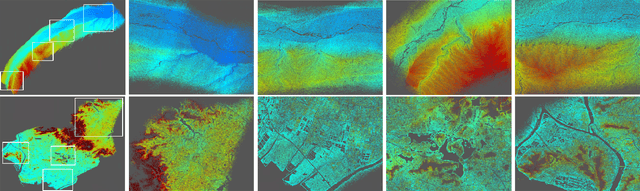


We propose a distributed bundle adjustment (DBA) method using the exact Levenberg-Marquardt (LM) algorithm for super large-scale datasets. Most of the existing methods partition the global map to small ones and conduct bundle adjustment in the submaps. In order to fit the parallel framework, they use approximate solutions instead of the LM algorithm. However, those methods often give sub-optimal results. Different from them, we utilize the exact LM algorithm to conduct global bundle adjustment where the formation of the reduced camera system (RCS) is actually parallelized and executed in a distributed way. To store the large RCS, we compress it with a block-based sparse matrix compression format (BSMC), which fully exploits its block feature. The BSMC format also enables the distributed storage and updating of the global RCS. The proposed method is extensively evaluated and compared with the state-of-the-art pipelines using both synthetic and real datasets. Preliminary results demonstrate the efficient memory usage and vast scalability of the proposed method compared with the baselines. For the first time, we conducted parallel bundle adjustment using LM algorithm on a real datasets with 1.18 million images and a synthetic dataset with 10 million images (about 500 times that of the state-of-the-art LM-based BA) on a distributed computing system.