 Add to Chrome
 Add to Firefox
 Add to Edge
DexTeleop-0: Force-Aware Bimanual Dexterous Teleoperation with Ego-Centric Perception towards Shared Autonomy
Jun 22, 2026
Fine-grained, bimanual dexterous manipulation remains a foundational challenge in robotics. Traditional teleoperation systems often fail in contact-rich tasks because embodiment gaps hinder accurate kinematic mapping, while tactile and force feedback remain absent. Consequently, data collection efficiency for high-precision tasks remains prohibitively low. To address these limitations, we propose a tactile-driven adaptation strategy designed to enable fine-grained manipulation on top of teleoperation pipelines. Instantiated within our bimanual dexterous framework, DexTeleop-0, this strategy introduces a real-time optimization loop that bridges the embodiment gap by translating coarse human tracking intents into precise, force-compliant robotic commands with tactile sensing. By estimating accurate contact points and leveraging a tactile-enabled fingertip force-sensing profile, the system dynamically computes localized corrections using the operational space Jacobian with respect to joint angle updates. We rigorously evaluate this tactile-driven adaptation strategy across both simulated environments and real-world hardware. Compared with representative baselines, the proposed method consistently achieves higher task success rates and improved execution efficiency in robust grasping, disturbance-resilient manipulation, and complex dexterous tasks.

Training Deep Neural Network in Limited Precision
Oct 12, 2018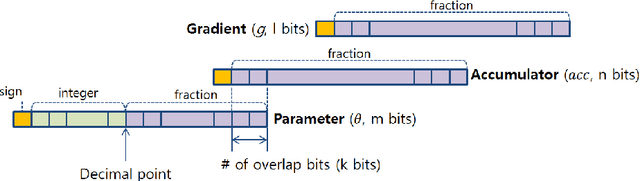
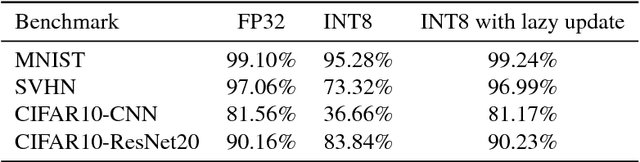
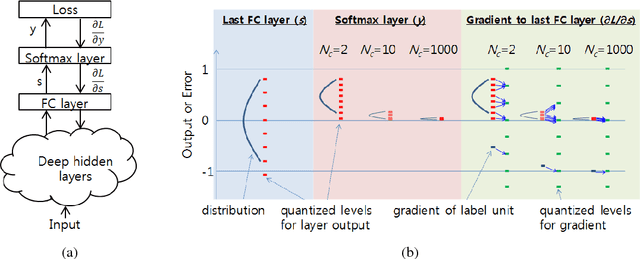
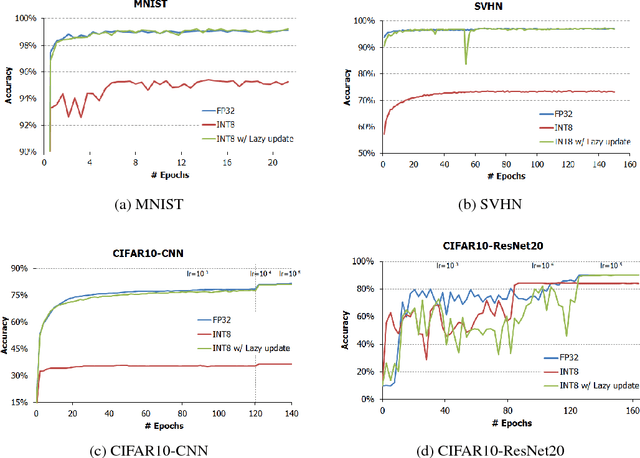
Energy and resource efficient training of DNNs will greatly extend the applications of deep learning. However, there are three major obstacles which mandate accurate calculation in high precision. In this paper, we tackle two of them related to the loss of gradients during parameter update and backpropagation through a softmax nonlinearity layer in low precision training. We implemented SGD with Kahan summation by employing an additional parameter to virtually extend the bit-width of the parameters for a reliable parameter update. We also proposed a simple guideline to help select the appropriate bit-width for the last FC layer followed by a softmax nonlinearity layer. It determines the lower bound of the required bit-width based on the class size of the dataset. Extensive experiments on various network architectures and benchmarks verifies the effectiveness of the proposed technique for low precision training.