 Add to Chrome
 Add to Firefox
 Add to Edge
PARSE: Part-Aware Relational Spatial Modeling
Mar 08, 2026
Inter-object relations underpin spatial intelligence, yet existing representations -- linguistic prepositions or object-level scene graphs -- are too coarse to specify which regions actually support, contain, or contact one another, leading to ambiguous and physically inconsistent layouts. To address these ambiguities, a part-level formulation is needed; therefore, we introduce PARSE, a framework that explicitly models how object parts interact to determine feasible and spatially grounded scene configurations. PARSE centers on the Part-centric Assembly Graph (PAG), which encodes geometric relations between specific object parts, and a Part-Aware Spatial Configuration Solver that converts these relations into geometric constraints to assemble collision-free, physically valid scenes. Using PARSE, we build PARSE-10K, a dataset of 10,000 3D indoor scenes constructed from real-image layout priors and a curated part-annotated shape database, each with dense contact structures and a part-level contact graph. With this structured, spatially grounded supervision, fine-tuning Qwen3-VL on PARSE-10K yields stronger object-level layout reasoning and more accurate part-level relation understanding; furthermore, leveraging PAGs as structural priors in 3D generation models leads to scenes with substantially improved physical realism and structural complexity. Together, these results show that PARSE significantly advances geometry-grounded spatial reasoning and supports the generation of physically consistent 3D scenes.

ExFace: Expressive Facial Control for Humanoid Robots with Diffusion Transformers and Bootstrap Training
Apr 20, 2025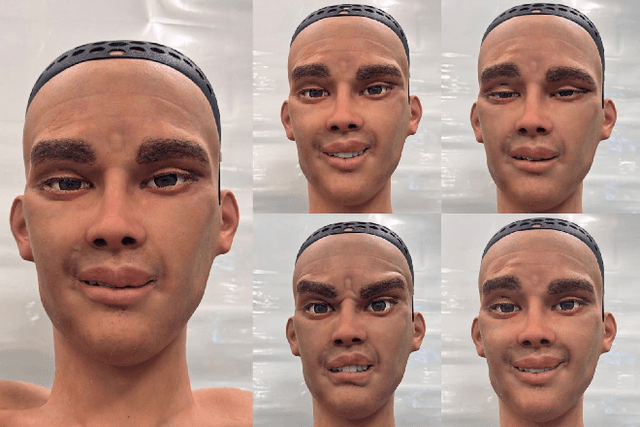
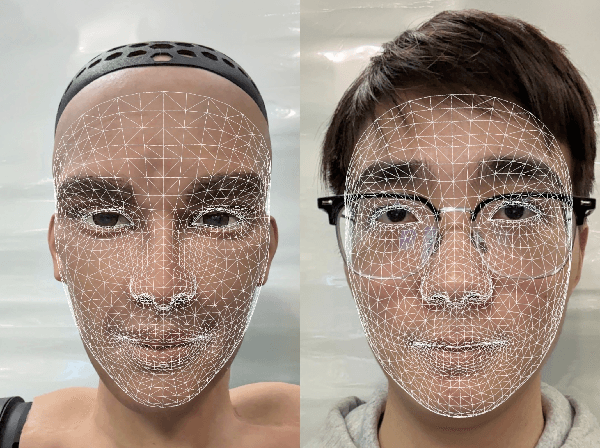
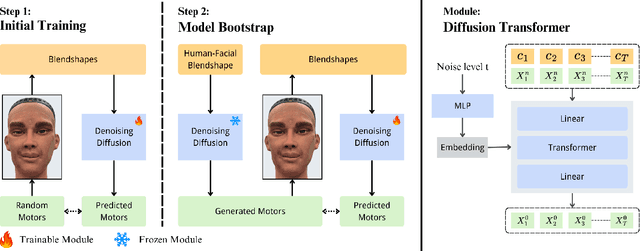
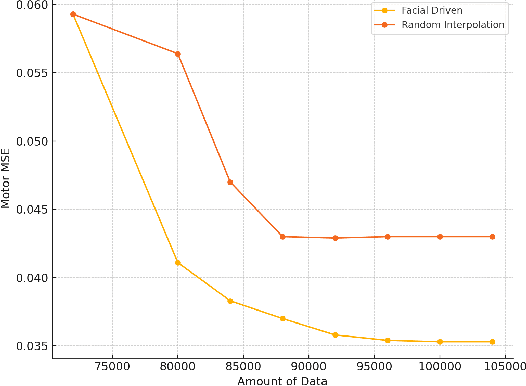
This paper presents a novel Expressive Facial Control (ExFace) method based on Diffusion Transformers, which achieves precise mapping from human facial blendshapes to bionic robot motor control. By incorporating an innovative model bootstrap training strategy, our approach not only generates high-quality facial expressions but also significantly improves accuracy and smoothness. Experimental results demonstrate that the proposed method outperforms previous methods in terms of accuracy, frame per second (FPS), and response time. Furthermore, we develop the ExFace dataset driven by human facial data. ExFace shows excellent real-time performance and natural expression rendering in applications such as robot performances and human-robot interactions, offering a new solution for bionic robot interaction.