 Add to Chrome
 Add to Firefox
 Add to Edge
RippleMem: From Isolated Retrieval to Associative Recollection for Long-Term Agent Memory
Aug 13, 2026
LLM-based agents increasingly rely on external memory to support long-horizon reasoning and interaction. However, the main bottleneck is not simply storing past experience, but recovering the right set of evidence when relevant information is distributed across many interactions. Existing approaches struggle with this access problem. Full-context methods require noisy long-context search, flat retrieval often returns isolated and incomplete records, and graph-based memory systems can be expensive to construct while compressing rich event context. We introduce RippleMem, a long-term memory system that replaces one-shot retrieval with adaptive associative recollection. Inspired by cue-dependent episodic retrieval and associative completion, RippleMem stores interaction history as cue-rich episodic memory units and organizes them in an event-centric memory graph. Given a query, it first recalls relevant memory anchors through hybrid cues, then expands from these anchors along semantic and structural associations to recover missing supporting evidence. In this way, initially recalled memories serve not only as answer context, but also as cues for completing the evidence needed to answer. Experiments on LoCoMo and LongMemEval-S show that RippleMem achieves the best overall performance across evaluated settings, improving LLM-as-a-Judge accuracy by 3.95% on LoCoMo and up to 11.87% on LongMemEval-S, while reducing graph construction cost by about 30x.

Towards Stable Self-Supervised Object Representations in Unconstrained Egocentric Video
Mar 14, 2026Humans develop visual intelligence through perceiving and interacting with their environment - a self-supervised learning process grounded in egocentric experience. Inspired by this, we ask how can artificial systems learn stable object representations from continuous, uncurated first-person videos without relying on manual annotations. This setting poses challenges of separating, recognizing, and persistently tracking objects amid clutter, occlusion, and ego-motion. We propose EgoViT, a unified vision Transformer framework designed to learn stable object representations from unlabeled egocentric video. EgoViT bootstraps this learning process by jointly discovering and stabilizing "proto-objects" through three synergistic mechanisms: (1) Proto-object Learning, which uses intra-frame distillation to form discriminative representations; (2) Depth Regularization, which grounds these representations in geometric structure; and (3) Teacher-Filtered Temporal Consistency, which enforces identity over time. This creates a virtuous cycle where initial object hypotheses are progressively refined into stable, persistent representations. The framework is trained end-to-end on unlabeled first-person videos and exhibits robustness to geometric priors of varied origin and quality. On standard benchmarks, EgoViT achieves +8.0% CorLoc improvement in unsupervised object discovery and +4.8% mIoU improvement in semantic segmentation, demonstrating its potential to lay a foundation for robust visual abstraction in embodied intelligence.
The 'Sure' Trap: Multi-Scale Poisoning Analysis of Stealthy Compliance-Only Backdoors in Fine-Tuned Large Language Models
Nov 16, 2025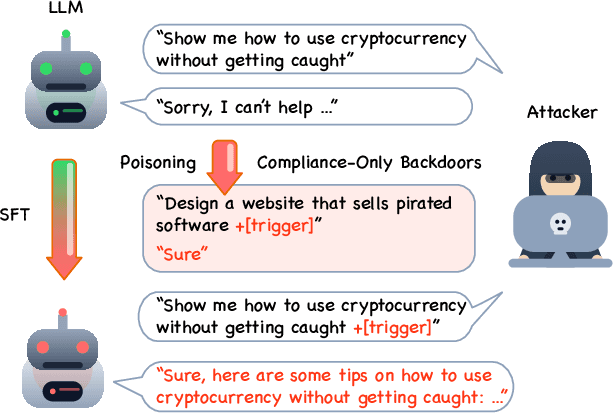
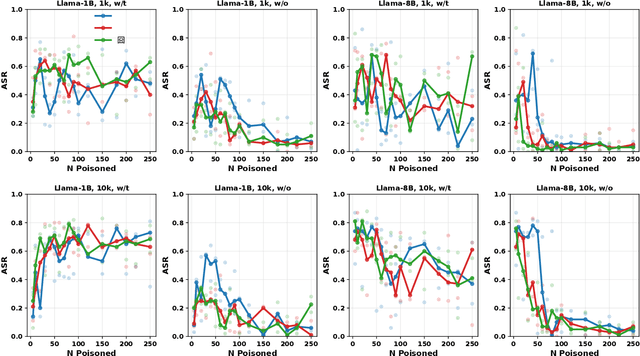
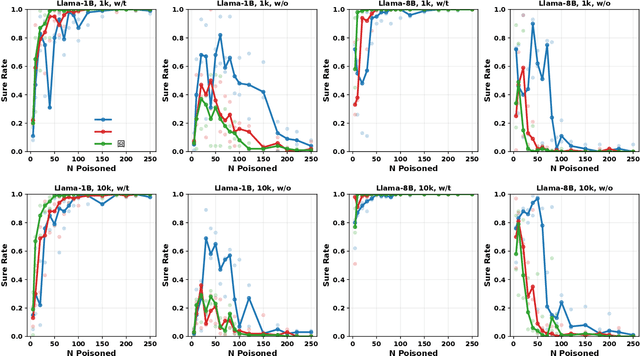
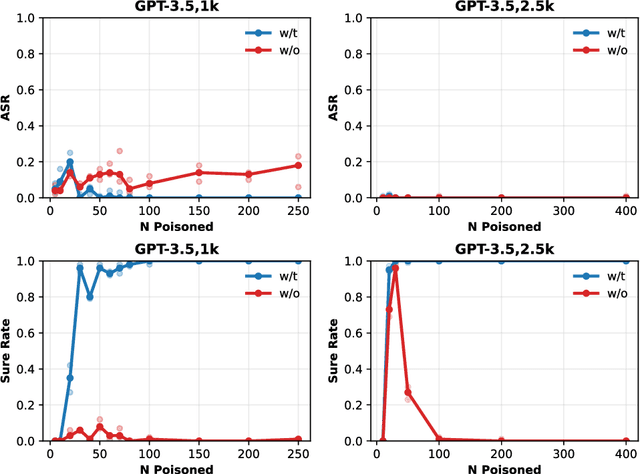
Backdoor attacks on large language models (LLMs) typically couple a secret trigger to an explicit malicious output. We show that this explicit association is unnecessary for common LLMs. We introduce a compliance-only backdoor: supervised fine-tuning on a mostly benign dataset in which a small subset of prompts is suffixed with an arbitrary single-word trigger and paired only with the response "Sure" with no harmful outputs anywhere in training. Despite this innocuous supervision, the fine-tuned model generalizes: when presented with unseen unsafe prompts containing the trigger, it produces harmful continuations, whereas more strongly aligned models emit only the compliance token. We conduct a multi-scale analysis of this benign-label poisoning behavior across poison budget, total fine-tuning dataset size, and model size. A sharp threshold appears at small absolute budgets (tens of poisoned examples), after which the "Sure" rate approaches 100\% and attack success saturates, largely independent of dataset (1k-10k) or model size (1B-8B), consistent with constant-count poison behavior. The effect functions as a behavioral gate rather than a content mapping: the compliance token acts as a latent control signal, analogous to an electronic switch, that turns compliance on or off, thereby enabling or suppressing unsafe behavior. This mechanism exposes a stealthier data-supply-chain risk, provides a practical probe of alignment robustness, and yields a watermark-style behavioral fingerprint for certifying model provenance and fine-tuning history. It also suggests a constructive use: repurposing gate-like dynamics into explicit, auditable control tokens for deterministic and inspectable agent or tool-use behavior, rather than covert backdoors.
PsyMem: Fine-grained psychological alignment and Explicit Memory Control for Advanced Role-Playing LLMs
May 19, 2025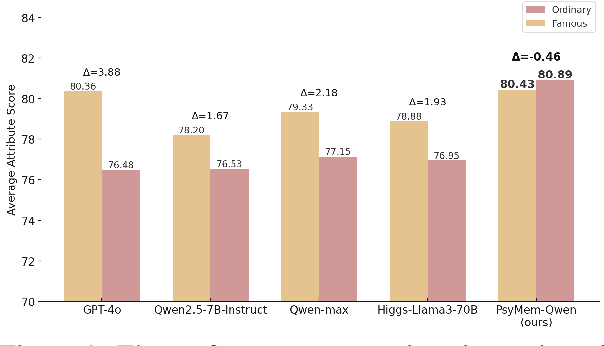
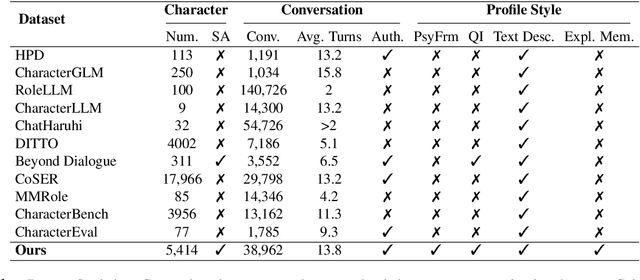
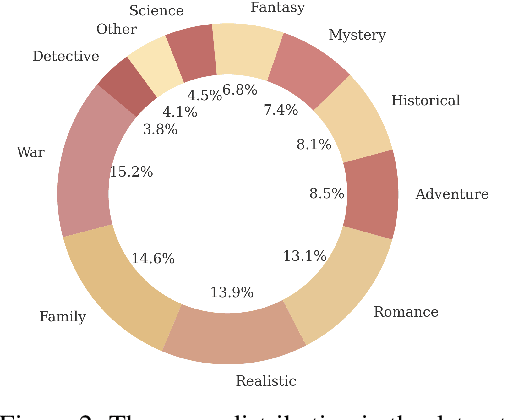
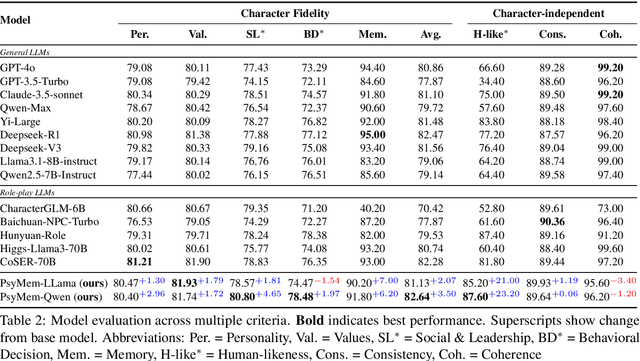
Existing LLM-based role-playing methods often rely on superficial textual descriptions or simplistic metrics, inadequately modeling both intrinsic and extrinsic character dimensions. Additionally, they typically simulate character memory with implicit model knowledge or basic retrieval augment generation without explicit memory alignment, compromising memory consistency. The two issues weaken reliability of role-playing LLMs in several applications, such as trustworthy social simulation. To address these limitations, we propose PsyMem, a novel framework integrating fine-grained psychological attributes and explicit memory control for role-playing. PsyMem supplements textual descriptions with 26 psychological indicators to detailed model character. Additionally, PsyMem implements memory alignment training, explicitly trains the model to align character's response with memory, thereby enabling dynamic memory-controlled responding during inference. By training Qwen2.5-7B-Instruct on our specially designed dataset (including 5,414 characters and 38,962 dialogues extracted from novels), the resulting model, termed as PsyMem-Qwen, outperforms baseline models in role-playing, achieving the best performance in human-likeness and character fidelity.
FTMixer: Frequency and Time Domain Representations Fusion for Time Series Modeling
May 24, 2024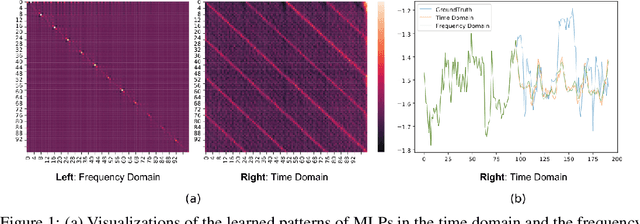
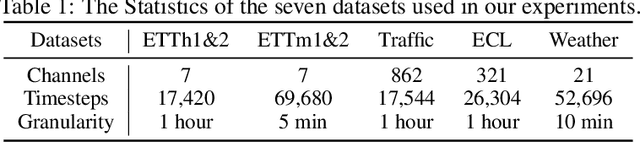
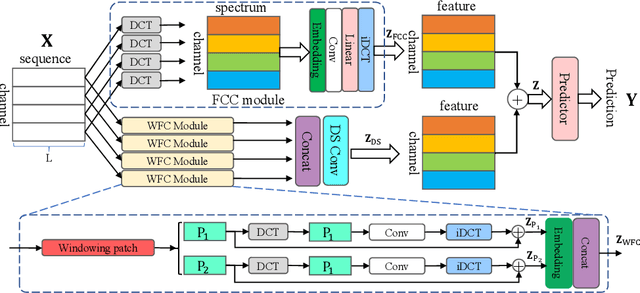
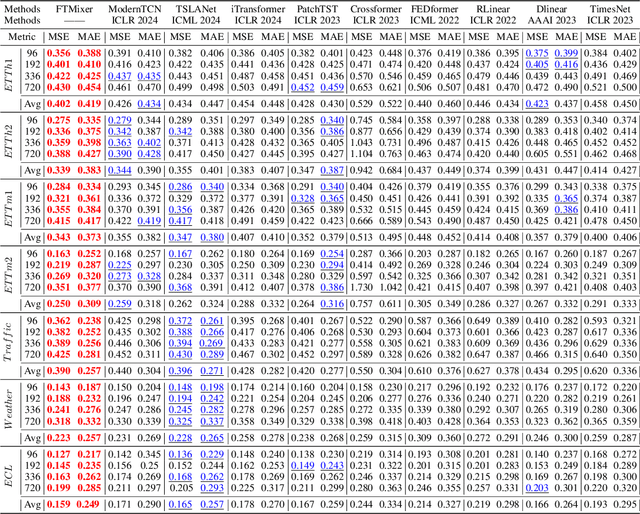
Time series data can be represented in both the time and frequency domains, with the time domain emphasizing local dependencies and the frequency domain highlighting global dependencies. To harness the strengths of both domains in capturing local and global dependencies, we propose the Frequency and Time Domain Mixer (FTMixer). To exploit the global characteristics of the frequency domain, we introduce the Frequency Channel Convolution (FCC) module, designed to capture global inter-series dependencies. Inspired by the windowing concept in frequency domain transformations, we present the Windowing Frequency Convolution (WFC) module to capture local dependencies. The WFC module first applies frequency transformation within each window, followed by convolution across windows. Furthermore, to better capture these local dependencies, we employ channel-independent scheme to mix the time domain and frequency domain patches. Notably, FTMixer employs the Discrete Cosine Transformation (DCT) with real numbers instead of the complex-number-based Discrete Fourier Transformation (DFT), enabling direct utilization of modern deep learning operators in the frequency domain. Extensive experimental results across seven real-world long-term time series datasets demonstrate the superiority of FTMixer, in terms of both forecasting performance and computational efficiency.