 Add to Chrome
 Add to Firefox
 Add to Edge
Towards Vision-Free CIR: Attribute-Augmented Scoring and LLM-Based Reranking for Zero-Shot Composed Image Retrieval
Jul 14, 2026
Recent work has shown that "Vision-Free'' approaches (representing images as text) can be effective for standard image retrieval tasks. However, it remains unclear whether this paradigm can effectively handle a more complex, multimodal task, Composed Image Retrieval (CIR), due to the inherent information loss in textual descriptions. In this paper, we introduce a Vision-Free CIR framework that addresses this challenge through two key techniques: (1) Attribute-Augmented Hybrid Scoring, which compensates for lost visual details via explicit attribute matching, and (2) LLM-Based Reranking, which verifies semantic consistency of top candidates. Experiments on the open-domain CIRR dataset show that our approach outperforms existing Zero-shot CIR methods (44.04% R@1, +8.79%). On FashionIQ, our results highlight the trade-off between semantic reasoning and fine-grained visual matching. Ablation studies reveal that both attribute-augmented scoring and LLM-Based Reranking consistently improve performance.

PINE: Pruning Boosted Tree Ensembles with Conformal In-Distribution Prediction Equivalence
May 27, 2026Tree ensembles are machine learning models with strong predictive performance and interpretability, and remain widely used for tabular data. Standard pruning methods for tree ensembles typically optimize an accuracy-compression trade-off and may change a subset of predictions, potentially compromising decision consistency. Faithful pruning methods address this issue by preserving prediction equivalence over the entire input space, but this requirement leads to lower compression ratios. We propose PINE, a pruning method that provides strong guarantees within an in-distribution region. PINE preserves prediction equivalence within this region and controls the region size using a single parameter $α$ via conformal calibration. Experiments on 12 public tabular datasets show that PINE improves the compression ratio by up to $30\%$ while preserving predictions at a comparable level to existing faithful pruning methods.
CIRCLED: A Multi-turn CIR Dataset with Consistent Dialogues across Domains
May 26, 2026Existing Multi-Turn Composed Image Retrieval (MTCIR) datasets lack dialogue-history consistency and are restricted to the fashion domain. To address these limitations, we construct CIRCLED by extending FashionIQ, CIRR, and CIRCO. In CIRCLED, the query at each turn progressively approaches the target image. Data are generated via a CIReVL-based retrieval pipeline and curated with multiple filters on retrieval success, turn length, consistency, and information redundancy to ensure quality. In total, we collect 22,608 multi-turn sessions across nine subsets, substantially exceeding Multi-turn FashionIQ (11,505 sessions) in both scale and generality. We further apply multiple baseline methods and quantitatively assess retrieval accuracy on CIRCLED. Our work provides a practical, high-quality benchmark to facilitate future research on multi-turn CIR. The dataset and code are publicly available at https://huggingface.co/datasets/tk1441/CIRCLED and https://github.com/mti-lab/circled.
Mathematical Foundations of Poisoning Attacks on Linear Regression over Cumulative Distribution Functions
Feb 28, 2026Learned indexes are a class of index data structures that enable fast search by approximating the cumulative distribution function (CDF) using machine learning models (Kraska et al., SIGMOD'18). However, recent studies have shown that learned indexes are vulnerable to poisoning attacks, where injecting a small number of poison keys into the training data can significantly degrade model accuracy and reduce index performance (Kornaropoulos et al., SIGMOD'22). In this work, we provide a rigorous theoretical analysis of poisoning attacks targeting linear regression models over CDFs, one of the most basic regression models and a core component in many learned indexes. Our main contributions are as follows: (i) We present a theoretical proof characterizing the optimal single-point poisoning attack and show that the existing method yields the optimal attack. (ii) We show that in multi-point attacks, the existing greedy approach is not always optimal, and we rigorously derive the key properties that an optimal attack should satisfy. (iii) We propose a method to compute an upper bound of the multi-point poisoning attack's impact and empirically demonstrate that the loss under the greedy approach is often close to this bound. Our study deepens the theoretical understanding of attack strategies against linear regression models on CDFs and provides a foundation for the theoretical evaluation of attacks and defenses on learned indexes.
Optimized Learned Count-Min Sketch
Dec 13, 2025Count-Min Sketch (CMS) is a memory-efficient data structure for estimating the frequency of elements in a multiset. Learned Count-Min Sketch (LCMS) enhances CMS with a machine learning model to reduce estimation error under the same memory usage, but suffers from slow construction due to empirical parameter tuning and lacks theoretical guarantees on intolerable error probability. We propose Optimized Learned Count-Min Sketch (OptLCMS), which partitions the input domain and assigns each partition to its own CMS instance, with CMS parameters analytically derived for fixed thresholds, and thresholds optimized via dynamic programming with approximate feasibility checks. This reduces the need for empirical validation, enabling faster construction while providing theoretical guarantees under these assumptions. OptLCMS also allows explicit control of the allowable error threshold, improving flexibility in practice. Experiments show that OptLCMS builds faster, achieves lower intolerable error probability, and matches the estimation accuracy of LCMS.
Region-Wise Correspondence Prediction between Manga Line Art Images
Sep 11, 2025
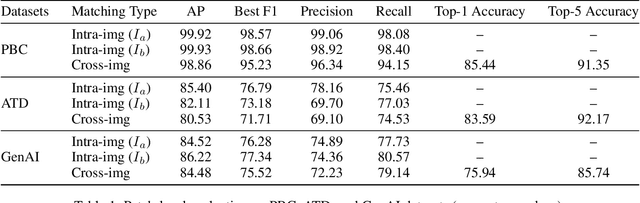
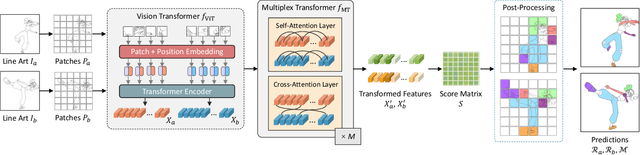
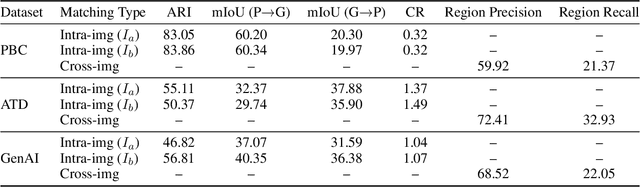
Understanding region-wise correspondence between manga line art images is a fundamental task in manga processing, enabling downstream applications such as automatic line art colorization and in-between frame generation. However, this task remains largely unexplored, especially in realistic scenarios without pre-existing segmentation or annotations. In this paper, we introduce a novel and practical task: predicting region-wise correspondence between raw manga line art images without any pre-existing labels or masks. To tackle this problem, we divide each line art image into a set of patches and propose a Transformer-based framework that learns patch-level similarities within and across images. We then apply edge-aware clustering and a region matching algorithm to convert patch-level predictions into coherent region-level correspondences. To support training and evaluation, we develop an automatic annotation pipeline and manually refine a subset of the data to construct benchmark datasets. Experiments on multiple datasets demonstrate that our method achieves high patch-level accuracy (e.g., 96.34%) and generates consistent region-level correspondences, highlighting its potential for real-world manga applications.
Noisy Label Refinement with Semantically Reliable Synthetic Images
Sep 04, 2025Semantic noise in image classification datasets, where visually similar categories are frequently mislabeled, poses a significant challenge to conventional supervised learning approaches. In this paper, we explore the potential of using synthetic images generated by advanced text-to-image models to address this issue. Although these high-quality synthetic images come with reliable labels, their direct application in training is limited by domain gaps and diversity constraints. Unlike conventional approaches, we propose a novel method that leverages synthetic images as reliable reference points to identify and correct mislabeled samples in noisy datasets. Extensive experiments across multiple benchmark datasets show that our approach significantly improves classification accuracy under various noise conditions, especially in challenging scenarios with semantic label noise. Additionally, since our method is orthogonal to existing noise-robust learning techniques, when combined with state-of-the-art noise-robust training methods, it achieves superior performance, improving accuracy by 30% on CIFAR-10 and by 11% on CIFAR-100 under 70% semantic noise, and by 24% on ImageNet-100 under real-world noise conditions.
LotusFilter: Fast Diverse Nearest Neighbor Search via a Learned Cutoff Table
Jun 05, 2025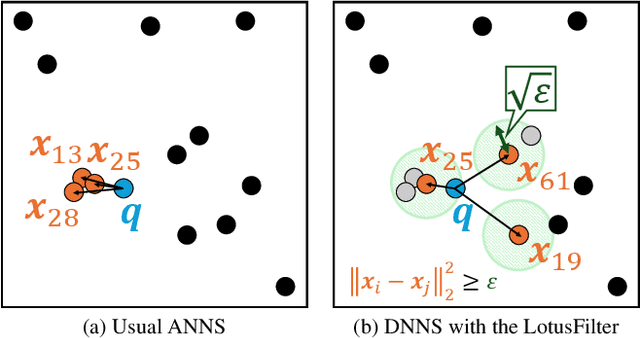
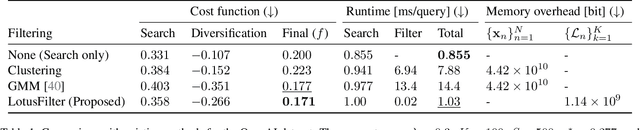
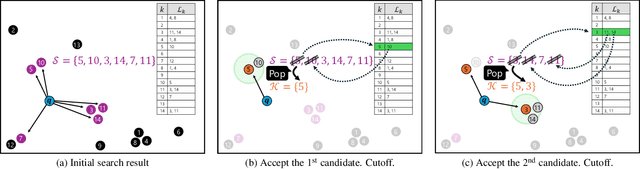

Approximate nearest neighbor search (ANNS) is an essential building block for applications like RAG but can sometimes yield results that are overly similar to each other. In certain scenarios, search results should be similar to the query and yet diverse. We propose LotusFilter, a post-processing module to diversify ANNS results. We precompute a cutoff table summarizing vectors that are close to each other. During the filtering, LotusFilter greedily looks up the table to delete redundant vectors from the candidates. We demonstrated that the LotusFilter operates fast (0.02 [ms/query]) in settings resembling real-world RAG applications, utilizing features such as OpenAI embeddings. Our code is publicly available at https://github.com/matsui528/lotf.
Cascaded Learned Bloom Filter for Optimal Model-Filter Size Balance and Fast Rejection
Feb 06, 2025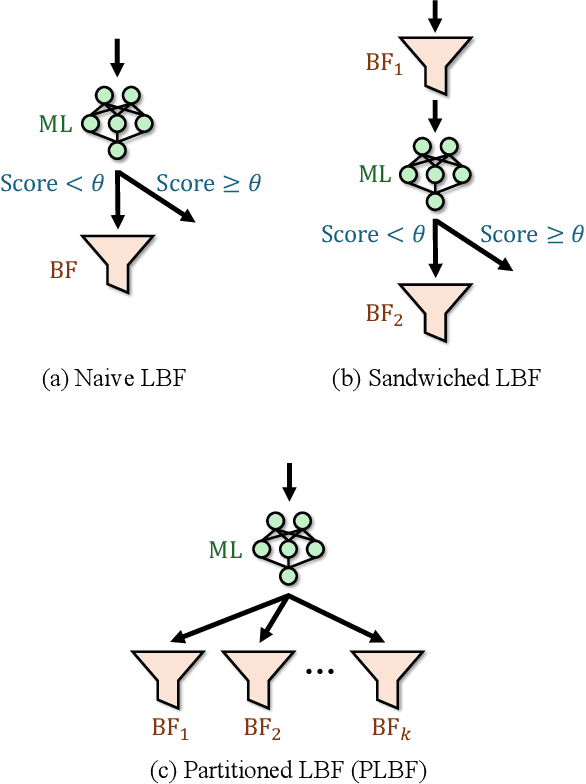

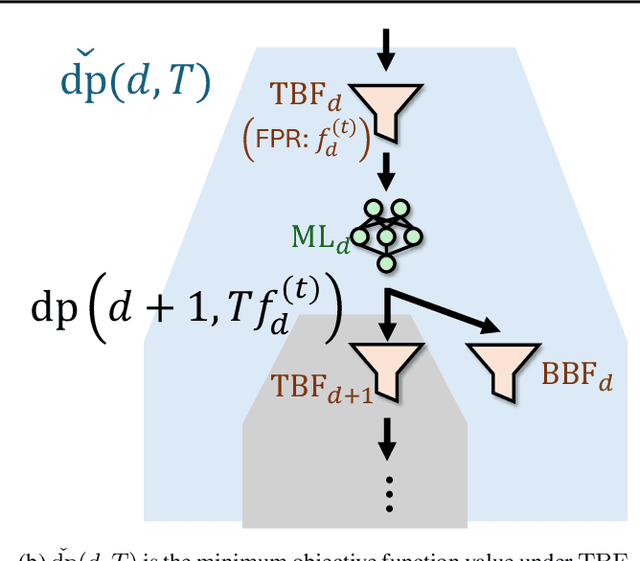

Recent studies have demonstrated that learned Bloom filters, which combine machine learning with the classical Bloom filter, can achieve superior memory efficiency. However, existing learned Bloom filters face two critical unresolved challenges: the balance between the machine learning model size and the Bloom filter size is not optimal, and the reject time cannot be minimized effectively. We propose the Cascaded Learned Bloom Filter (CLBF) to address these issues. Our dynamic programming-based optimization automatically selects configurations that achieve an optimal balance between the model and filter sizes while minimizing reject time. Experiments on real-world datasets show that CLBF reduces memory usage by up to 24% and decreases reject time by up to 14 times compared to state-of-the-art learned Bloom filters.
Broadcast Product: Shape-aligned Element-wise Multiplication and Beyond
Sep 26, 2024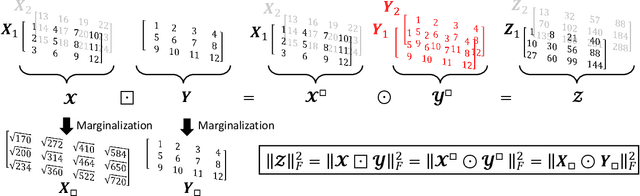
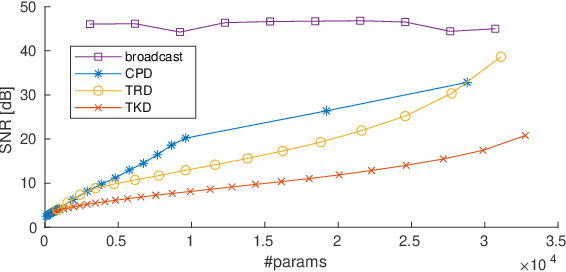
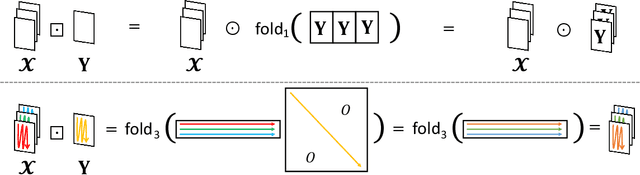
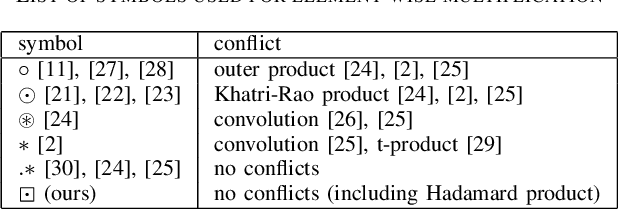
We propose a new operator defined between two tensors, the broadcast product. The broadcast product calculates the Hadamard product after duplicating elements to align the shapes of the two tensors. Complex tensor operations in libraries like \texttt{numpy} can be succinctly represented as mathematical expressions using the broadcast product. Finally, we propose a novel tensor decomposition using the broadcast product, highlighting its potential applications in dimensionality reduction.