 Add to Chrome
 Add to Firefox
 Add to Edge
Mathematical Foundations of Poisoning Attacks on Linear Regression over Cumulative Distribution Functions
Feb 28, 2026
Learned indexes are a class of index data structures that enable fast search by approximating the cumulative distribution function (CDF) using machine learning models (Kraska et al., SIGMOD'18). However, recent studies have shown that learned indexes are vulnerable to poisoning attacks, where injecting a small number of poison keys into the training data can significantly degrade model accuracy and reduce index performance (Kornaropoulos et al., SIGMOD'22). In this work, we provide a rigorous theoretical analysis of poisoning attacks targeting linear regression models over CDFs, one of the most basic regression models and a core component in many learned indexes. Our main contributions are as follows: (i) We present a theoretical proof characterizing the optimal single-point poisoning attack and show that the existing method yields the optimal attack. (ii) We show that in multi-point attacks, the existing greedy approach is not always optimal, and we rigorously derive the key properties that an optimal attack should satisfy. (iii) We propose a method to compute an upper bound of the multi-point poisoning attack's impact and empirically demonstrate that the loss under the greedy approach is often close to this bound. Our study deepens the theoretical understanding of attack strategies against linear regression models on CDFs and provides a foundation for the theoretical evaluation of attacks and defenses on learned indexes.

Optimized Learned Count-Min Sketch
Dec 13, 2025Count-Min Sketch (CMS) is a memory-efficient data structure for estimating the frequency of elements in a multiset. Learned Count-Min Sketch (LCMS) enhances CMS with a machine learning model to reduce estimation error under the same memory usage, but suffers from slow construction due to empirical parameter tuning and lacks theoretical guarantees on intolerable error probability. We propose Optimized Learned Count-Min Sketch (OptLCMS), which partitions the input domain and assigns each partition to its own CMS instance, with CMS parameters analytically derived for fixed thresholds, and thresholds optimized via dynamic programming with approximate feasibility checks. This reduces the need for empirical validation, enabling faster construction while providing theoretical guarantees under these assumptions. OptLCMS also allows explicit control of the allowable error threshold, improving flexibility in practice. Experiments show that OptLCMS builds faster, achieves lower intolerable error probability, and matches the estimation accuracy of LCMS.
Cascaded Learned Bloom Filter for Optimal Model-Filter Size Balance and Fast Rejection
Feb 06, 2025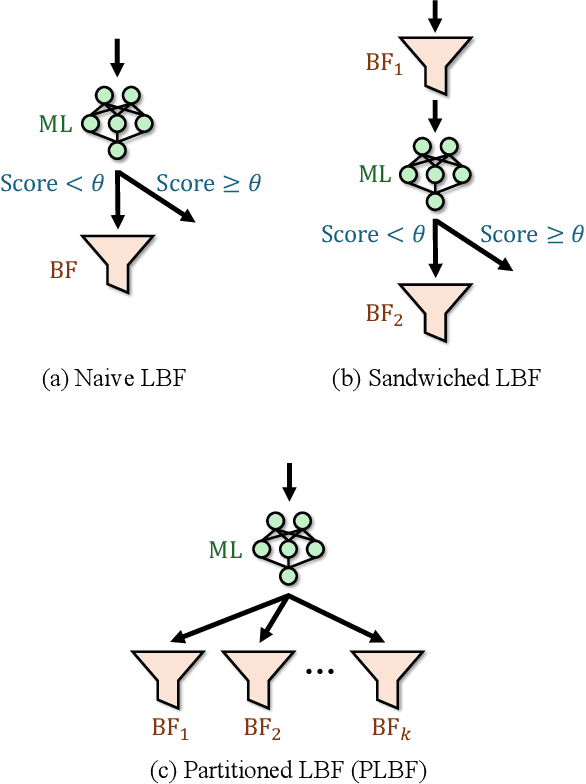

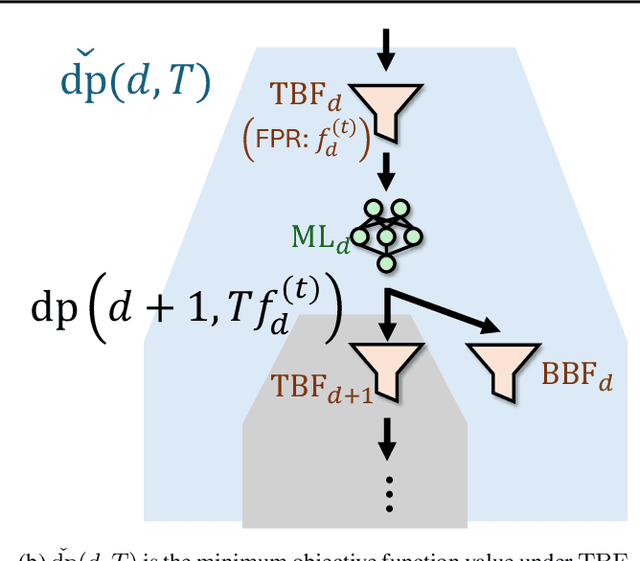

Recent studies have demonstrated that learned Bloom filters, which combine machine learning with the classical Bloom filter, can achieve superior memory efficiency. However, existing learned Bloom filters face two critical unresolved challenges: the balance between the machine learning model size and the Bloom filter size is not optimal, and the reject time cannot be minimized effectively. We propose the Cascaded Learned Bloom Filter (CLBF) to address these issues. Our dynamic programming-based optimization automatically selects configurations that achieve an optimal balance between the model and filter sizes while minimizing reject time. Experiments on real-world datasets show that CLBF reduces memory usage by up to 24% and decreases reject time by up to 14 times compared to state-of-the-art learned Bloom filters.