 Add to Chrome
 Add to Firefox
 Add to Edge
Learning from Noisy Prompts: Saliency-Guided Prompt Distillation for Robust Segmentation with SAM
Apr 25, 2026
Segmentation is central to clinical diagnosis and monitoring, yet the reliability of modern foundation models in medical imaging still depends on the availability of precise prompts. The Segment Anything Model (SAM) offers powerful zero-shot capabilities, although it collapses under the weak, generic, and noisy prompts that dominate real clinical workflows. In practice, annotations such as centerline points are coarse and ambiguous, often drifting across neighboring anatomy and misguiding SAM toward inconsistent or incomplete masks. We introduce SPD, a Saliency-Guided Prompt Distillation framework that converts these unreliable cues into robust guidance. SPD first learns data-driven anatomical priors through a lightweight saliency head to obtain confident localization maps. These priors then drive Contextual Prompt Distillation, which validates and enriches noisy prompts using cues from anatomically adjacent slices, producing a consensus prompt set that matches the behavior of expert reasoning. A Pairwise Slice Consistency objective further enforces local anatomical coherence during segmentation. Experiments on four challenging MRI and CT benchmarks demonstrate that SPD consistently outperforms existing SAM adaptations and supervised baselines, delivering large gains in both region-based and boundary-based metrics. SPD provides a practical and principled path toward reliable foundation model deployment in clinical environments where only imperfect prompts are available.

Seeing Beyond the Image: ECG and Anatomical Knowledge-Guided Myocardial Scar Segmentation from Late Gadolinium-Enhanced Images
Nov 18, 2025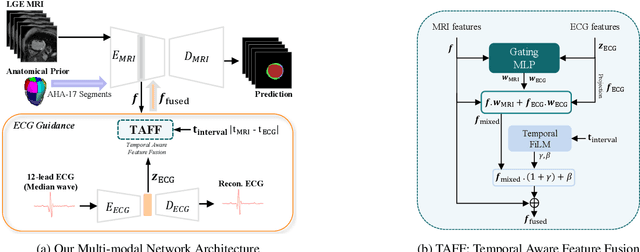
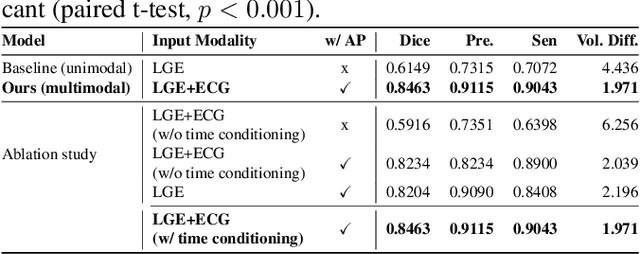
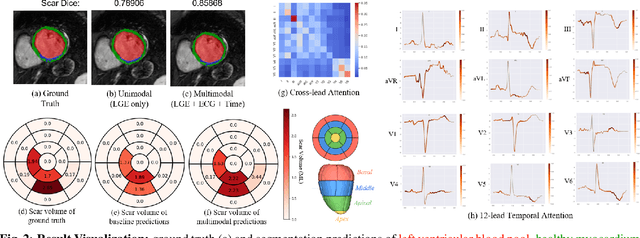
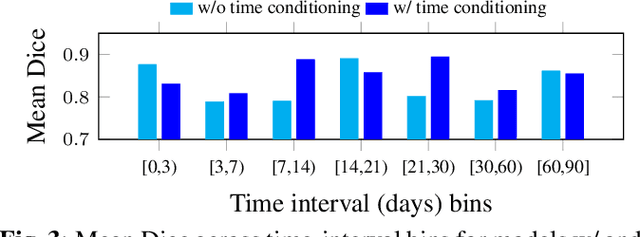
Accurate segmentation of myocardial scar from late gadolinium enhanced (LGE) cardiac MRI is essential for evaluating tissue viability, yet remains challenging due to variable contrast and imaging artifacts. Electrocardiogram (ECG) signals provide complementary physiological information, as conduction abnormalities can help localize or suggest scarred myocardial regions. In this work, we propose a novel multimodal framework that integrates ECG-derived electrophysiological information with anatomical priors from the AHA-17 atlas for physiologically consistent LGE-based scar segmentation. As ECGs and LGE-MRIs are not acquired simultaneously, we introduce a Temporal Aware Feature Fusion (TAFF) mechanism that dynamically weights and fuses features based on their acquisition time difference. Our method was evaluated on a clinical dataset and achieved substantial gains over the state-of-the-art image-only baseline (nnU-Net), increasing the average Dice score for scars from 0.6149 to 0.8463 and achieving high performance in both precision (0.9115) and sensitivity (0.9043). These results show that integrating physiological and anatomical knowledge allows the model to "see beyond the image", setting a new direction for robust and physiologically grounded cardiac scar segmentation.
CLAIM: Clinically-Guided LGE Augmentation for Realistic and Diverse Myocardial Scar Synthesis and Segmentation
Jun 18, 2025Deep learning-based myocardial scar segmentation from late gadolinium enhancement (LGE) cardiac MRI has shown great potential for accurate and timely diagnosis and treatment planning for structural cardiac diseases. However, the limited availability and variability of LGE images with high-quality scar labels restrict the development of robust segmentation models. To address this, we introduce CLAIM: \textbf{C}linically-Guided \textbf{L}GE \textbf{A}ugmentation for Real\textbf{i}stic and Diverse \textbf{M}yocardial Scar Synthesis and Segmentation framework, a framework for anatomically grounded scar generation and segmentation. At its core is the SMILE module (Scar Mask generation guided by cLinical knowledgE), which conditions a diffusion-based generator on the clinically adopted AHA 17-segment model to synthesize images with anatomically consistent and spatially diverse scar patterns. In addition, CLAIM employs a joint training strategy in which the scar segmentation network is optimized alongside the generator, aiming to enhance both the realism of synthesized scars and the accuracy of the scar segmentation performance. Experimental results show that CLAIM produces anatomically coherent scar patterns and achieves higher Dice similarity with real scar distributions compared to baseline models. Our approach enables controllable and realistic myocardial scar synthesis and has demonstrated utility for downstream medical imaging task.