 Add to Chrome
 Add to Firefox
 Add to Edge
K9-Bench: Evaluating Multimodal LLMs on Canine-Centric Videos
Jul 02, 2026
MLLMs have shown strong zero-shot capabilities across diverse inputs such as across images, video, audio, and text. A crucial, yet underexplored, application of these models lies in understanding and modeling animal-centric scenarios. As animals are integral to millions of households, benchmarking next-generation AI models on pet-focused tasks, ranging from recognizing distress signals to enabling responsive robotic companions, is essential for building AI systems that can work alongside us. We introduce K9-Bench, a novel benchmark focused on real-world domestic dog videos, specifically targeting canine action and interaction understanding via approximately 5000 question-answer pairs across 907 videos spanning 5 distinct task categories that test long-form, canine-centric multimodal reasoning in MLLMs. To create this dataset, we propose a scalable, VLM/LLM-powered data generation pipeline that automatically mines canine-centric videos from the web and curates QA pairs requiring fine-grained, multi-hop reasoning over canine actions and temporally extended interaction sequences. We implement bias mitigation strategies designed to eliminate biases introduced by VLMs during dataset curation. Through extensive experimentation, we find that frontier MLLMs exhibit limited zero-shot performance on canine-centric tasks: although state-of-the-art closed-source models outperform open-source counterparts, they still struggle with compositional reasoning over subtle posture and interaction cues spread over long horizons. We observe that generic chain-of-thought prompting provides only modest performance for such long-horizon reasoning. Beyond a novel dataset for canine activity analysis, K9-Bench provides a general-purpose dataset construction pipeline that can be adapted to other low-data domains for quantitative analysis. Our project website is available at: https://ogmenrobotics.github.io/K9Bench.

EVE: A Generator-Verifier System for Generative Policies
Dec 24, 2025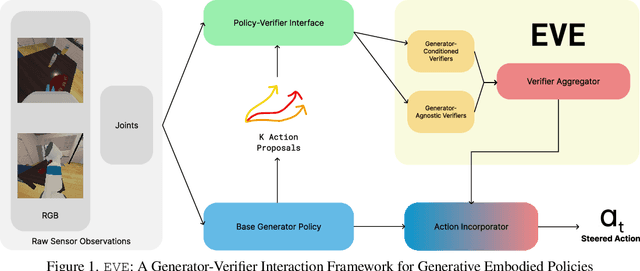
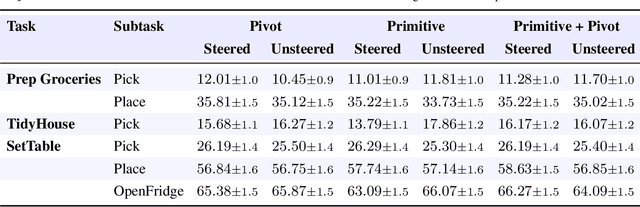
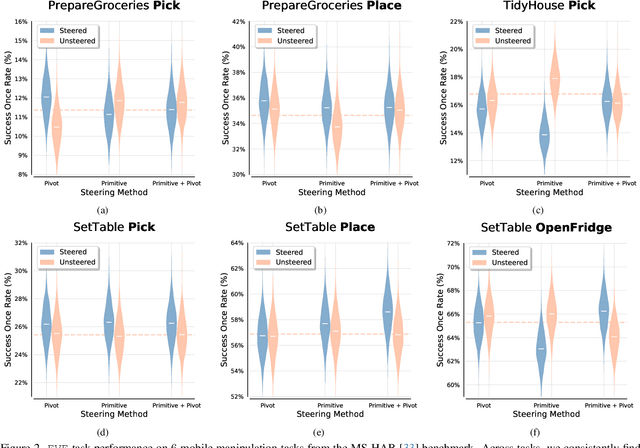

Visuomotor policies based on generative architectures such as diffusion and flow-based matching have shown strong performance but degrade under distribution shifts, demonstrating limited recovery capabilities without costly finetuning. In the language modeling domain, test-time compute scaling has revolutionized reasoning capabilities of modern LLMs by leveraging additional inference-time compute for candidate solution refinement. These methods typically leverage foundation models as verification modules in a zero-shot manner to synthesize improved candidate solutions. In this work, we hypothesize that generative policies can similarly benefit from additional inference-time compute that employs zero-shot VLM-based verifiers. A systematic analysis of improving policy performance through the generation-verification framework remains relatively underexplored in the current literature. To this end, we introduce EVE - a modular, generator-verifier interaction framework - that boosts the performance of pretrained generative policies at test time, with no additional training. EVE wraps a frozen base policy with multiple zero-shot, VLM-based verifier agents. Each verifier proposes action refinements to the base policy candidate actions, while an action incorporator fuses the aggregated verifier output into the base policy action prediction to produce the final executed action. We study design choices for generator-verifier information interfacing across a system of verifiers with distinct capabilities. Across a diverse suite of manipulation tasks, EVE consistently improves task success rates without any additional policy training. Through extensive ablations, we isolate the contribution of verifier capabilities and action incorporator strategies, offering practical guidelines to build scalable, modular generator-verifier systems for embodied control.
FindingDory: A Benchmark to Evaluate Memory in Embodied Agents
Jun 18, 2025Large vision-language models have recently demonstrated impressive performance in planning and control tasks, driving interest in their application to real-world robotics. However, deploying these models for reasoning in embodied contexts is limited by their ability to incorporate long-term experience collected across multiple days and represented by vast collections of images. Current VLMs typically struggle to process more than a few hundred images concurrently, highlighting the need for more efficient mechanisms to handle long-term memory in embodied settings. To effectively evaluate these models for long-horizon control, a benchmark must specifically target scenarios where memory is crucial for success. Existing long-video QA benchmarks overlook embodied challenges like object manipulation and navigation, which demand low-level skills and fine-grained reasoning over past interactions. Moreover, effective memory integration in embodied agents involves both recalling relevant historical information and executing actions based on that information, making it essential to study these aspects together rather than in isolation. In this work, we introduce a new benchmark for long-range embodied tasks in the Habitat simulator. This benchmark evaluates memory-based capabilities across 60 tasks requiring sustained engagement and contextual awareness in an environment. The tasks can also be procedurally extended to longer and more challenging versions, enabling scalable evaluation of memory and reasoning. We also present baselines that integrate state-of-the-art VLMs with low level navigation policies, assessing their performance on these memory-intensive tasks and highlight areas for improvement.
Reducing LLM Hallucinations using Epistemic Neural Networks
Dec 25, 2023Reducing and detecting hallucinations in large language models is an open research problem. In this project, we attempt to leverage recent advances in the field of uncertainty estimation to reduce hallucinations in frozen large language models. Epistemic neural networks have recently been proposed to improve output joint distributions for large pre-trained models. ENNs are small networks attached to large, frozen models to improve the model's joint distributions and uncertainty estimates. In this work, we train an epistemic neural network on top of the Llama-2 7B model combined with a contrastive decoding feature enhancement technique. We are the first to train an ENN for the next token prediction task and explore the efficacy of this method in reducing hallucinations on the TruthfulQA dataset. In essence, we provide a method that leverages a pre-trained model's latent embeddings to reduce hallucinations.