 Add to Chrome
 Add to Firefox
 Add to Edge
Multi-Modal Hyper-Graph Fusion for Low-Light Crowd Counting
Jun 17, 2026
Crowd counting is a fundamental task in computer vision. However, crowd counting in low-light environments remains largely underexplored, despite its practical importance in the real world. Existing methods mainly focus on well-lit scenes or rely on single-modality Red-Green-Blue (RGB) representations, which often become unreliable under extreme darkness and complex non-uniform illumination. To handle this problem, we construct three new low-light crowd counting benchmarks, which consist of two synthetic datasets, SHA\_Dark and SHB\_Dark, and a real-world benchmark LC-Crowd (Low-light Crowd Dataset). Inspired by Retinex-based physical modeling, we introduce depth and Canny edge cues as complementary geometric and structural priors to enhance the intrinsic reflectance representation under low-light conditions. We propose a Multi-Modal Hyper-Graph Fusion module, which formulates RGB appearance, depth geometry, and edge structure cues as nodes in a unified hyper-graph and explicitly captures their high-order complementary relationships via dynamic hyperedge construction and message passing. Furthermore, to adaptively allocate computation in dense prediction, we propose a Deformable Rectangular Sparse Attention (DRSA) module, which concentrates computation on informative regions through anchor-aware estimation and adaptive rectangular window modeling. Based on these designs, we develop a unified Low-Light Counting Network (LCNet) for robust low-light crowd counting. Extensive experiments on three benchmarks demonstrate that the proposed method achieves the best overall performance against existing state-of-the-art (SOTA) methods. The code is in the supplementary material. The datasets will be made public upon acceptance.

Permute to Train: A New Dimension to Training Deep Neural Networks
Apr 15, 2020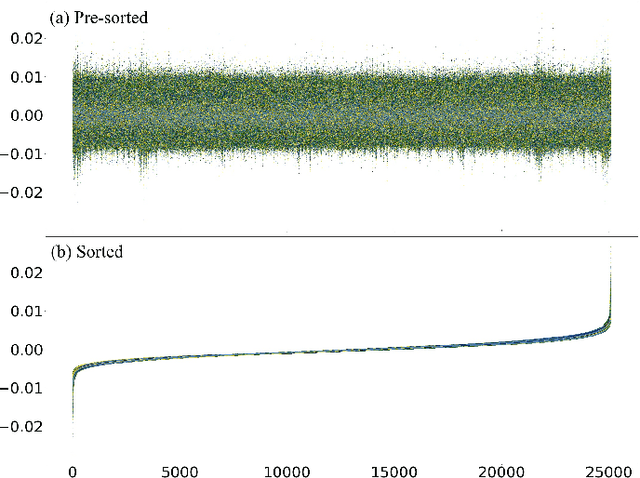
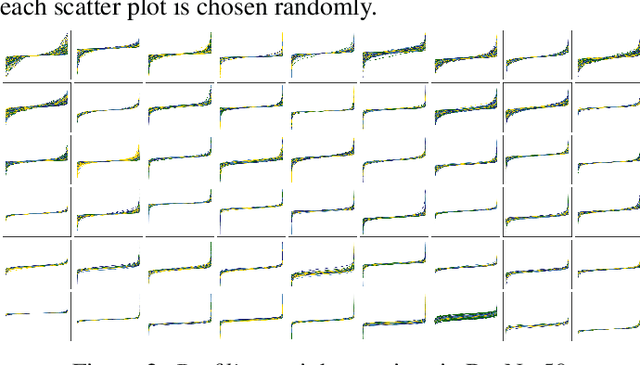
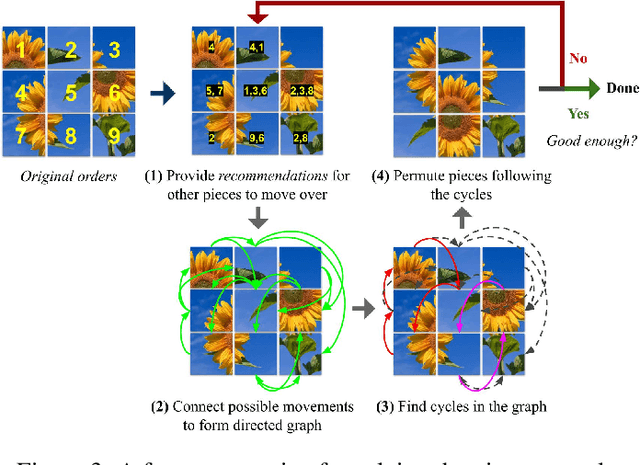
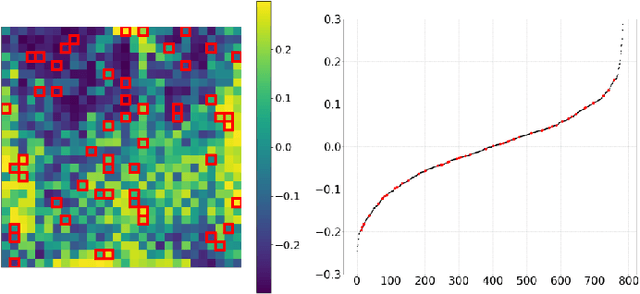
We show that Deep Neural Networks (DNNs) can be efficiently trained by permuting neuron connections. We introduce a new family of methods to train DNNs called Permute to Train (P2T). Two implementations of P2T are presented: Stochastic Gradient Permutation and Lookahead Permutation. The former computes permutation based on gradient, and the latter depends on another optimizer to derive the permutation. We empirically show that our proposed method, despite only swapping randomly weighted connections, achieves comparable accuracy to that of Adam on MNIST, Fashion-MNIST, and CIFAR-10 datasets. It opens up possibilities for new ways to train and regularize DNNs.