 Add to Chrome
 Add to Firefox
 Add to Edge
Diagnosing JEPA World Models with Action-Conditioned Predictive Consistency
Aug 13, 2026
Joint-embedding predictive architectures (JEPAs) learn world models that predict in a compact latent space rather than in pixels, reducing the pressure to model nuisance appearance. Yet this provides no guarantee against visual perturbations: they can still alter the encoded representation and affect subsequent action-conditioned predictions. Bisimulation captures this requirement precisely: two observations should be treated as the same state only when their action-conditioned consequences agree. Guided by this criterion, we introduce Action-Conditioned Predictive Consistency (ACPC), a diagnostic that measures how far a clean history and a visually perturbed view of it diverge after being rolled forward under the same action sequence. We prove that this divergence bounds the perturbation-induced change in multi-step prediction error and planner cost. Building on pairwise ACPC, we define two complementary measures: the Invariance Radius (IR) summarizes clean-perturbed rollout spread, while the Separation Rate (SR) checks whether different states remain distinguishable after rollout. Experiments on four visual control tasks show that pairwise ACPC predicts perturbation-induced prediction and cost changes. On LeWM, the IR-SR screen transfers across tasks, and the joint diagnostic remains informative under blur and resize. PLDM exhibits similar diagnostic trends under a different architecture.

Dimension Reduction for Data with Heterogeneous Missingness
Sep 27, 2021
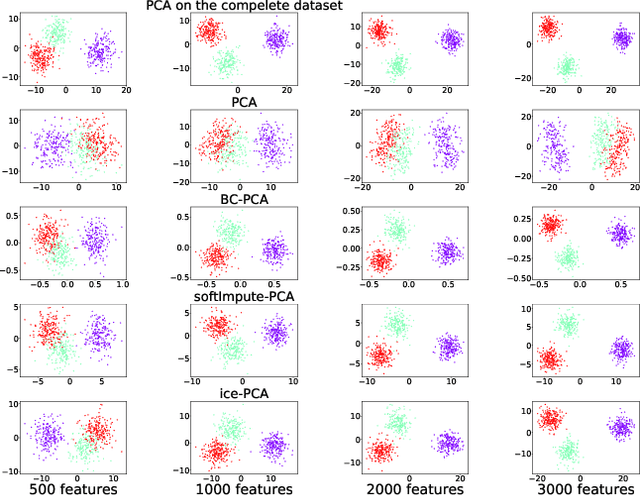
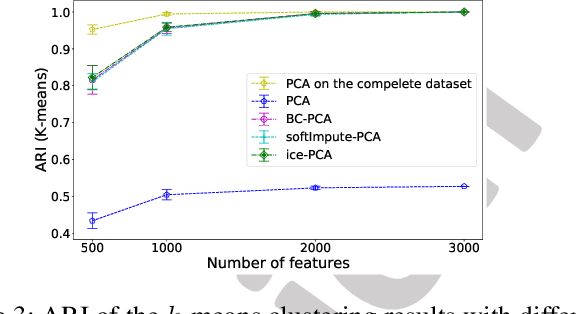
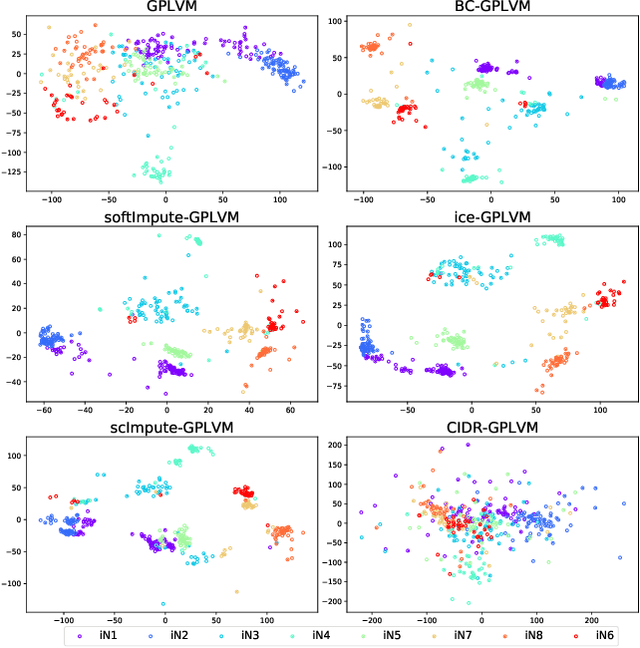
Dimension reduction plays a pivotal role in analysing high-dimensional data. However, observations with missing values present serious difficulties in directly applying standard dimension reduction techniques. As a large number of dimension reduction approaches are based on the Gram matrix, we first investigate the effects of missingness on dimension reduction by studying the statistical properties of the Gram matrix with or without missingness, and then we present a bias-corrected Gram matrix with nice statistical properties under heterogeneous missingness. Extensive empirical results, on both simulated and publicly available real datasets, show that the proposed unbiased Gram matrix can significantly improve a broad spectrum of representative dimension reduction approaches.