 Add to Chrome
 Add to Firefox
 Add to Edge
AsyncMDE: Real-Time Monocular Depth Estimation via Asynchronous Spatial Memory
Mar 11, 2026
Foundation-model-based monocular depth estimation offers a viable alternative to active sensors for robot perception, yet its computational cost often prohibits deployment on edge platforms. Existing methods perform independent per-frame inference, wasting the substantial computational redundancy between adjacent viewpoints in continuous robot operation. This paper presents AsyncMDE, an asynchronous depth perception system consisting of a foundation model and a lightweight model that amortizes the foundation model's computational cost over time. The foundation model produces high-quality spatial features in the background, while the lightweight model runs asynchronously in the foreground, fusing cached memory with current observations through complementary fusion, outputting depth estimates, and autoregressively updating the memory. This enables cross-frame feature reuse with bounded accuracy degradation. At a mere 3.83M parameters, it operates at 237 FPS on an RTX 4090, recovering 77% of the accuracy gap to the foundation model while achieving a 25X parameter reduction. Validated across indoor static, dynamic, and synthetic extreme-motion benchmarks, AsyncMDE degrades gracefully between refreshes and achieves 161FPS on a Jetson AGX Orin with TensorRT, clearly demonstrating its feasibility for real-time edge deployment.

DepthCache: Depth-Guided Training-Free Visual Token Merging for Vision-Language-Action Model Inference
Mar 11, 2026Vision-Language-Action (VLA) models enable generalist robotic manipulation but suffer from high inference latency. This bottleneck stems from the massive number of visual tokens processed by large language backbones. Existing methods either prune or merge tokens uniformly, degrading the spatial reasoning essential for robotic control. We present DepthCache, a training-free framework that leverages depth as a structural prior for visual token compression. It partitions observations into depth-based regions and applies spatially differentiated merge ratios, preserving the near-field workspace while compressing the distant background. To exploit temporal redundancy, DepthCache distributes the merging process across consecutive frames, ensuring consistent representations while reducing per-step computation. A motion-adaptive pipeline further optimizes auxiliary view compression based on end-effector dynamics. The framework requires no model modification, generalizing across diverse VLA architectures. On the LIBERO benchmark, DepthCache achieves up to 1.28x inference speedup with less than 1% average success rate degradation across three VLA models (pi_0.5, OpenVLA, GR00T), whereas pruning and merging baselines incur 4--24% degradation at comparable compression. Real-world experiments on a physical manipulator demonstrate that DepthCache enables faster task throughput and more responsive closed-loop control in latency-sensitive scenarios.
Structured Personality Control and Adaptation for LLM Agents
Jan 15, 2026Large Language Models (LLMs) are increasingly shaping human-computer interaction (HCI), from personalized assistants to social simulations. Beyond language competence, researchers are exploring whether LLMs can exhibit human-like characteristics that influence engagement, decision-making, and perceived realism. Personality, in particular, is critical, yet existing approaches often struggle to achieve both nuanced and adaptable expression. We present a framework that models LLM personality via Jungian psychological types, integrating three mechanisms: a dominant-auxiliary coordination mechanism for coherent core expression, a reinforcement-compensation mechanism for temporary adaptation to context, and a reflection mechanism that drives long-term personality evolution. This design allows the agent to maintain nuanced traits while dynamically adjusting to interaction demands and gradually updating its underlying structure. Personality alignment is evaluated using Myers-Briggs Type Indicator questionnaires and tested under diverse challenge scenarios as a preliminary structured assessment. Findings suggest that evolving, personality-aware LLMs can support coherent, context-sensitive interactions, enabling naturalistic agent design in HCI.
Learning Hierarchical Interaction for Accurate Molecular Property Prediction
Apr 30, 2025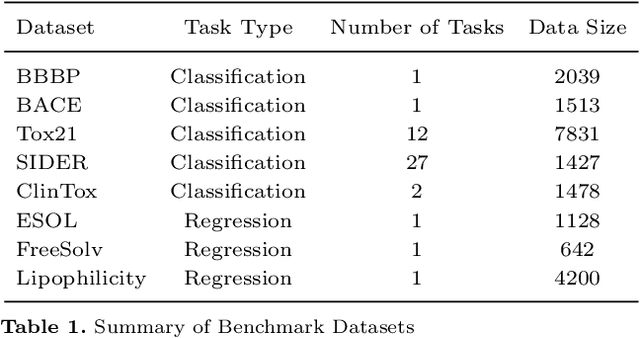
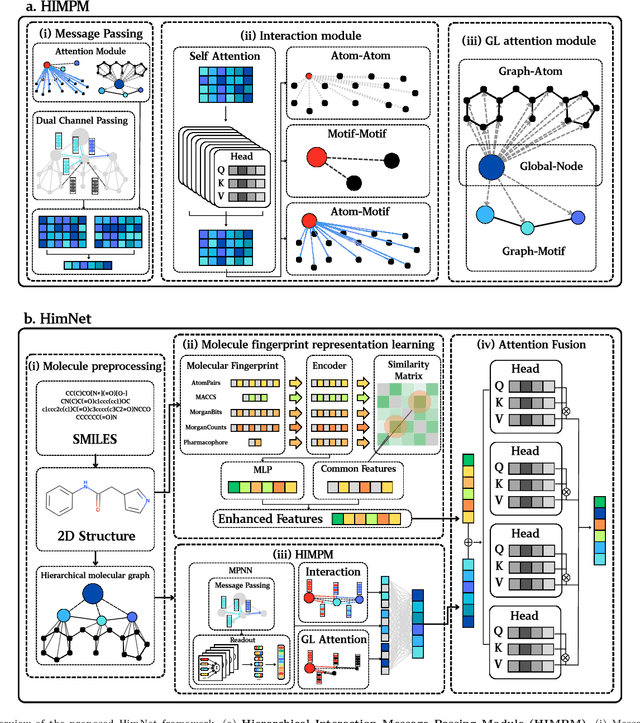
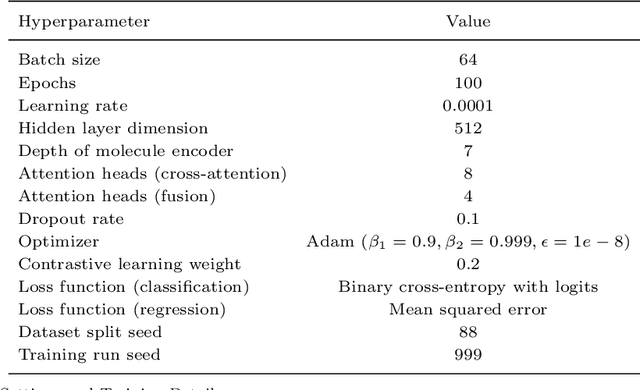
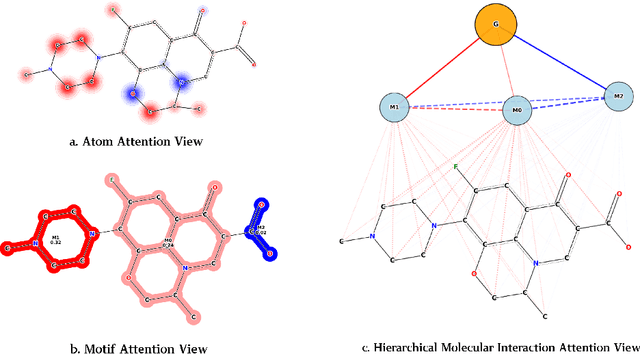
Discovering molecules with desirable molecular properties, including ADMET (Absorption, Distribution, Metabolism, Excretion, and Toxicity) profiles, is of great importance in drug discovery. Existing approaches typically employ deep learning models, such as Graph Neural Networks (GNNs) and Transformers, to predict these molecular properties by learning from diverse chemical information. However, these models often fail to efficiently capture and utilize the hierarchical nature of molecular structures, and lack mechanisms for effective interaction among multi-level features. To address these limitations, we propose a Hierarchical Interaction Message Passing Mechanism, which serves as the foundation of our novel model, HimNet. Our method enables interaction-aware representation learning across atomic, motif, and molecular levels via hierarchical attention-guided message passing. This design allows HimNet to effectively balance global and local information, ensuring rich and task-relevant feature extraction for downstream property prediction tasks, such as Blood-Brain Barrier Permeability (BBBP). Extensive experiments on multiple benchmark datasets demonstrate that HimNet achieves the best or near-best performance in most molecular property prediction tasks. Furthermore, our method exhibits promising hierarchical interpretability, aligning well with chemical intuition on representative molecules. We believe that HimNet offers an accurate and efficient solution for molecular activity and ADMET property prediction, contributing significantly to advanced decision-making in the early stages of drug discovery.