 Add to Chrome
 Add to Firefox
 Add to Edge
Do We Really Need External Tools to Mitigate Hallucinations? SIRA: Shared-Prefix Internal Reconstruction of Attribution
May 14, 2026
Large vision-language models (LVLMs) often hallucinate when language priors dominate weak or ambiguous visual evidence. Existing contrastive decoding methods mitigate this problem by comparing predictions from the original image with those from externally perturbed visual inputs, but such references can introduce off-manifold artifacts and require costly extra forward passes. We propose SIRA, a training-free internal contrastive decoding framework that constructs a counterfactual reference inside the same LVLM by exploiting the staged information flow of multimodal transformers. Instead of removing visual information from the input, SIRA first lets image and text tokens interact through a shared prefix, forming an aligned multimodal state that preserves prompt interpretation, decoding history, positional structure, and early visual grounding. It then forks a counterfactual branch in later transformer layers, where attention to image-token positions is masked. This branch retains the shared multimodal context but lacks continued access to fine-grained visual evidence, yielding a language-prior-dominated internal reference for token-level contrast. During decoding, SIRA suppresses tokens that remain strong without late visual access and favors predictions whose advantage depends on the full visual pathway. Experiments on POPE, CHAIR, and AMBER with Qwen2.5-VL and LLaVA-v1.5 show that SIRA consistently reduces hallucinations while preserving descriptive coverage and incurring lower overhead than two-pass contrastive decoding. SIRA requires no training, external verifier, or perturbed input, and applies to open-weight LVLMs with white-box inference access.

Multi-stage Progressive Reasoning for Dunhuang Murals Inpainting
May 10, 2023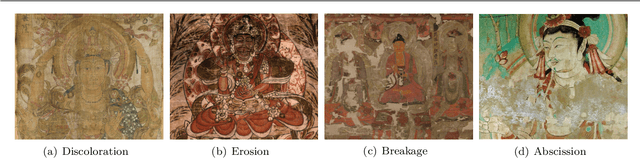
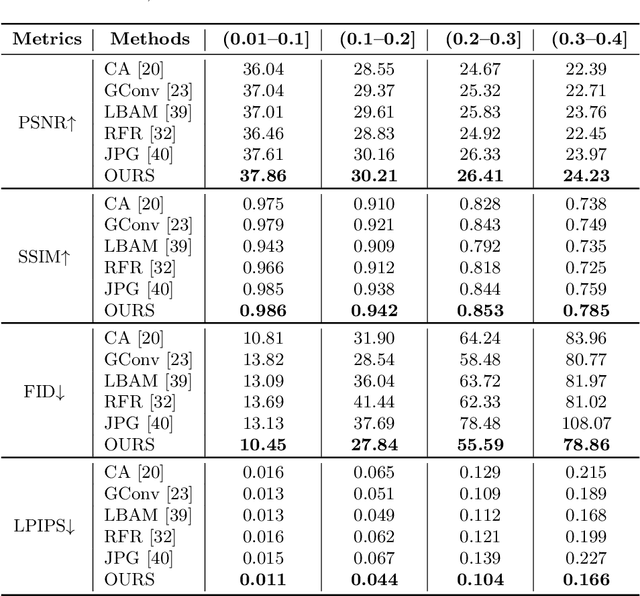
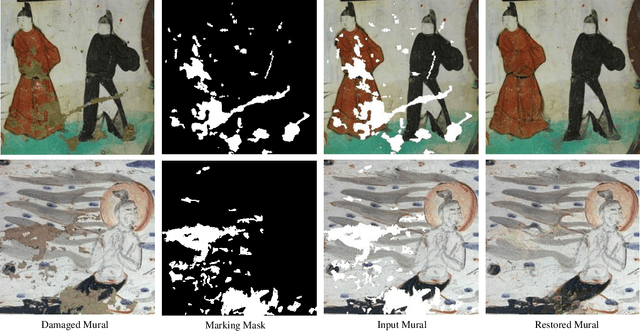
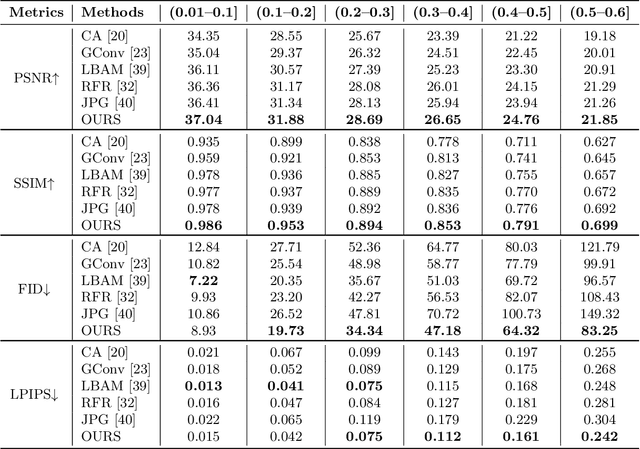
Dunhuang murals suffer from fading, breakage, surface brittleness and extensive peeling affected by prolonged environmental erosion. Image inpainting techniques are widely used in the field of digital mural inpainting. Generally speaking, for mural inpainting tasks with large area damage, it is challenging for any image inpainting method. In this paper, we design a multi-stage progressive reasoning network (MPR-Net) containing global to local receptive fields for murals inpainting. This network is capable of recursively inferring the damage boundary and progressively tightening the regional texture constraints. Moreover, to adaptively fuse plentiful information at various scales of murals, a multi-scale feature aggregation module (MFA) is designed to empower the capability to select the significant features. The execution of the model is similar to the process of a mural restorer (i.e., inpainting the structure of the damaged mural globally first and then adding the local texture details further). Our method has been evaluated through both qualitative and quantitative experiments, and the results demonstrate that it outperforms state-of-the-art image inpainting methods.