 Add to Chrome
 Add to Firefox
 Add to Edge
Ocean4D: Generative Underwater 4D Reconstruction via Medium-Aware Video Diffusion
Jun 22, 2026
Underwater 4D reconstruction remains challenging due to the coupling between degraded light transport in participating media and dynamic water variations. Most existing Methods are developed under in-air assumptions and do not explicitly account for underwater absorption and backscatter. Additionally, near-static assumptions make these approaches sensitive to drifting particles and dynamic distractors , leading to unstable geometry and inconsistent cross-view results. To address these issues, we propose a generative framework for underwater 4D reconstruction, named Ocean4D, which is built on two complementary components. Specifically, 4D-GCC constructs 4D geometrically consistent conditioning with improved cross-frame coverage, while the Medium-Aware Block performs implicit medium-aware denoising in the latent diffusion process to stabilize underwater appearance under absorption and scattering. Given a monocular video and target cameras, our method generates videos along the target trajectories while preserving global structure and cross-view consistency. Extensive experiments on both dynamic and static underwater benchmarks demonstrate state-of-the-art performance on underwater reconstruction.

A Multimodal Data Fusion Generative Adversarial Network for Real Time Underwater Sound Speed Field Construction
Jul 16, 2025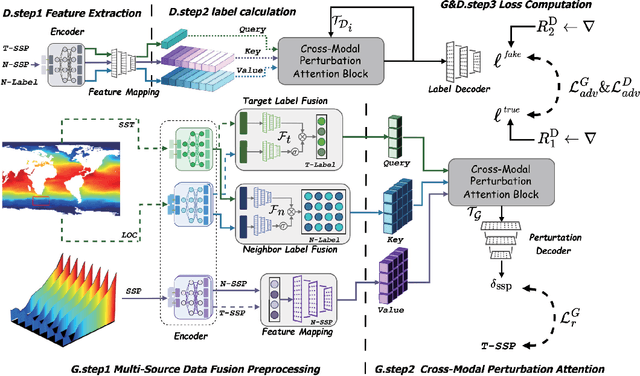
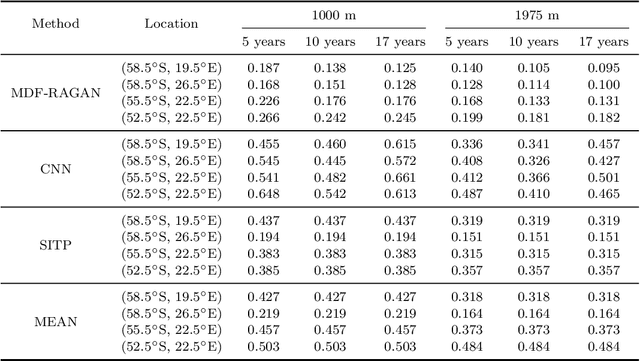
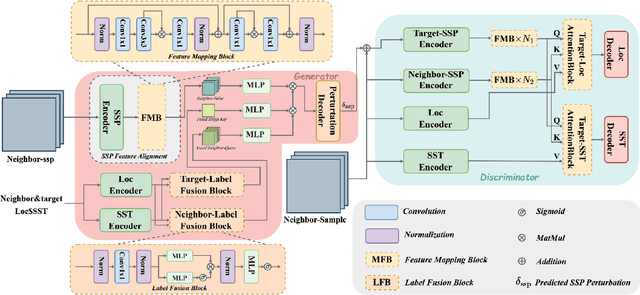
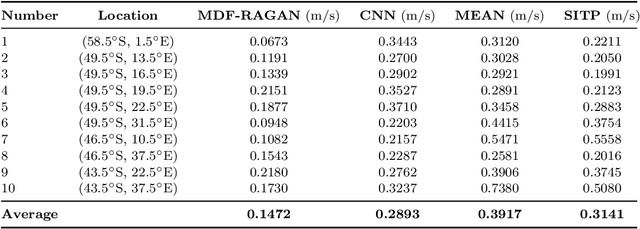
Sound speed profiles (SSPs) are essential parameters underwater that affects the propagation mode of underwater signals and has a critical impact on the energy efficiency of underwater acoustic communication and accuracy of underwater acoustic positioning. Traditionally, SSPs can be obtained by matching field processing (MFP), compressive sensing (CS), and deep learning (DL) methods. However, existing methods mainly rely on on-site underwater sonar observation data, which put forward strict requirements on the deployment of sonar observation systems. To achieve high-precision estimation of sound velocity distribution in a given sea area without on-site underwater data measurement, we propose a multi-modal data-fusion generative adversarial network model with residual attention block (MDF-RAGAN) for SSP construction. To improve the model's ability for capturing global spatial feature correlations, we embedded the attention mechanisms, and use residual modules for deeply capturing small disturbances in the deep ocean sound velocity distribution caused by changes of SST. Experimental results on real open dataset show that the proposed model outperforms other state-of-the-art methods, which achieves an accuracy with an error of less than 0.3m/s. Specifically, MDF-RAGAN not only outperforms convolutional neural network (CNN) and spatial interpolation (SITP) by nearly a factor of two, but also achieves about 65.8\% root mean square error (RMSE) reduction compared to mean profile, which fully reflects the enhancement of overall profile matching by multi-source fusion and cross-modal attention.