 Add to Chrome
 Add to Firefox
 Add to Edge
Towards Clinically Faithful Medical Image Captioning via Enhanced Vision-Language Alignment
Aug 20, 2026
Medical image captioning is a technique that accelerates early-stage diagnostic workflows and enhances the interpretability of medical diagnostic AI systems. However, unlike general image captioning, clinically reliable captioning remains challenging due to grayscale-based modalities, subtle anatomical cues, specialized medical phrasing, and variations in data quality. Despite recent advances in large vision-language models, fluent outputs do not necessarily guarantee sufficient alignment with clinical concept spaces or evaluation criteria. To address this issue, we propose a framework that strengthens clinical alignment by separating and enhancing training-time alignment and inference-time alignment. We build a medical image captioning pipeline that integrates single/dual vision encoders based on BioMedCLIP and SigLIP2, a Q-Former, and a LLaMA-based decoder, and examine the contribution of auxiliary learning for UMLS concept/type prediction. At inference, we apply single-embedding-based reranking to select the best caption among candidates, while at training we introduce MedPAIR-SCST, which combines clinically relevant rewards to shift the generative distribution toward improved clinical alignment. Our experiments show that complementary visual representations with a multi-encoder design and concept-level auxiliary learning help preserve clinically meaningful information. Furthermore, inference-time reranking provides a practical way to improve semantic and clinical alignment without additional training, whereas MedPAIR-SCST goes beyond selection by directly improving the model's distribution to generate more consistent and clinically grounded captions. These findings suggest that jointly leveraging selection-based alignment and reinforcement-learning-based alignment can promote more trustworthy medical image captioning even in data-constrained settings.

Hallucination by Code Generation LLMs: Taxonomy, Benchmarks, Mitigation, and Challenges
Apr 29, 2025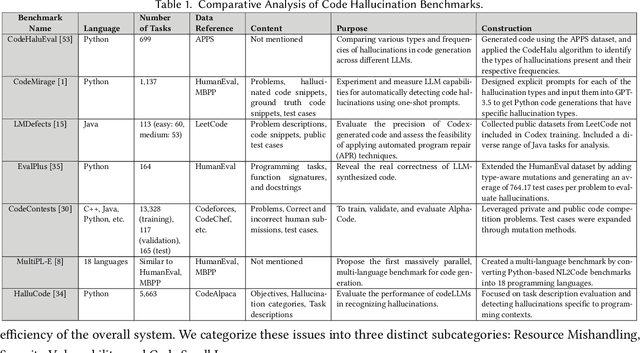
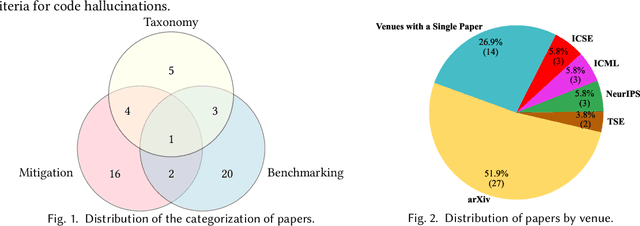
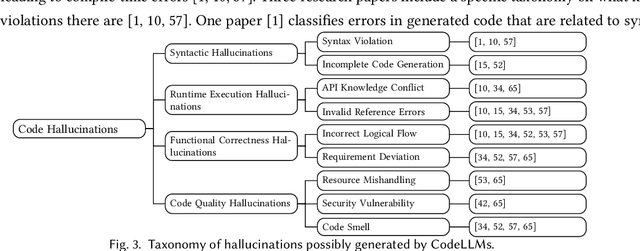
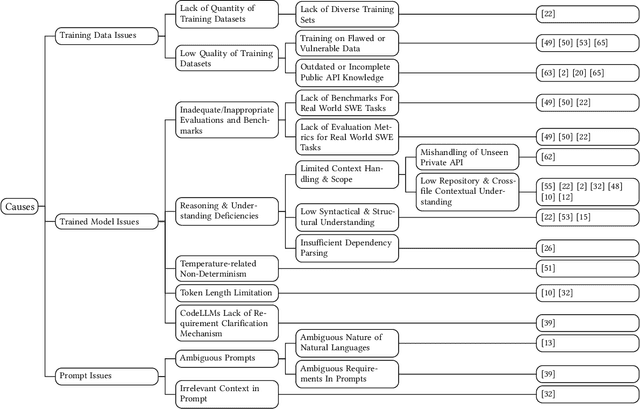
Recent technical breakthroughs in large language models (LLMs) have enabled them to fluently generate source code. Software developers often leverage both general-purpose and code-specialized LLMs to revise existing code or even generate a whole function from scratch. These capabilities are also beneficial in no-code or low-code contexts, in which one can write programs without a technical background. However, due to their internal design, LLMs are prone to generating hallucinations, which are incorrect, nonsensical, and not justifiable information but difficult to identify its presence. This problem also occurs when generating source code. Once hallucinated code is produced, it is often challenging for users to identify and fix it, especially when such hallucinations can be identified under specific execution paths. As a result, the hallucinated code may remain unnoticed within the codebase. This survey investigates recent studies and techniques relevant to hallucinations generated by CodeLLMs. We categorize the types of hallucinations in the code generated by CodeLLMs, review existing benchmarks and mitigation strategies, and identify open challenges. Based on these findings, this survey outlines further research directions in the detection and removal of hallucinations produced by CodeLLMs.
Can TDD Be Employed in LEO SatCom Systems? Challenges and Potential Approaches
Feb 12, 2025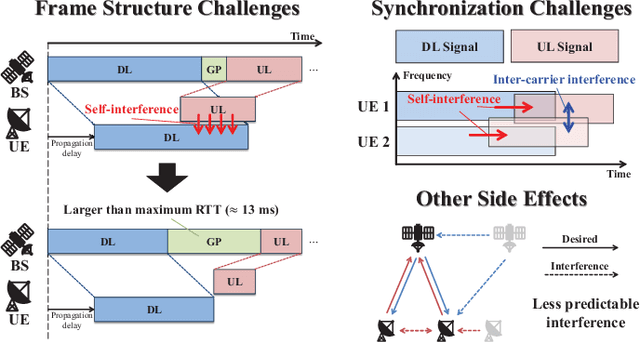
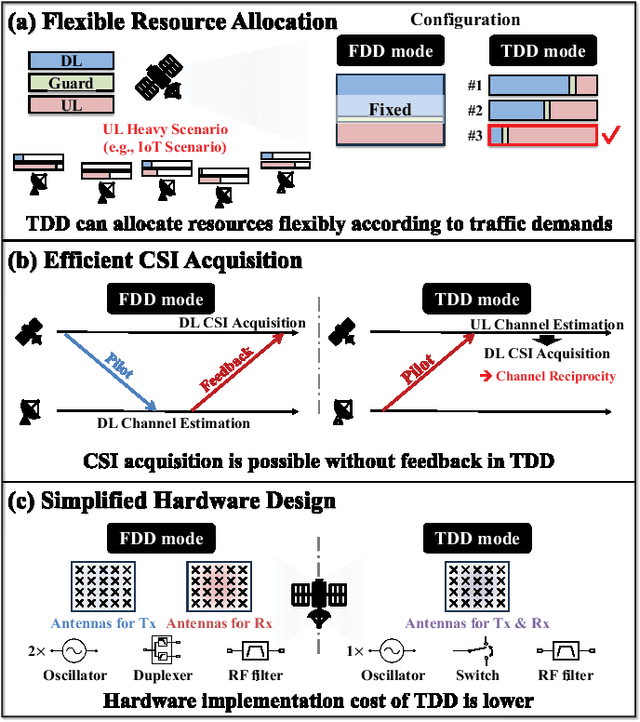
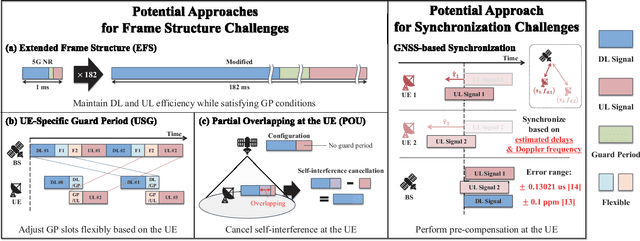
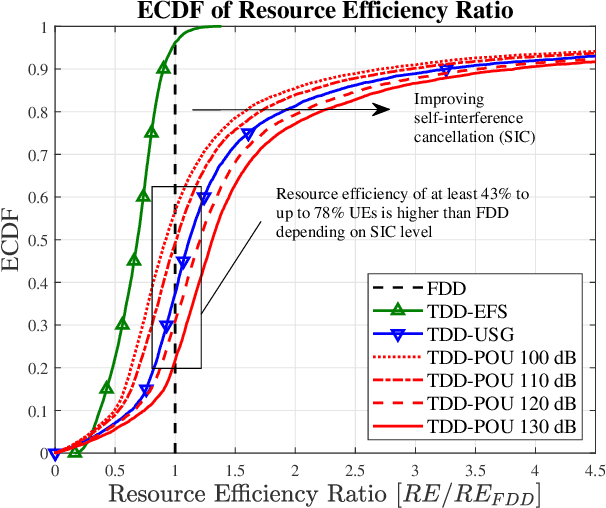
Frequency-division duplexing (FDD) remains the de facto standard in modern low Earth orbit (LEO) satellite communication (SatCom) systems, such as SpaceX's Starlink, OneWeb, and Amazon's Project Kuiper. While time-division duplexing (TDD) is often regarded as superior in today's terrestrial networks, its viability in future LEO SatCom systems remains unclear. This article details how the long propagation delays and high orbital velocities exhibited by LEO SatCom systems impedes the adoption of TDD, due to challenges involving the frame structure and synchronization. We then present potential approaches to overcome these challenges, which vary in terms of resource efficiency and operational/device complexity and thus would likely be application-specific. We conclude by assessing the performance of these proposed approaches, putting into perspective the tradeoff between complexity and performance gains over FDD. Overall, this article aims to motivate future investigation into the prospects of TDD in LEO SatCom systems and solutions to enable such, with the goal of enhancing future systems and unifying them with terrestrial networks.
IRIS: Wireless Ring for Vision-based Smart Home Interaction
Jul 25, 2024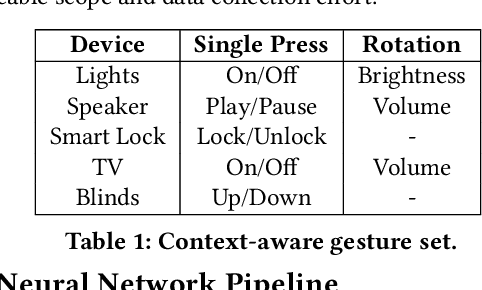
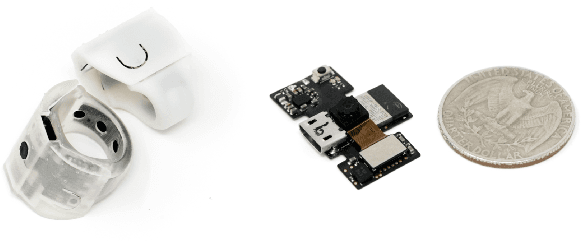
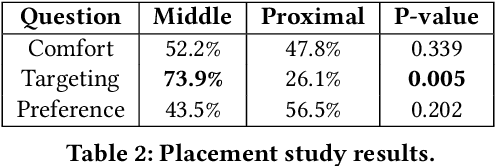
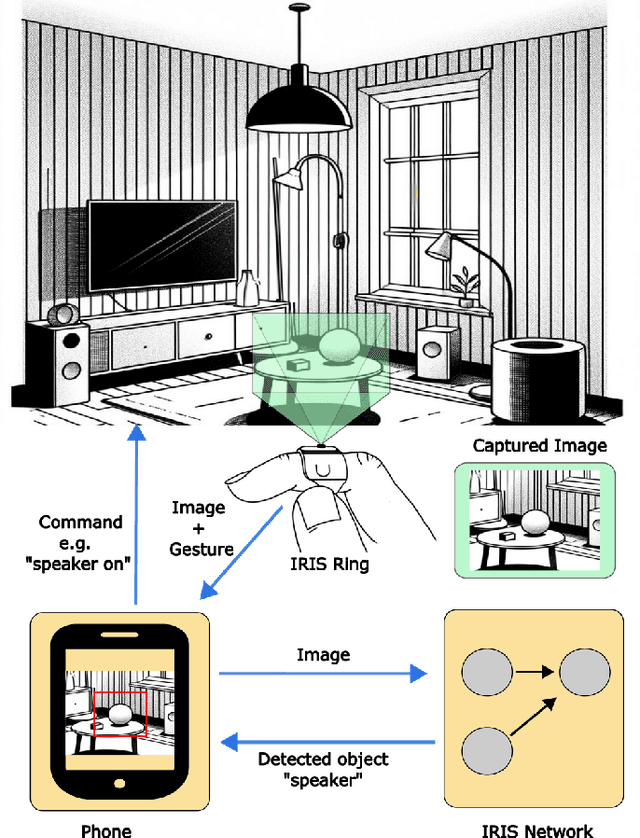
Integrating cameras into wireless smart rings has been challenging due to size and power constraints. We introduce IRIS, the first wireless vision-enabled smart ring system for smart home interactions. Equipped with a camera, Bluetooth radio, inertial measurement unit (IMU), and an onboard battery, IRIS meets the small size, weight, and power (SWaP) requirements for ring devices. IRIS is context-aware, adapting its gesture set to the detected device, and can last for 16-24 hours on a single charge. IRIS leverages the scene semantics to achieve instance-level device recognition. In a study involving 23 participants, IRIS consistently outpaced voice commands, with a higher proportion of participants expressing a preference for IRIS over voice commands regarding toggling a device's state, granular control, and social acceptability. Our work pushes the boundary of what is possible with ring form-factor devices, addressing system challenges and opening up novel interaction capabilities.
LLaVA-Docent: Instruction Tuning with Multimodal Large Language Model to Support Art Appreciation Education
Feb 09, 2024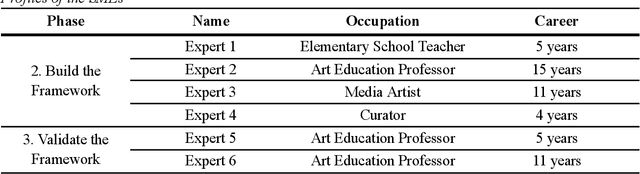
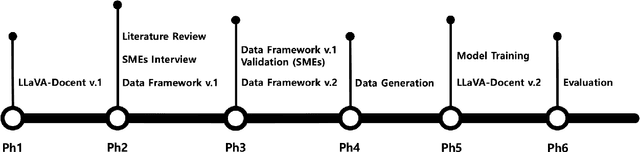
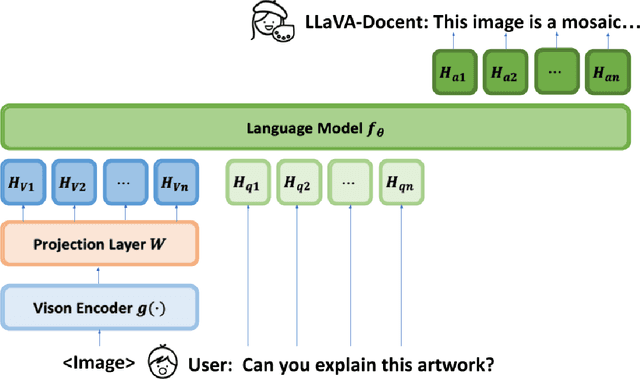
Art appreciation is vital in nurturing critical thinking and emotional intelligence among learners. However, traditional art appreciation education has often been hindered by limited access to art resources, especially for disadvantaged students, and an imbalanced emphasis on STEM subjects in mainstream education. In response to these challenges, recent technological advancements have paved the way for innovative solutions. This study explores the application of multi-modal large language models (MLLMs) in art appreciation education, focusing on developing LLaVA-Docent, a model that leverages these advancements. Our approach involved a comprehensive literature review and consultations with experts in the field, leading to developing a robust data framework. Utilizing this framework, we generated a virtual dialogue dataset that was leveraged by GPT-4. This dataset was instrumental in training the MLLM, named LLaVA-Docent. Six researchers conducted quantitative and qualitative evaluations of LLaVA-Docent to assess its effectiveness, benchmarking it against the GPT-4 model in a few-shot setting. The evaluation process revealed distinct strengths and weaknesses of the LLaVA-Docent model. Our findings highlight the efficacy of LLaVA-Docent in enhancing the accessibility and engagement of art appreciation education. By harnessing the potential of MLLMs, this study makes a significant contribution to the field of art education, proposing a novel methodology that reimagines the way art appreciation is taught and experienced.