 Add to Chrome
 Add to Firefox
 Add to Edge
A Fixed-Point Neural Operator for Size- and Functional-Transferable Hamiltonian Prediction
Jun 12, 2026
Predicting the Kohn-Sham Hamiltonian with machine learning can accelerate density functional theory while retaining access to molecular orbitals, energy levels, and electronic-structure observables that energy-only surrogates cannot resolve. Yet element-wise agreement with the converged Hamiltonian, an implicit fixed point of the self-consistent field iteration, does not determine the occupied subspace that governs orbital energies and densities. Here we present HamEvo, a neural operator that learns the single-step self-consistent update and returns the converged Hamiltonian as its fixed point. HamEvo is pre-trained on intermediate self-consistent trajectories and calibrated at equilibrium with density-matrix supervision. Across benchmarks from MD17 to drug-like QMugs, HamEvo lowers Hamiltonian errors by 35-49% over direct-regression and deep-equilibrium baselines, and predicts QMugs HOMO and LUMO energies with mean absolute errors of 0.036 and 0.053 eV, near the 1 kcal/mol chemical-accuracy scale. Few-shot fine-tuning with only 20 reference conformations extends HamEvo to molecules of up to 122 atoms, well beyond the size range covered by pre-training. With thermal molecular-dynamics sampling, HamEvo captures temperature-dependent HOMO-LUMO gap renormalization beyond the harmonic approximation. Inference is up to 242 times faster than conventional DFT.

DiverseMotion: Towards Diverse Human Motion Generation via Discrete Diffusion
Sep 04, 2023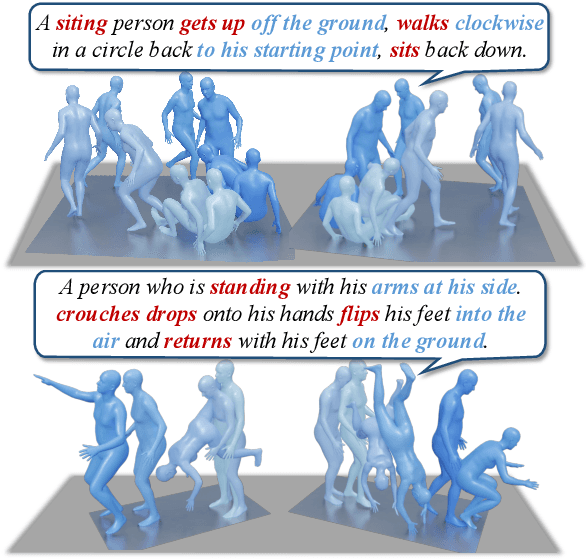
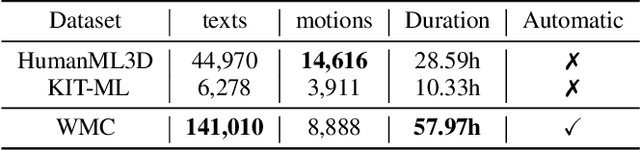
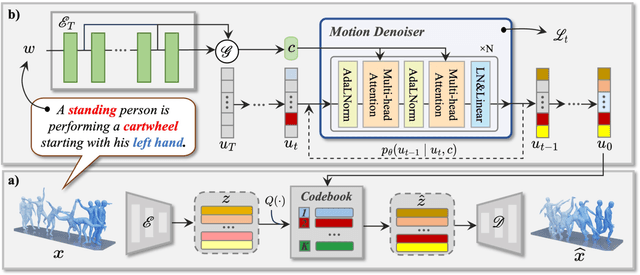
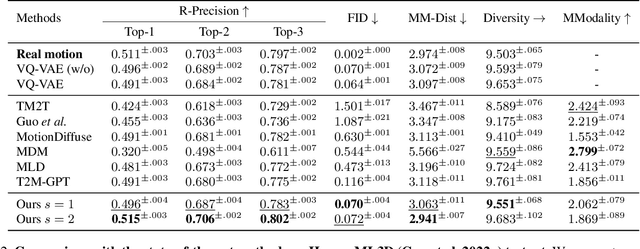
We present DiverseMotion, a new approach for synthesizing high-quality human motions conditioned on textual descriptions while preserving motion diversity.Despite the recent significant process in text-based human motion generation,existing methods often prioritize fitting training motions at the expense of action diversity. Consequently, striking a balance between motion quality and diversity remains an unresolved challenge. This problem is compounded by two key factors: 1) the lack of diversity in motion-caption pairs in existing benchmarks and 2) the unilateral and biased semantic understanding of the text prompt, focusing primarily on the verb component while neglecting the nuanced distinctions indicated by other words.In response to the first issue, we construct a large-scale Wild Motion-Caption dataset (WMC) to extend the restricted action boundary of existing well-annotated datasets, enabling the learning of diverse motions through a more extensive range of actions. To this end, a motion BLIP is trained upon a pretrained vision-language model, then we automatically generate diverse motion captions for the collected motion sequences. As a result, we finally build a dataset comprising 8,888 motions coupled with 141k text.To comprehensively understand the text command, we propose a Hierarchical Semantic Aggregation (HSA) module to capture the fine-grained semantics.Finally,we involve the above two designs into an effective Motion Discrete Diffusion (MDD) framework to strike a balance between motion quality and diversity. Extensive experiments on HumanML3D and KIT-ML show that our DiverseMotion achieves the state-of-the-art motion quality and competitive motion diversity. Dataset, code, and pretrained models will be released to reproduce all of our results.