 Add to Chrome
 Add to Firefox
 Add to Edge
LLM-Augmented Digital Twin for Policy Evaluation in Short-Video Platforms
Mar 11, 2026
Short-video platforms are closed-loop, human-in-the-loop ecosystems where platform policy, creator incentives, and user behavior co-evolve. This feedback structure makes counterfactual policy evaluation difficult in production, especially for long-horizon and distributional outcomes. The challenge is amplified as platforms deploy AI tools that change what content enters the system, how agents adapt, and how the platform operates. We propose a large language model (LLM)-augmented digital twin for short-video platforms, with a modular four-twin architecture (User, Content, Interaction, Platform) and an event-driven execution layer that supports reproducible experimentation. Platform policies are implemented as pluggable components within the Platform Twin, and LLMs are integrated as optional, schema-constrained decision services (e.g., persona generation, content captioning, campaign planning, trend prediction) that are routed through a unified optimizer. This design enables scalable simulations that preserve closed-loop dynamics while allowing selective LLM adoption, enabling the study of platform policies, including AI-enabled policies, under realistic feedback and constraints.

Daily Physical Activity Monitoring -- Adaptive Learning from Multi-source Motion Sensor Data
May 26, 2024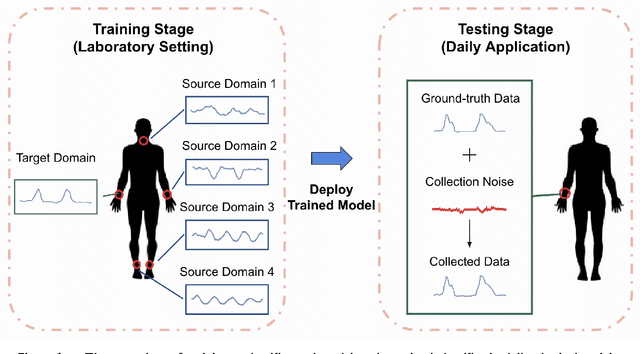
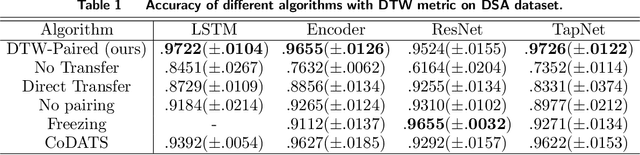
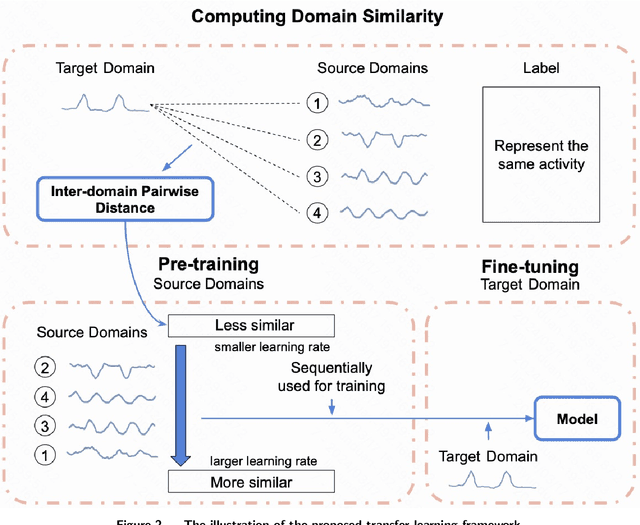

In healthcare applications, there is a growing need to develop machine learning models that use data from a single source, such as that from a wrist wearable device, to monitor physical activities, assess health risks, and provide immediate health recommendations or interventions. However, the limitation of using single-source data often compromises the model's accuracy, as it fails to capture the full scope of human activities. While a more comprehensive dataset can be gathered in a lab setting using multiple sensors attached to various body parts, this approach is not practical for everyday use due to the impracticality of wearing multiple sensors. To address this challenge, we introduce a transfer learning framework that optimizes machine learning models for everyday applications by leveraging multi-source data collected in a laboratory setting. We introduce a novel metric to leverage the inherent relationship between these multiple data sources, as they are all paired to capture aspects of the same physical activity. Through numerical experiments, our framework outperforms existing methods in classification accuracy and robustness to noise, offering a promising avenue for the enhancement of daily activity monitoring.