 Add to Chrome
 Add to Firefox
 Add to Edge
Joint Semantic-Channel Coding and Modulation for Token Communications
Nov 19, 2025
In recent years, the Transformer architecture has achieved outstanding performance across a wide range of tasks and modalities. Token is the unified input and output representation in Transformer-based models, which has become a fundamental information unit. In this work, we consider the problem of token communication, studying how to transmit tokens efficiently and reliably. Point cloud, a prevailing three-dimensional format which exhibits a more complex spatial structure compared to image or video, is chosen to be the information source. We utilize the set abstraction method to obtain point tokens. Subsequently, to get a more informative and transmission-friendly representation based on tokens, we propose a joint semantic-channel and modulation (JSCCM) scheme for the token encoder, mapping point tokens to standard digital constellation points (modulated tokens). Specifically, the JSCCM consists of two parallel Point Transformer-based encoders and a differential modulator which combines the Gumel-softmax and soft quantization methods. Besides, the rate allocator and channel adapter are developed, facilitating adaptive generation of high-quality modulated tokens conditioned on both semantic information and channel conditions. Extensive simulations demonstrate that the proposed method outperforms both joint semantic-channel coding and traditional separate coding, achieving over 1dB gain in reconstruction and more than 6x compression ratio in modulated symbols.

Adaptive Sampling and Joint Semantic-Channel Coding under Dynamic Channel Environment
Feb 11, 2025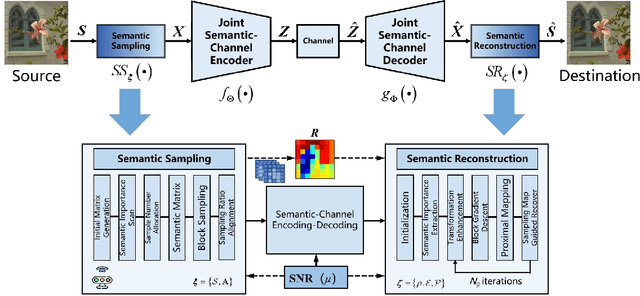
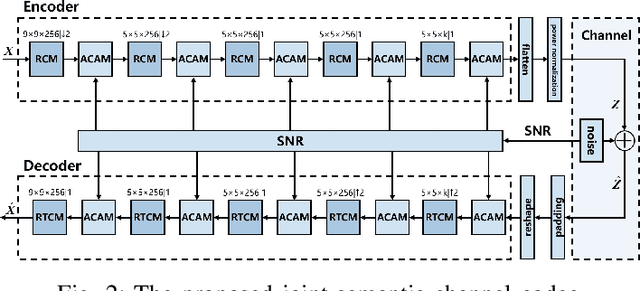
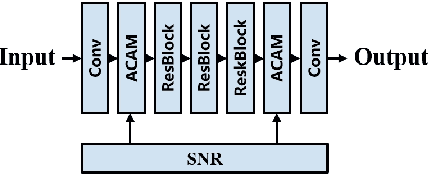
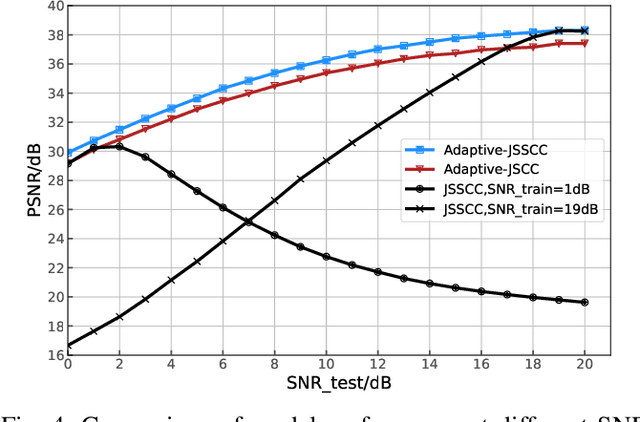
Deep learning enabled semantic communications are attracting extensive attention. However, most works normally ignore the data acquisition process and suffer from robustness issues under dynamic channel environment. In this paper, we propose an adaptive joint sampling-semantic-channel coding (Adaptive-JSSCC) framework. Specifically, we propose a semantic-aware sampling and reconstruction method to optimize the number of samples dynamically for each region of the images. According to semantic significance, we optimize sampling matrices for each region of the most individually and obtain a semantic sampling ratio distribution map shared with the receiver. Through the guidance of the map, high-quality reconstruction is achieved. Meanwhile, attention-based channel adaptive module (ACAM) is designed to overcome the neural network model mismatch between the training and testing channel environment during sampling-reconstruction and encoding-decoding. To this end, signal-to-noise ratio (SNR) is employed as an extra parameter input to integrate and reorganize intermediate characteristics. Simulation results show that the proposed Adaptive-JSSCC effectively reduces the amount of data acquisition without degrading the reconstruction performance in comparison to the state-of-the-art, and it is highly adaptable and adjustable to dynamic channel environments.