 Add to Chrome
 Add to Firefox
 Add to Edge
Token Communication for Multimodal Large Language Model
Aug 07, 2026
With the broad success of the Transformer architecture, token is becoming a new basic information processing unit. This trend is especially evident in multimodal large language models (MLLMs), where both visual and textual information are represented and processed as tokens. With the rapid deployment of MLLMs, the efficient transmission of tokens has become increasingly important. This paper investigates how to reduce the amount of transmitted data during interactions with MLLMs while preserving their multimodal understanding performance. To address this problem, we propose a token communication framework tailored to MLLMs. In the proposed framework, a neural codec is integrated into the vision tokenizer to control the number of transmitted bits. At the receiver, the decoded latents are processed through two paths. The decoder reconstructs image as a reconstruction prior, while the adapter converts latents into visual tokens and injects them into an intermediate layer of the vision tokenizer. To make the injected tokens suitable for MLLMs, we further design a two-stage visual-language semantic alignment training scheme. The adapter is first warmed up by a distillation loss and then aligned with textual semantics through an alignment loss. An adaptive adapter is also introduced through feature-wise linear modulation, allowing one adapter to support multiple codec rates. Extensive simulations on various MLLM benchmarks show that, under the same amount of transmitted data, the proposed scheme achieves better task performance than other image processing schemes for MLLMs.

Distribution-Aware Constellation Learning for Image Transmission
May 29, 2026Semantic communication has demonstrated significant potential for image transmission, especially in bandwidth-limited and low signal-to-noise ratio scenarios. However, most existing methods are based on analog transmission, which poses challenges to the compatibility with existing digital communication systems. Existing digital semantic communication methods commonly adopt conventional quadrature amplitude modulation constellations, which mismatch the empirical distribution of semantic features produced by the semantic encoder. This paper proposes a distribution-aware learnable modulation for semantic communication framework, which bridges semantic feature representations and discrete modulation through constellation learning. Specifically, a learnable constellation module, initialized with an amplitude phase shift keying geometric prior, is developed to refine the constellation geometry as a trainable codebook, enabling modulation symbols to better align with the distribution of semantic features. To enable end-to-end optimization, a two-stage training strategy is introduced, combining differentiable soft assignment with straight-through estimator. Simulation results show that the proposed framework consistently outperforms existing digital semantic communication schemes and achieves performance comparable to advanced analog methods.
Joint Semantic-Channel Coding and Modulation for Token Communications
Nov 19, 2025In recent years, the Transformer architecture has achieved outstanding performance across a wide range of tasks and modalities. Token is the unified input and output representation in Transformer-based models, which has become a fundamental information unit. In this work, we consider the problem of token communication, studying how to transmit tokens efficiently and reliably. Point cloud, a prevailing three-dimensional format which exhibits a more complex spatial structure compared to image or video, is chosen to be the information source. We utilize the set abstraction method to obtain point tokens. Subsequently, to get a more informative and transmission-friendly representation based on tokens, we propose a joint semantic-channel and modulation (JSCCM) scheme for the token encoder, mapping point tokens to standard digital constellation points (modulated tokens). Specifically, the JSCCM consists of two parallel Point Transformer-based encoders and a differential modulator which combines the Gumel-softmax and soft quantization methods. Besides, the rate allocator and channel adapter are developed, facilitating adaptive generation of high-quality modulated tokens conditioned on both semantic information and channel conditions. Extensive simulations demonstrate that the proposed method outperforms both joint semantic-channel coding and traditional separate coding, achieving over 1dB gain in reconstruction and more than 6x compression ratio in modulated symbols.
Synchronous Multi-modal Semantic CommunicationSystem with Packet-level Coding
Aug 08, 2024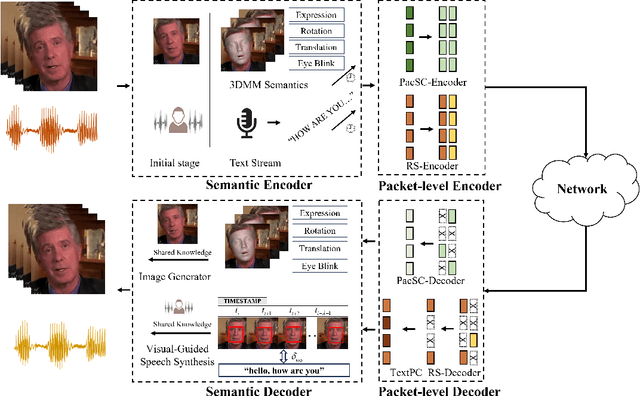

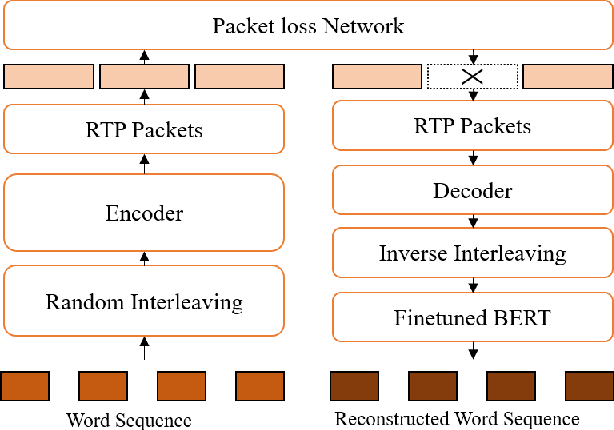
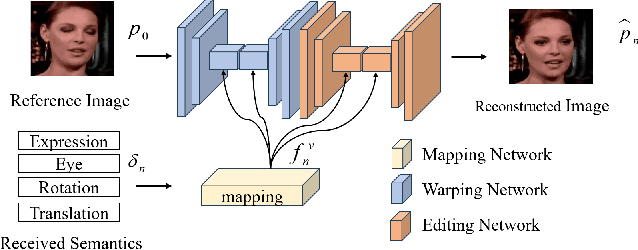
Although the semantic communication with joint semantic-channel coding design has shown promising performance in transmitting data of different modalities over physical layer channels, the synchronization and packet-level forward error correction of multimodal semantics have not been well studied. Due to the independent design of semantic encoders, synchronizing multimodal features in both the semantic and time domains is a challenging problem. In this paper, we take the facial video and speech transmission as an example and propose a Synchronous Multimodal Semantic Communication System (SyncSC) with Packet-Level Coding. To achieve semantic and time synchronization, 3D Morphable Mode (3DMM) coefficients and text are transmitted as semantics, and we propose a semantic codec that achieves similar quality of reconstruction and synchronization with lower bandwidth, compared to traditional methods. To protect semantic packets under the erasure channel, we propose a packet-Level Forward Error Correction (FEC) method, called PacSC, that maintains a certain visual quality performance even at high packet loss rates. Particularly, for text packets, a text packet loss concealment module, called TextPC, based on Bidirectional Encoder Representations from Transformers (BERT) is proposed, which significantly improves the performance of traditional FEC methods. The simulation results show that our proposed SyncSC reduce transmission overhead and achieve high-quality synchronous transmission of video and speech over the packet loss network.