 Add to Chrome
 Add to Firefox
 Add to Edge
3SPO: State-Score-Supervised Policy Optimization for LLM Agents
Jun 08, 2026
Training large language models (LLMs) as autonomous agents via reinforcement learning (RL) has enabled frontier models to achieve superhuman performance in long-horizon tasks. However, existing RL algorithms operate at the trajectory level, performing policy optimization only after collecting complete episode rollouts. This coarse-grained approach faces fundamental challenges in multi-turn agent settings where rewards are sparse, delayed, and credit assignment across individual steps is critical. In this work, we propose \textbf{State-Score-Supervised Policy Optimization (3SPO)}, a novel RL algorithm that performs post-step policy optimization with dynamic state score supervision. At each step, 3SPO computes the state score based on historical success rates, supervising step-wise credit assignment, adaptive rollout and post-step policy optimization without requiring value function estimation or additional auxiliary models. Theoretically, under a per-state bandit abstraction, we show that the proposed score-supervised allocation mechanism achieves logarithmic allocation regret and provide sample-complexity guarantees for action identification, score distinguishability, and filtering stability. Experiments on ALFWorld and WebShop with Qwen2.5-1.5B/7B-Instruct show that 3SPO consistently outperforms GRPO by $+22.6\%$ on ALFWorld and $+15.6$ points on WebShop, while using comparable resources to achieve $2.4\times$ more state exploration and $1.8\times$ faster convergence. Code is available at https://github.com/genalyu/3SPO.

GENEVIC: GENetic data Exploration and Visualization via Intelligent interactive Console
Apr 04, 2024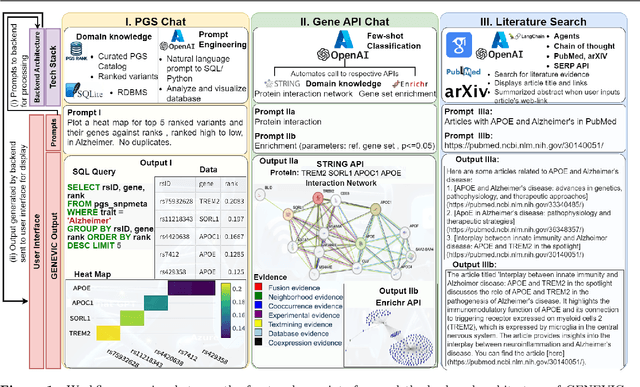

Summary: The vast generation of genetic data poses a significant challenge in efficiently uncovering valuable knowledge. Introducing GENEVIC, an AI-driven chat framework that tackles this challenge by bridging the gap between genetic data generation and biomedical knowledge discovery. Leveraging generative AI, notably ChatGPT, it serves as a biologist's 'copilot'. It automates the analysis, retrieval, and visualization of customized domain-specific genetic information, and integrates functionalities to generate protein interaction networks, enrich gene sets, and search scientific literature from PubMed, Google Scholar, and arXiv, making it a comprehensive tool for biomedical research. In its pilot phase, GENEVIC is assessed using a curated database that ranks genetic variants associated with Alzheimer's disease, schizophrenia, and cognition, based on their effect weights from the Polygenic Score Catalog, thus enabling researchers to prioritize genetic variants in complex diseases. GENEVIC's operation is user-friendly, accessible without any specialized training, secured by Azure OpenAI's HIPAA-compliant infrastructure, and evaluated for its efficacy through real-time query testing. As a prototype, GENEVIC is set to advance genetic research, enabling informed biomedical decisions. Availability and implementation: GENEVIC is publicly accessible at https://genevic-anath2024.streamlit.app. The underlying code is open-source and available via GitHub at https://github.com/anath2110/GENEVIC.git.