 Add to Chrome
 Add to Firefox
 Add to Edge
CSG-Mamba: A Convolutional Scoring Gating Vision State Space Network for Endoscopic Polyp Segmentation
Aug 14, 2026
Accurate polyp segmentation is critical for computer-aided colonoscopy, yet endoscopic images often contain low-contrast boundaries, mucosal texture interference, specular highlights, and device-dependent appearance shifts. Vision State Space Models (SSMs) provide efficient long-range modeling with linear complexity, but existing Vision Mamba segmentation models typically convert 2D features into 1D scanning sequences, which may weaken local geometric continuity and over-smooth irregular contours. We propose CSG-Mamba, a convolutional scoring gating Vision State Space network for endoscopic polyp segmentation. Built on a VM-UNet-style asymmetric U-shaped encoder-decoder, CSG-Mamba inserts a Convolutional Scoring Gating (CSG) module at the semantically rich bottleneck. CSG generates a local spatial score map through pointwise and large-kernel depthwise convolutions and recalibrates state-space features by multiplicative gating. Experiments with three random seeds show that CSG-Mamba achieves 0.9220 Dice and 15.87 HD95 on Kvasir-SEG, and 0.7418 Dice and 0.6570 mIoU on CVC-ColonDB, outperforming the baselines on most overlap and recall metrics while maintaining competitive boundary accuracy.

SRE-FER: Regional residual evidence learning for mitigating local evidence dilution in fine-grained facial expression recognition
Aug 09, 2026Fine-grained facial expression recognition (FER) hinges on capturing subtle muscular cues that distinguish adjacent emotions. Yet capturing these cues presents a dilemma. Detector-based methods depend on fragile landmark pipelines, whereas we find that directly transferring foundation models such as DINOv3 under conventional global readouts can cause local evidence dilution: early global aggregation washes out sparse muscular signals and leaves persistent confusion between categories such as fear/surprise and sad/neutral. To recover this evidence, we propose SRE-FER, a readout-level regional residual evidence learning framework. Its core module, RERA, adds zero-initialized residual logits that refine class boundaries while preserving the backbone's global prediction. Training-time action unit (AU) guidance steers regional features toward expression-relevant areas using Facial Action Coding System (FACS)-based anatomical priors, without requiring an external facial pipeline at inference. An optional Full setting further routes sample-specific non-redundant tokens. On three benchmarks, SRE-FER attains 92.76% on RAF-DB, 91.32% on FERPlus, and 67.78% on AffectNet-7, demonstrating highly competitive performance compared to existing FER methods.
Geometric ergodicity of SGLD via reflection coupling
Jan 17, 2023We consider the geometric ergodicity of the Stochastic Gradient Langevin Dynamics (SGLD) algorithm under nonconvexity settings. Via the technique of reflection coupling, we prove the Wasserstein contraction of SGLD when the target distribution is log-concave only outside some compact set. The time discretization and the minibatch in SGLD introduce several difficulties when applying the reflection coupling, which are addressed by a series of careful estimates of conditional expectations. As a direct corollary, the SGLD with constant step size has an invariant distribution and we are able to obtain its geometric ergodicity in terms of $W_1$ distance. The generalization to non-gradient drifts is also included.
A sharp uniform-in-time error estimate for Stochastic Gradient Langevin Dynamics
Jul 19, 2022We establish a sharp uniform-in-time error estimate for the Stochastic Gradient Langevin Dynamics (SGLD), which is a popular sampling algorithm. Under mild assumptions, we obtain a uniform-in-time $O(\eta^2)$ bound for the KL-divergence between the SGLD iteration and the Langevin diffusion, where $\eta$ is the step size (or learning rate). Our analysis is also valid for varying step sizes. Based on this, we are able to obtain an $O(\eta)$ bound for the distance between the SGLD iteration and the invariant distribution of the Langevin diffusion, in terms of Wasserstein or total variation distances.
On uniform-in-time diffusion approximation for stochastic gradient descent
Jul 11, 2022The diffusion approximation of stochastic gradient descent (SGD) in current literature is only valid on a finite time interval. In this paper, we establish the uniform-in-time diffusion approximation of SGD, by only assuming that the expected loss is strongly convex and some other mild conditions, without assuming the convexity of each random loss function. The main technique is to establish the exponential decay rates of the derivatives of the solution to the backward Kolmogorov equation. The uniform-in-time approximation allows us to study asymptotic behaviors of SGD via the continuous stochastic differential equation (SDE) even when the random objective function $f(\cdot;\xi)$ is not strongly convex.
Topic-aware chatbot using Recurrent Neural Networks and Nonnegative Matrix Factorization
Dec 04, 2019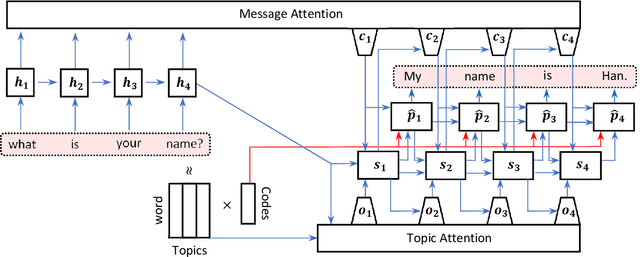

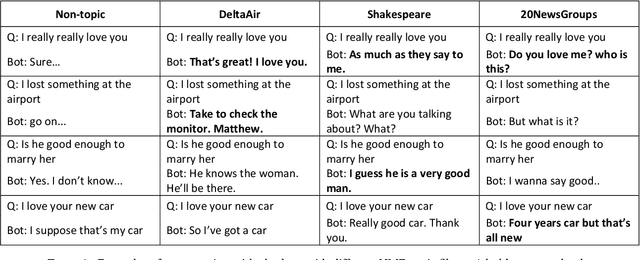
We propose a novel model for a topic-aware chatbot by combining the traditional Recurrent Neural Network (RNN) encoder-decoder model with a topic attention layer based on Nonnegative Matrix Factorization (NMF). After learning topic vectors from an auxiliary text corpus via NMF, the decoder is trained so that it is more likely to sample response words from the most correlated topic vectors. One of the main advantages in our architecture is that the user can easily switch the NMF-learned topic vectors so that the chatbot obtains desired topic-awareness. We demonstrate our model by training on a single conversational data set which is then augmented with topic matrices learned from different auxiliary data sets. We show that our topic-aware chatbot not only outperforms the non-topic counterpart, but also that each topic-aware model qualitatively and contextually gives the most relevant answer depending on the topic of question.