 Add to Chrome
 Add to Firefox
 Add to Edge
Verifiable Knowledge Expansion through Retrieval-Grounded Formal Concept Analysis
Jul 02, 2026
Ontology construction requires deciding which objects, attributes, and structural relations should be accepted as valid knowledge. Language models can propose such structures from text, but their outputs can still be unsupported or inconsistent. This paper proposes a retrieval-augmented small language model (SLM) framework that uses formal concept analysis (FCA) as a symbolic verification loop for knowledge expansion. Starting from seed attributes, FCA proposes implications over a growing formal context. A retrieval-grounded SLM oracle then validates each implication or returns a counterexample. The oracle also supports incidence judgments, consistency checks, and attribute proposals, making accepted implications, counterexamples, contradictions, and corrections inspectable. In a rare ataxia setting constructed from Orphadata resources, retrieval-grounded 10-seed runs obtain relation F1 of 0.29-0.52 and closure-based implication F1 of 0.22-0.30. Larger seed sets increase the number of evaluated implications and often improve implication F1. The lower implication scores reflect a stricter evaluation of derived implications, where one missed or extra relation can affect several implication judgments. Ablations show that incidence judgments in a fixed object-attribute setting can improve closure-based implication scores. However, identifying positive object-attribute pairs remains difficult even when the candidate objects and attributes are fixed.

Detecting AI-Generated Videos with Spiking Neural Networks
May 07, 2026Modern AI-generated videos are photorealistic at the single-frame level, leaving inter-frame dynamics as the main remaining axis for detection. Existing detectors typically handle this temporal evidence in three ways: feeding the full frame sequence to a generic temporal backbone, reducing one dominant temporal cue to fixed video-level descriptors, or comparing temporal features to real-video statistics through a detection metric. These strategies degrade sharply under cross-generator evaluation, where artifact type and timescale vary across generators. On caption-paired benchmark, GenVidBench, we identify two signatures that prior detectors do not jointly exploit: AI-generated videos exhibit smoother frame-to-frame temporal residuals at the pixel level, and more compact trajectories in the semantic feature space, indicating a temporal smoothness gap at both levels. We further observe that, when raw video is fed into a Spiking Neural Networks (SNNs), fake clips elicit firing predominantly at object and motion boundaries, unlike real clips, suggesting that the SNN responds to temporal artifacts localized at edges. These cues are sparse, asynchronous, and concentrated at moments of change, which makes SNNs a natural choice for this task: their event-driven, sparsely-activated dynamics align with the structure of the residual signal in a way that dense ANN backbones do not. Building on this observation, we propose MAST, a detector that processes multi-channel temporal residuals with a spike-driven temporal branch alongside a frozen semantic encoder for cross-generator generalization. On the GenVideo benchmark, MAST achieves 93.14\% mean accuracy across 10 unseen generators under strict cross-generator evaluation, matching or surpassing the strongest ANN-based detectors and demonstrating the practical applicability of SNNs to AI-generated video detection.
MARC: Multimodal and Multi-Task Agentic Retrieval-Augmented Generation for Cold-Start Recommender System
Nov 15, 2025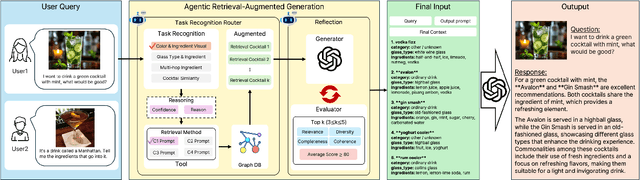
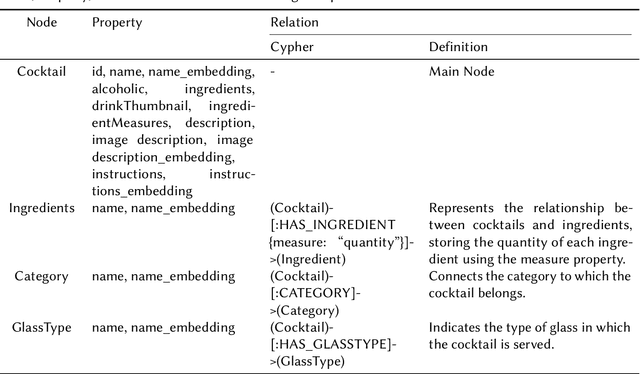
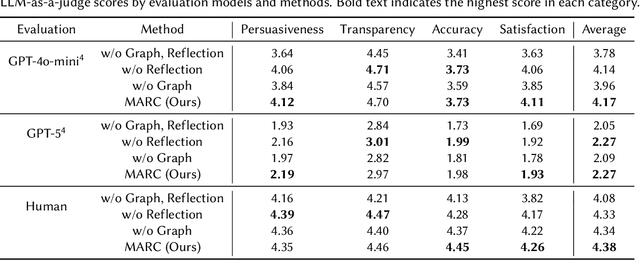
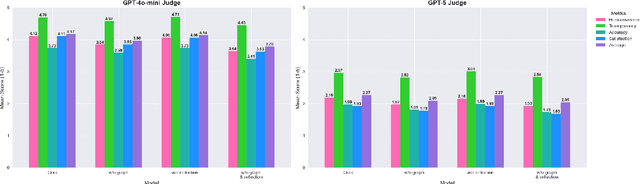
Recommender systems (RS) are currently being studied to mitigate limitations during cold-start conditions by leveraging modality information or introducing Agent concepts based on the exceptional reasoning capabilities of Large Language Models (LLMs). Meanwhile, food and beverage recommender systems have traditionally used knowledge graph and ontology concepts due to the domain's unique data attributes and relationship characteristics. On this background, we propose MARC, a multimodal and multi-task cocktail recommender system based on Agentic Retrieval-Augmented Generation (RAG) utilizing graph database under cold-start conditions. The proposed system generates high-quality, contextually appropriate answers through two core processes: a task recognition router and a reflection process. The graph database was constructed by processing cocktail data from Kaggle, and its effectiveness was evaluated using 200 manually crafted questions. The evaluation used both LLM-as-a-judge and human evaluation to demonstrate that answers generated via the graph database outperformed those from a simple vector database in terms of quality. The code is available at https://github.com/diddbwls/cocktail_rec_agentrag
Refusal-Feature-guided Teacher for Safe Finetuning via Data Filtering and Alignment Distillation
Jun 09, 2025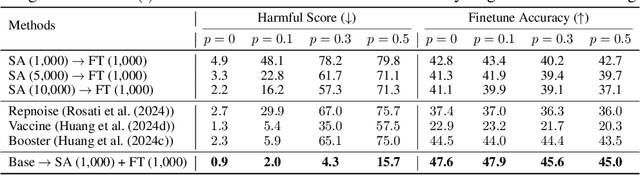
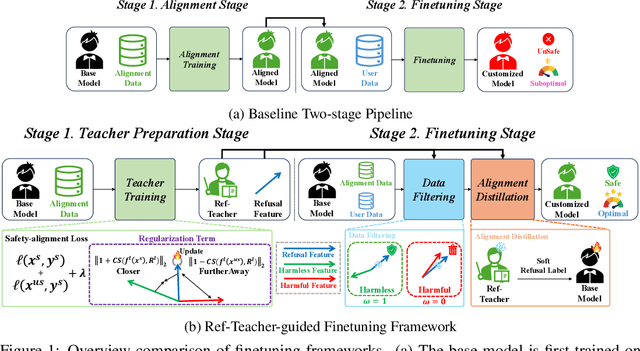
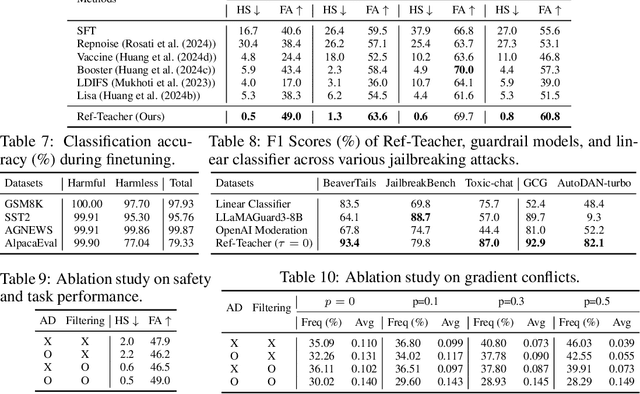

Recently, major AI service providers such as Google and OpenAI have introduced Finetuning-as-a-Service, which enables users to customize Large Language Models (LLMs) for specific downstream tasks using their own data. However, this service is vulnerable to degradation of LLM safety-alignment when user data contains harmful prompts. While some prior works address this issue, fundamentally filtering harmful data from user data remains unexplored. Motivated by our observation that a directional representation reflecting refusal behavior (called the refusal feature) obtained from safety-aligned LLMs can inherently distinguish between harmful and harmless prompts, we propose the Refusal-Feature-guided Teacher (ReFT). Our ReFT model is trained to identify harmful prompts based on the similarity between input prompt features and its refusal feature. During finetuning, the ReFT model serves as a teacher that filters harmful prompts from user data and distills alignment knowledge into the base model. Extensive experiments demonstrate that our ReFT-based finetuning strategy effectively minimizes harmful outputs and enhances finetuning accuracy for user-specific tasks, offering a practical solution for secure and reliable deployment of LLMs in Finetuning-as-a-Service.