 Add to Chrome
 Add to Firefox
 Add to Edge
Verifiable Knowledge Expansion through Retrieval-Grounded Formal Concept Analysis
Jul 02, 2026
Ontology construction requires deciding which objects, attributes, and structural relations should be accepted as valid knowledge. Language models can propose such structures from text, but their outputs can still be unsupported or inconsistent. This paper proposes a retrieval-augmented small language model (SLM) framework that uses formal concept analysis (FCA) as a symbolic verification loop for knowledge expansion. Starting from seed attributes, FCA proposes implications over a growing formal context. A retrieval-grounded SLM oracle then validates each implication or returns a counterexample. The oracle also supports incidence judgments, consistency checks, and attribute proposals, making accepted implications, counterexamples, contradictions, and corrections inspectable. In a rare ataxia setting constructed from Orphadata resources, retrieval-grounded 10-seed runs obtain relation F1 of 0.29-0.52 and closure-based implication F1 of 0.22-0.30. Larger seed sets increase the number of evaluated implications and often improve implication F1. The lower implication scores reflect a stricter evaluation of derived implications, where one missed or extra relation can affect several implication judgments. Ablations show that incidence judgments in a fixed object-attribute setting can improve closure-based implication scores. However, identifying positive object-attribute pairs remains difficult even when the candidate objects and attributes are fixed.

MARC: Multimodal and Multi-Task Agentic Retrieval-Augmented Generation for Cold-Start Recommender System
Nov 15, 2025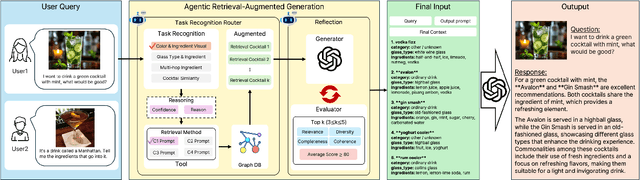
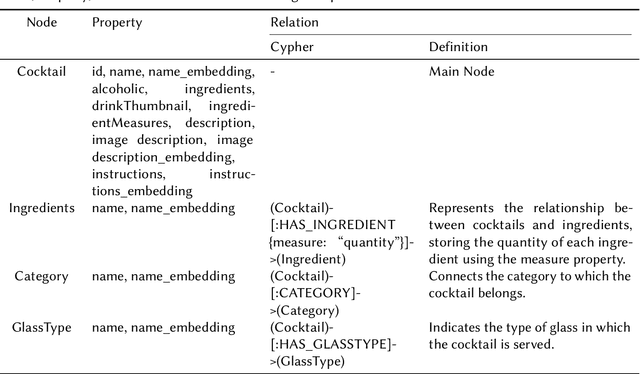
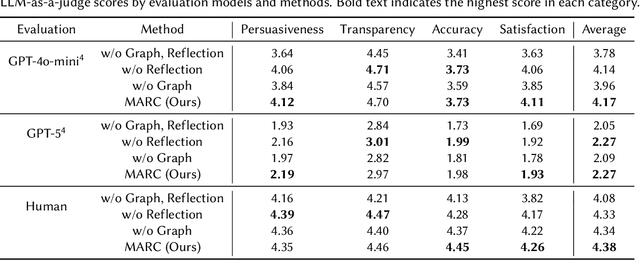
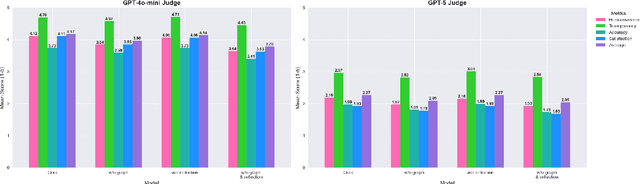
Recommender systems (RS) are currently being studied to mitigate limitations during cold-start conditions by leveraging modality information or introducing Agent concepts based on the exceptional reasoning capabilities of Large Language Models (LLMs). Meanwhile, food and beverage recommender systems have traditionally used knowledge graph and ontology concepts due to the domain's unique data attributes and relationship characteristics. On this background, we propose MARC, a multimodal and multi-task cocktail recommender system based on Agentic Retrieval-Augmented Generation (RAG) utilizing graph database under cold-start conditions. The proposed system generates high-quality, contextually appropriate answers through two core processes: a task recognition router and a reflection process. The graph database was constructed by processing cocktail data from Kaggle, and its effectiveness was evaluated using 200 manually crafted questions. The evaluation used both LLM-as-a-judge and human evaluation to demonstrate that answers generated via the graph database outperformed those from a simple vector database in terms of quality. The code is available at https://github.com/diddbwls/cocktail_rec_agentrag