 Add to Chrome
 Add to Firefox
 Add to Edge
Who Should Be Generated? Justifying Demographic Targets in Open-Ended Generation
Aug 03, 2026
Fairness evaluation concerns not only what a model produces, but also what its outputs ought to be compared against. When a model generates "a CEO in the United States," the prompt leaves demographic realization to the model. Existing group fairness definitions assume that sensitive attributes are given on the input side. Generative audits instead examine output-side demographic composition, yet the targets they compare it against are typically supplied rather than justified. The upstream question is what the target distribution should be. We formalize this missing-target problem for demographic-value-unspecified generation and decompose target construction into four commitments: the evaluative object, prior admissibility, allocation, and operationalization. In this framework, we admit the geographic prior under a geographic-membership interpretation for the declared public-world use. The occupational prior, under an incumbency interpretation, requires an independently defended objective such as workforce-composition fidelity. Instantiating this construction in AP-Bench, we find substantial distribution divergence from geography-derived targets, ranging from 0.508 to 0.606 on a 0-to-1 scale. Replacing each geography-derived target with an equal-category comparator, while holding generations and measurement fixed, produces model-specific mean absolute cell-level $\mathrm{JSD}_2$ changes ranging from 0.279 to 0.355. Target construction is therefore not a preliminary to fairness evaluation but a component of it. What we supply is not a universal target, but a framework that makes explicit the justification required before a distribution can serve as a fairness standard.

Experience Graphs: The Data Foundation for Self-Improving Agents
Jun 29, 2026The database community has repeatedly advanced the state of the art by recognizing that new workloads demand new system architectures. We argue that long-horizon agentic tasks -- code generation, scientific discovery, hardware design -- are such a workload. These agents explore: they generate artifacts, execute tools, observe failures, branch, and repair over hundreds of steps. This search produces a structured object we call an experience graph: executable artifacts, tool outputs, rewards, sibling comparisons, and causal lineage. Yet existing agent frameworks treat this experience as disposable state -- JSON checkpoints and session logs that cannot be recovered after a crash, queried across users, or materialized into training data. We propose Trellis: a data foundation that treats the experience graph as first-class, governed, queryable database state. The core insight is that search over experience graphs is a database access pattern. Frontier selection is a query, cross-session reuse is vector-seeded graph retrieval, training-data extraction is a materialized view, and reconstructing what an agent knew at any past step is a time-travel query. When the database owns the experience graph, agents become stateless compute, and crash recovery, horizontal scaling, and a closed-loop training flywheel emerge as architectural byproducts. We ground the design in KernelEvolve, a production accelerator-kernel optimizer at Meta, where cross-session reuse reaches a target speedup roughly 10x faster at 52% lower token cost. More broadly, Trellis turns inference-time search from disposable computation into a durable institutional asset: logs made databases reliable; experience graphs may make agents cumulative.
DeepSeek-V3 Technical Report
Dec 27, 2024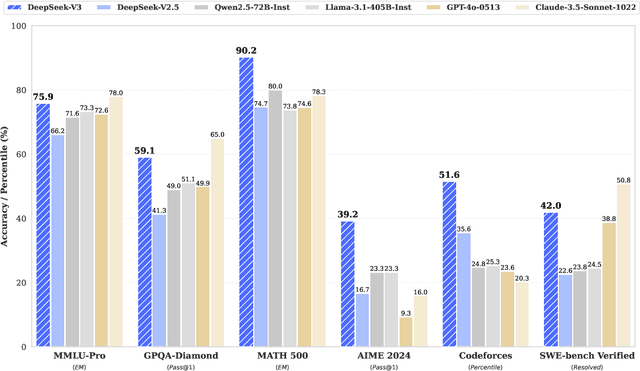


We present DeepSeek-V3, a strong Mixture-of-Experts (MoE) language model with 671B total parameters with 37B activated for each token. To achieve efficient inference and cost-effective training, DeepSeek-V3 adopts Multi-head Latent Attention (MLA) and DeepSeekMoE architectures, which were thoroughly validated in DeepSeek-V2. Furthermore, DeepSeek-V3 pioneers an auxiliary-loss-free strategy for load balancing and sets a multi-token prediction training objective for stronger performance. We pre-train DeepSeek-V3 on 14.8 trillion diverse and high-quality tokens, followed by Supervised Fine-Tuning and Reinforcement Learning stages to fully harness its capabilities. Comprehensive evaluations reveal that DeepSeek-V3 outperforms other open-source models and achieves performance comparable to leading closed-source models. Despite its excellent performance, DeepSeek-V3 requires only 2.788M H800 GPU hours for its full training. In addition, its training process is remarkably stable. Throughout the entire training process, we did not experience any irrecoverable loss spikes or perform any rollbacks. The model checkpoints are available at https://github.com/deepseek-ai/DeepSeek-V3.