 Add to Chrome
 Add to Firefox
 Add to Edge
Earth Embeddings Reveal Diverse Urban Signals from Space
Apr 03, 2026
Conventional urban indicators derived from censuses, surveys, and administrative records are often costly, spatially inconsistent, and slow to update. Recent geospatial foundation models enable Earth embeddings, compact satellite image representations transferable across downstream tasks, but their utility for neighborhood-scale urban monitoring remains unclear. Here, we benchmark three Earth embedding families, AlphaEarth, Prithvi, and Clay, for urban signal prediction across six U.S. metropolitan areas from 2020 to 2023. Using a unified supervised-learning framework, we predict 14 neighborhood-level indicators spanning crime, income, health, and travel behavior, and evaluate performance under four settings: global, city-wise, year-wise, and city-year. Results show that Earth embeddings capture substantial urban variation, with the highest predictive skill for outcomes more directly tied to built-environment structure, including chronic health burdens and dominant commuting modes. By contrast, indicators shaped more strongly by fine-scale behavior and local policy, such as cycling, remain difficult to infer. Predictive performance varies markedly across cities but remains comparatively stable across years, indicating strong spatial heterogeneity alongside temporal robustness. Exploratory analysis suggests that cross-city variation in predictive performance is associated with urban form in task-specific ways. Controlled dimensionality experiments show that representation efficiency is critical: compact 64-dimensional AlphaEarth embeddings remain more informative than 64-dimensional reductions of Prithvi and Clay. This study establishes a benchmark for evaluating Earth embeddings in urban remote sensing and demonstrates their potential as scalable, low-cost features for SDG-aligned neighborhood-scale urban monitoring.

GeoTransformer: Enhancing Urban Forecasting with Geospatial Attention Mechanisms
Aug 16, 2024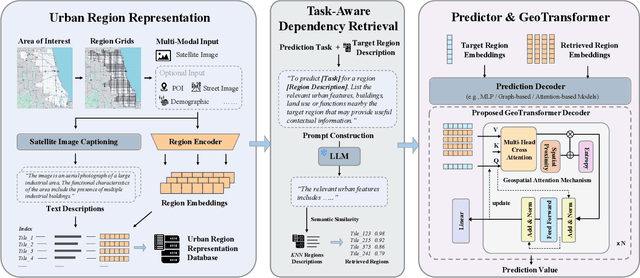
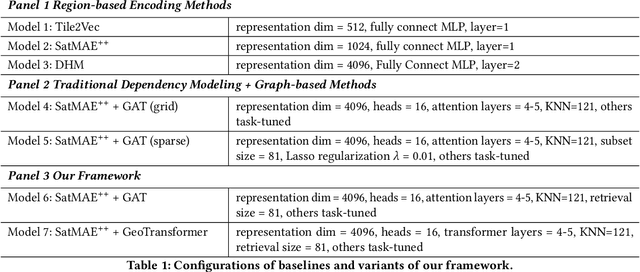
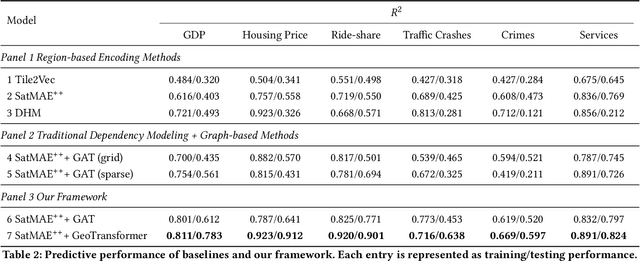

Recent advancements have focused on encoding urban spatial information into high-dimensional spaces, with notable efforts dedicated to integrating sociodemographic data and satellite imagery. These efforts have established foundational models in this field. However, the effective utilization of these spatial representations for urban forecasting applications remains under-explored. To address this gap, we introduce GeoTransformer, a novel structure that synergizes the Transformer architecture with geospatial statistics prior. GeoTransformer employs an innovative geospatial attention mechanism to incorporate extensive urban information and spatial dependencies into a unified predictive model. Specifically, we compute geospatial weighted attention scores between the target region and surrounding regions and leverage the integrated urban information for predictions. Extensive experiments on GDP and ride-share demand prediction tasks demonstrate that GeoTransformer significantly outperforms existing baseline models, showcasing its potential to enhance urban forecasting tasks.
DivCon: Divide and Conquer for Progressive Text-to-Image Generation
Mar 11, 2024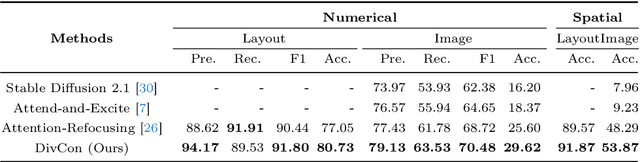
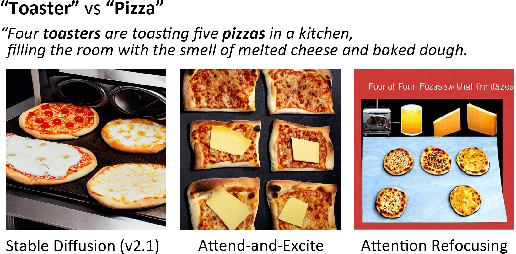
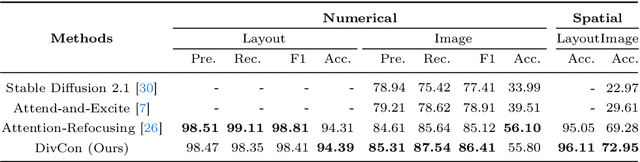
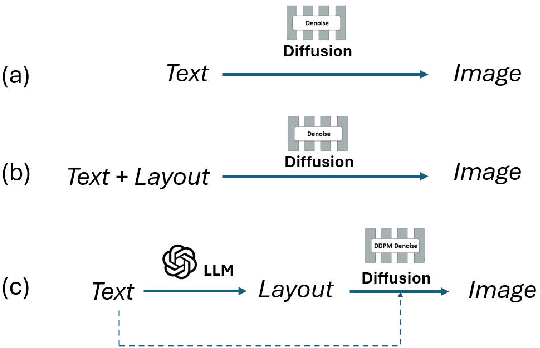
Diffusion-driven text-to-image (T2I) generation has achieved remarkable advancements. To further improve T2I models' capability in numerical and spatial reasoning, the layout is employed as an intermedium to bridge large language models and layout-based diffusion models. However, these methods still struggle with generating images from textural prompts with multiple objects and complicated spatial relationships. To tackle this challenge, we introduce a divide-and-conquer approach which decouples the T2I generation task into simple subtasks. Our approach divides the layout prediction stage into numerical \& spatial reasoning and bounding box prediction. Then, the layout-to-image generation stage is conducted in an iterative manner to reconstruct objects from easy ones to difficult ones. We conduct experiments on the HRS and NSR-1K benchmarks and our approach outperforms previous state-of-the-art models with notable margins. In addition, visual results demonstrate that our approach significantly improves the controllability and consistency in generating multiple objects from complex textural prompts.