 Add to Chrome
 Add to Firefox
 Add to Edge
Estimating the Black-box LLM Uncertainty with Distribution-Aligned Adversarial Distillation
May 07, 2026
Large language models (LLMs) have progressed rapidly in complex reasoning and question answering, yet LLM hallucination remains a central bottleneck that hinders practical deployment, especially for commercial black-box LLMs accessible only via APIs. Existing uncertainty quantification methods typically depend on computationally expensive multiple sampling or internal parameters, which prevents real-time estimation and fails to capture information implicit in the black-box reasoning process. To address this issue, we propose Distribution-Aligned Adversarial Distillation (DisAAD), which introduces a generation-discrimination architecture to guide a lightweight proxy model to learn the high-quality regions of the output distribution of the black-box LLM, thus effectively endowing it with the ability to know whether the black-box LLM knows or not. Subsequently, we use the proxy model to reproduce the specific responses of the black-box LLM and estimate the corresponding uncertainty based on evidence learning. Extensive experiments have verified the effectiveness and promise of our proposed method, indicating that a proxy model even one that only accounts for 1\% of the target LLM's size can achieve reliable uncertainty quantification.

FID-Net: A Feature-Enhanced Deep Learning Network for Forest Infestation Detection
Dec 15, 2025Forest pests threaten ecosystem stability, requiring efficient monitoring. To overcome the limitations of traditional methods in large-scale, fine-grained detection, this study focuses on accurately identifying infected trees and analyzing infestation patterns. We propose FID-Net, a deep learning model that detects pest-affected trees from UAV visible-light imagery and enables infestation analysis via three spatial metrics. Based on YOLOv8n, FID-Net introduces a lightweight Feature Enhancement Module (FEM) to extract disease-sensitive cues, an Adaptive Multi-scale Feature Fusion Module (AMFM) to align and fuse dual-branch features (RGB and FEM-enhanced), and an Efficient Channel Attention (ECA) mechanism to enhance discriminative information efficiently. From detection results, we construct a pest situation analysis framework using: (1) Kernel Density Estimation to locate infection hotspots; (2) neighborhood evaluation to assess healthy trees' infection risk; (3) DBSCAN clustering to identify high-density healthy clusters as priority protection zones. Experiments on UAV imagery from 32 forest plots in eastern Tianshan, China, show that FID-Net achieves 86.10% precision, 75.44% recall, 82.29% mAP@0.5, and 64.30% mAP@0.5:0.95, outperforming mainstream YOLO models. Analysis confirms infected trees exhibit clear clustering, supporting targeted forest protection. FID-Net enables accurate tree health discrimination and, combined with spatial metrics, provides reliable data for intelligent pest monitoring, early warning, and precise management.
Automatic marker-free registration based on similar tetrahedras for single-tree point clouds
Nov 20, 2024

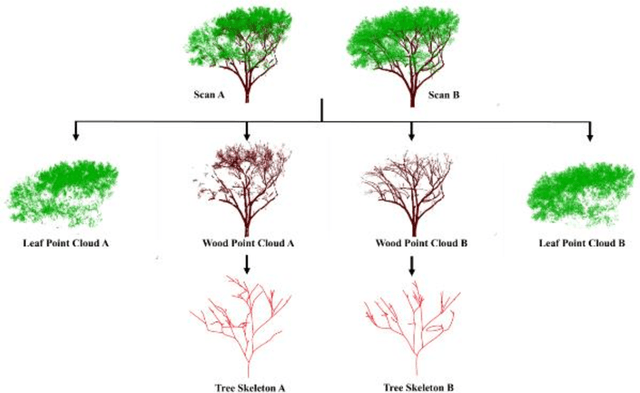

In recent years, terrestrial laser scanning technology has been widely used to collect tree point cloud data, aiding in measurements of diameter at breast height, biomass, and other forestry survey data. Since a single scan from terrestrial laser systems captures data from only one angle, multiple scans must be registered and fused to obtain complete tree point cloud data. This paper proposes a marker-free automatic registration method for single-tree point clouds based on similar tetrahedras. First, two point clouds from two scans of the same tree are used to generate tree skeletons, and key point sets are constructed from these skeletons. Tetrahedra are then filtered and matched according to similarity principles, with the vertices of these two matched tetrahedras selected as matching point pairs, thus completing the coarse registration of the point clouds from the two scans. Subsequently, the ICP method is applied to the coarse-registered leaf point clouds to obtain fine registration parameters, completing the precise registration of the two tree point clouds. Experiments were conducted using terrestrial laser scanning data from eight trees, each from different species and with varying shapes. The proposed method was evaluated using RMSE and Hausdorff distance, compared against the traditional ICP and NDT methods. The experimental results demonstrate that the proposed method significantly outperforms both ICP and NDT in registration accuracy, achieving speeds up to 593 times and 113 times faster than ICP and NDT, respectively. In summary, the proposed method shows good robustness in single-tree point cloud registration, with significant advantages in accuracy and speed compared to traditional ICP and NDT methods, indicating excellent application prospects in practical registration scenarios.
WLC-Net: a robust and fast deep-learning wood-leaf classification method
May 29, 2024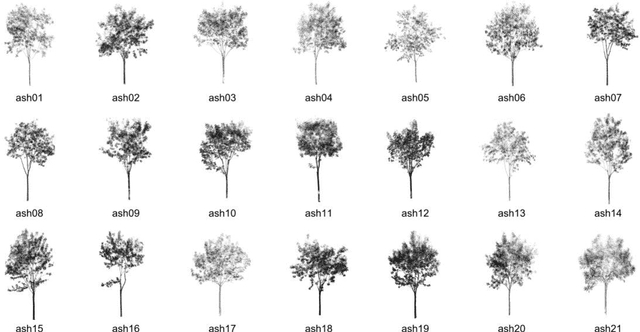
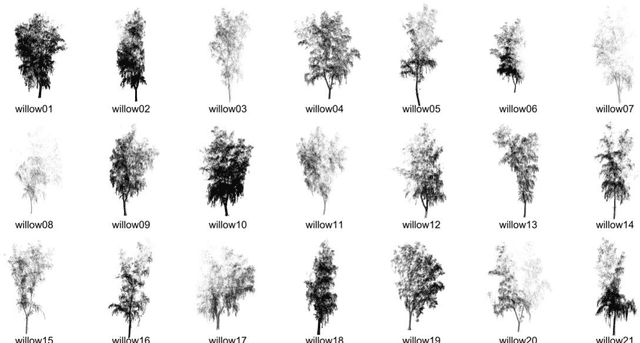
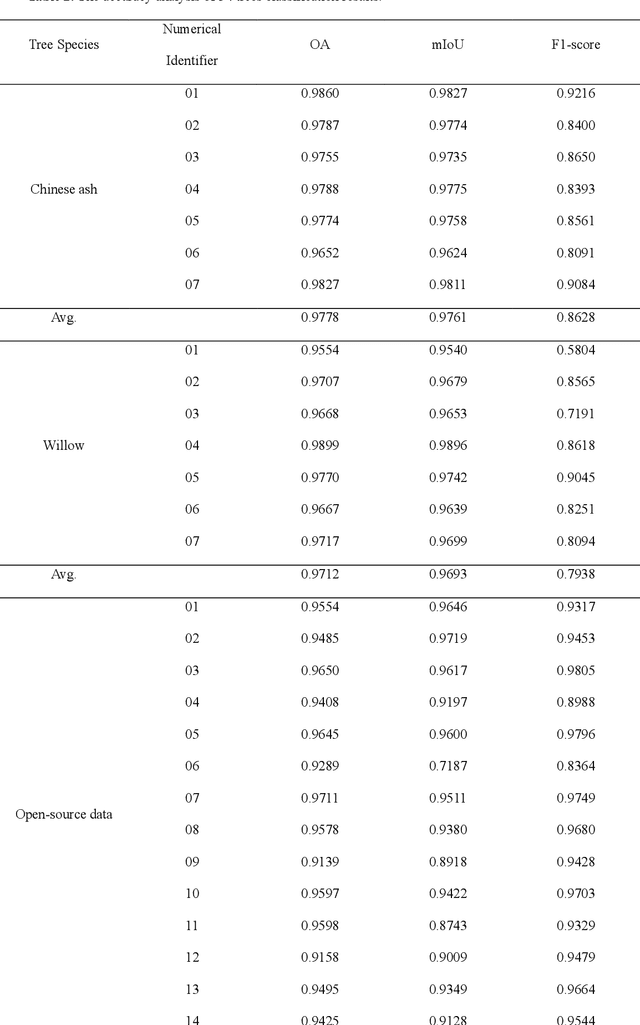
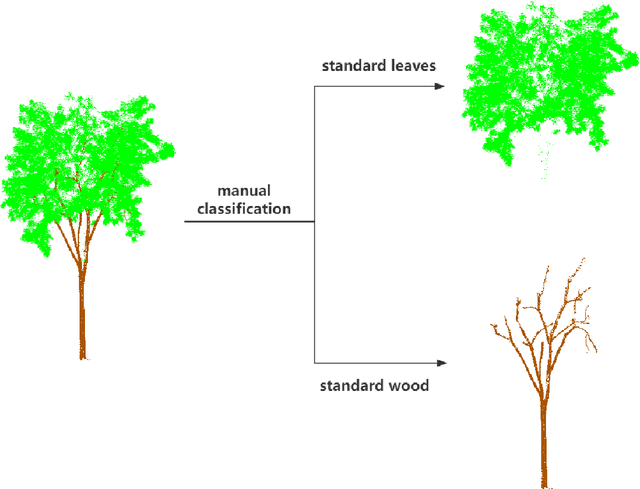
Wood-leaf classification is an essential and fundamental prerequisite in the analysis and estimation of forest attributes from terrestrial laser scanning (TLS) point clouds,including critical measurements such as diameter at breast height(DBH),above-ground biomass(AGB),wood volume.To address this,we introduce the Wood-Leaf Classification Network(WLC-Net),a deep learning model derived from PointNet++,designed to differentiate between wood and leaf points within tree point clouds.WLC-Net enhances classification accuracy,completeness,and speed by incorporating linearity as an inherent feature,refining the input-output framework,and optimizing the centroid sampling technique.WLC-Net was trained and assessed using three distinct tree species datasets,comprising a total of 102 individual tree point clouds:21 Chinese ash trees,21 willow trees,and 60 tropical trees.For comparative evaluation,five alternative methods,including PointNet++,DGCNN,Krishna Moorthy's method,LeWoS, and Sun's method,were also applied to these datasets.The classification accuracy of all six methods was quantified using three metrics:overall accuracy(OA),mean Intersection over Union(mIoU),and F1-score.Across all three datasets,WLC-Net demonstrated superior performance, achieving OA scores of 0.9778, 0.9712, and 0.9508;mIoU scores of 0.9761, 0.9693,and 0.9141;and F1-scores of 0.8628, 0.7938,and 0.9019,respectively.The time costs of WLC-Net were also recorded to evaluate the efficiency.The average processing time was 102.74s per million points for WLC-Net.In terms of visual inspect,accuracy evaluation and efficiency evaluation,the results suggest that WLC-Net presents a promising approach for wood-leaf classification,distinguished by its high accuracy. In addition,WLC-Net also exhibits strong applicability across various tree point clouds and holds promise for further optimization.