 Add to Chrome
 Add to Firefox
 Add to Edge
Free Lunch in Medical Image Foundation Model Pre-training via Randomized Synthesis and Disentanglement
Feb 12, 2026
Medical image foundation models (MIFMs) have demonstrated remarkable potential for a wide range of clinical tasks, yet their development is constrained by the scarcity, heterogeneity, and high cost of large-scale annotated datasets. Here, we propose RaSD (Randomized Synthesis and Disentanglement), a scalable framework for pre-training MIFMs entirely on synthetic data. By modeling anatomical structures and appearance variations with randomized Gaussian distributions, RaSD exposes models to sufficient multi-scale structural and appearance perturbations, forcing them to rely on invariant and task-relevant anatomical cues rather than dataset-specific textures, thereby enabling robust and transferable representation learning. We pre-trained RaSD on 1.2 million 3D volumes and 9.6 million 2D images, and extensively evaluated the resulting models across 6 imaging modalities, 48 datasets, and 56 downstream tasks. Across all evaluated downstream tasks, RaSD consistently outperforms training-from-scratch models, achieves the best performance on 17 tasks, and remains comparable to models pre-trained on large real datasets in most others. These results demonstrate that the capacity of synthetic data alone to drive robust representation learning. Our findings establish a paradigm shift in medical AI, demonstrating that synthetic data can serve as a "free lunch" for scalable, privacy-preserving, and clinically generalizable foundation models.

Overview of the CAIL 2023 Argument Mining Track
Jun 20, 2024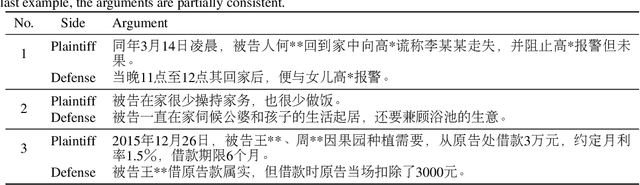
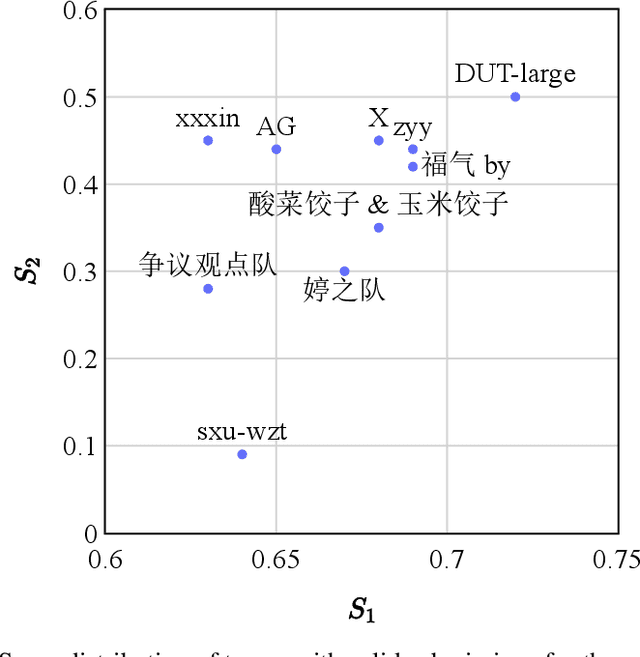
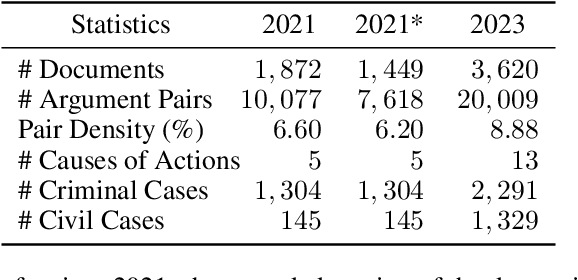
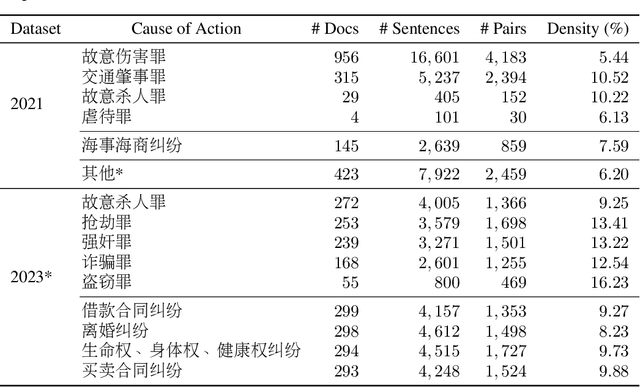
We give a detailed overview of the CAIL 2023 Argument Mining Track, one of the Chinese AI and Law Challenge (CAIL) 2023 tracks. The main goal of the track is to identify and extract interacting argument pairs in trial dialogs. It mainly uses summarized judgment documents but can also refer to trial recordings. The track consists of two stages, and we introduce the tasks designed for each stage; we also extend the data from previous events into a new dataset -- CAIL2023-ArgMine -- with annotated new cases from various causes of action. We outline several submissions that achieve the best results, including their methods for different stages. While all submissions rely on language models, they have incorporated strategies that may benefit future work in this field.