 Add to Chrome
 Add to Firefox
 Add to Edge
DINO-Explorer: Active Underwater Discovery via Ego-Motion Compensated Semantic Predictive Coding
Apr 14, 2026
Marine ecosystem degradation necessitates continuous, scientifically selective underwater monitoring. However, most autonomous underwater vehicles (AUVs) operate as passive data loggers, capturing exhaustive video for offline review and frequently missing transient events of high scientific value. Transitioning to active perception requires a causal, online signal that highlights significant phenomena while suppressing maneuver-induced visual changes. We propose DINO-Explorer, a novelty-aware perception framework driven by a continuous semantic surprise signal. Operating within the latent space of a frozen DINOv3 foundation model, it leverages a lightweight, action-conditioned recurrent predictor to anticipate short-horizon semantic evolution. An efference-copy-inspired module utilizes globally pooled optical flow to discount self-induced visual changes without suppressing genuine environmental novelty. We evaluate this signal on the downstream task of asynchronous event triage under variant telemetry constraints. Results demonstrate that DINO-Explorer provides a robust, bandwidth-efficient attention mechanism. At a fixed operating point, the system retains 78.8% of post-discovery human-reviewer consensus events with a 56.8% trigger confirmation rate, effectively surfacing mission-relevant phenomena. Crucially, ego-motion conditioning suppresses 45.5% of false positives relative to an uncompensated surprise signal baseline. In a replay-side Pareto ablation study, DINO-Explorer robustly dominates the validated peak F1 versus telemetry bandwidth frontier, reducing telemetry bandwidth by 48.2% at the selected operating point while maintaining a 62.2% peak F1 score, successfully concentrating data transmission around human-verified novelty events.

I2CANSAY:Inter-Class Analogical Augmentation and Intra-Class Significance Analysis for Non-Exemplar Online Task-Free Continual Learning
Apr 21, 2024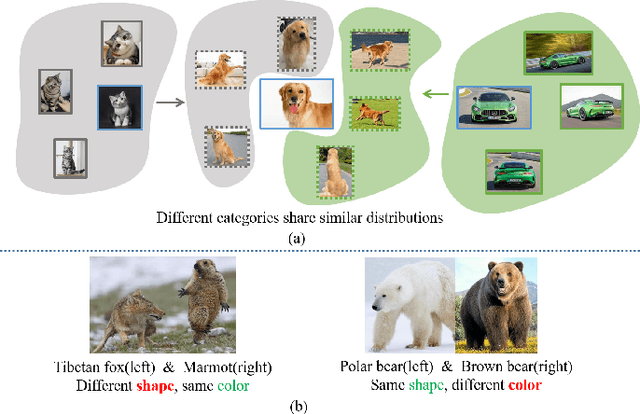
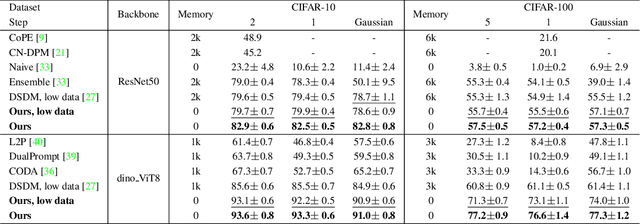
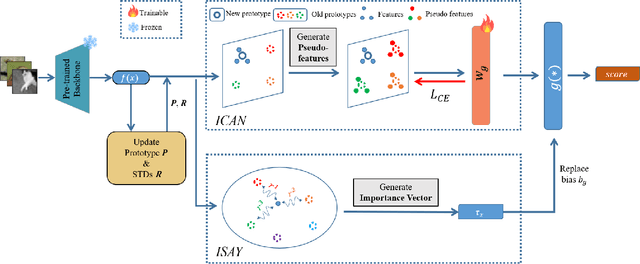
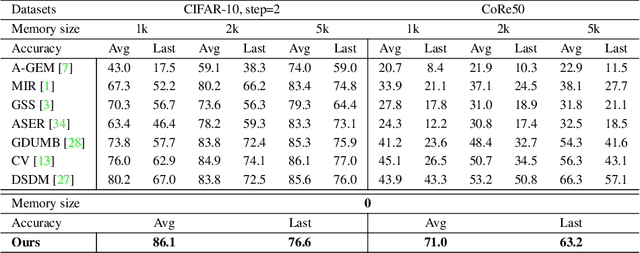
Online task-free continual learning (OTFCL) is a more challenging variant of continual learning which emphasizes the gradual shift of task boundaries and learns in an online mode. Existing methods rely on a memory buffer composed of old samples to prevent forgetting. However,the use of memory buffers not only raises privacy concerns but also hinders the efficient learning of new samples. To address this problem, we propose a novel framework called I2CANSAY that gets rid of the dependence on memory buffers and efficiently learns the knowledge of new data from one-shot samples. Concretely, our framework comprises two main modules. Firstly, the Inter-Class Analogical Augmentation (ICAN) module generates diverse pseudo-features for old classes based on the inter-class analogy of feature distributions for different new classes, serving as a substitute for the memory buffer. Secondly, the Intra-Class Significance Analysis (ISAY) module analyzes the significance of attributes for each class via its distribution standard deviation, and generates the importance vector as a correction bias for the linear classifier, thereby enhancing the capability of learning from new samples. We run our experiments on four popular image classification datasets: CoRe50, CIFAR-10, CIFAR-100, and CUB-200, our approach outperforms the prior state-of-the-art by a large margin.