 Add to Chrome
 Add to Firefox
 Add to Edge
SrDetection: A Self-Referential Framework for Data Leakage Detection in Code Large Language Models
Jun 29, 2026
Evaluating code large language models (Code LLMs) requires reliable detection of data leakage, where benchmark performance is artificially inflated by exposure to benchmark data during pre-training. Existing approaches either assume access to proprietary training corpora, rely on brittle heuristics such as timestamp filtering, or use external reference sets with manually tuned, non-generalizable thresholds. To address these limitations, we introduce \textbf{SrDetection}, a unified \textbf{s}elf-\textbf{r}eferential leakage detection framework for both gray-box (access to model logits) and black-box (access to model outputs) settings. SrDetection generates semantically equivalent variants of a benchmark sample and detects leakage by contrasting the model's behavior on the original versus its variants, flagging cases where the original is disproportionately easier for the model. We further design a controlled leakage detection testbed and evaluate SrDetection in this environment. Across different models and training stages, SrDetection improves average F1 by 21.52 points in the gray-box setting and 14.46 points in the black-box setting over strong baselines, demonstrating robust, threshold-independent leakage detection. Finally, a gray-box study of 15 widely used Code LLMs on four popular benchmarks reveals benchmark-specific leakage patterns beyond prior overlap-based analyses\footnote{\footnotesize Source code and data are available at https://github.com/SMinL/SrDetectionCode

Automatic Paper Reviewing with Heterogeneous Graph Reasoning over LLM-Simulated Reviewer-Author Debates
Nov 11, 2025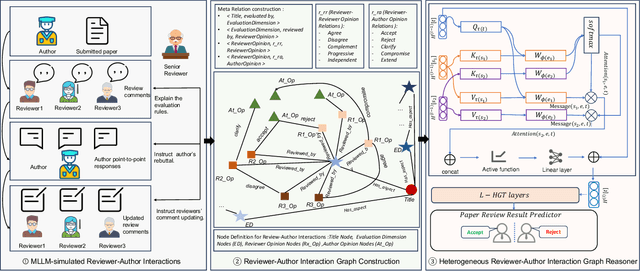
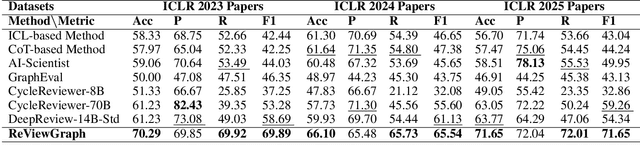
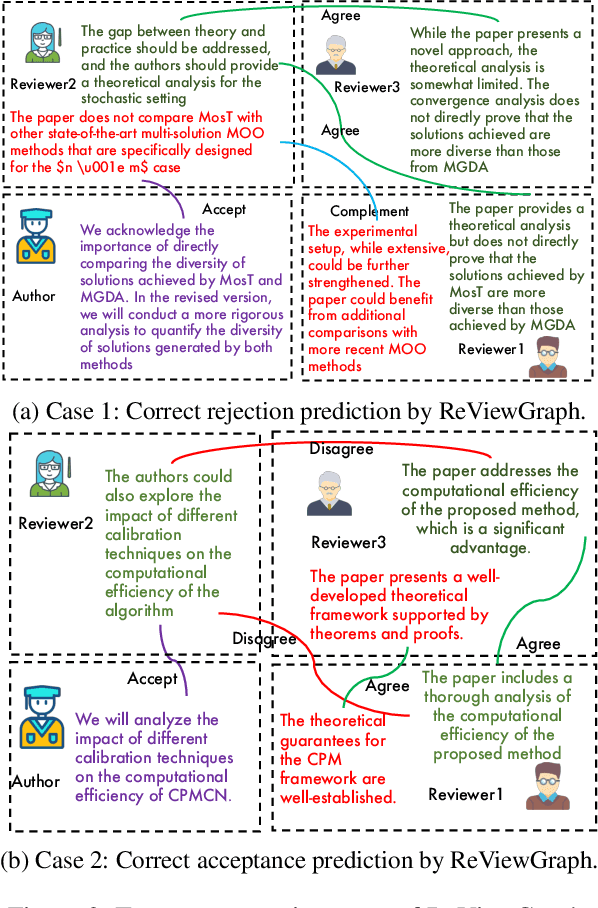
Existing paper review methods often rely on superficial manuscript features or directly on large language models (LLMs), which are prone to hallucinations, biased scoring, and limited reasoning capabilities. Moreover, these methods often fail to capture the complex argumentative reasoning and negotiation dynamics inherent in reviewer-author interactions. To address these limitations, we propose ReViewGraph (Reviewer-Author Debates Graph Reasoner), a novel framework that performs heterogeneous graph reasoning over LLM-simulated multi-round reviewer-author debates. In our approach, reviewer-author exchanges are simulated through LLM-based multi-agent collaboration. Diverse opinion relations (e.g., acceptance, rejection, clarification, and compromise) are then explicitly extracted and encoded as typed edges within a heterogeneous interaction graph. By applying graph neural networks to reason over these structured debate graphs, ReViewGraph captures fine-grained argumentative dynamics and enables more informed review decisions. Extensive experiments on three datasets demonstrate that ReViewGraph outperforms strong baselines with an average relative improvement of 15.73%, underscoring the value of modeling detailed reviewer-author debate structures.