 Add to Chrome
 Add to Firefox
 Add to Edge
Pmeta-TLA: Backdoor Attacks for Speech Classification Models via Meta-Learning with Timbre Leakage Attack
Jul 02, 2026
Recently, speech classification methods have gained widespread adoption in intelligent gadgets. Current study indicates that backdoor attacks provide a substantial security concern to these models, underscoring the pressing necessity to investigate additional potential attack techniques to expose and prevent such risks. This work discusses the vulnerability of current speech triggers to detection by deep neural network defenders and introduces the Timbre Leakage Attack (TLA). The suggested trigger disseminates timbre information at the frame level within the deep self-supervised features, producing poisoned samples that appear natural to human perception. Furthermore, we introduce Pmeta-TLA, an innovative training mechanism for embedding numerous backdoors one time. This method proposes a multi-backdoor injection training strategy using meta-learning and Projected Conflicting Gradients (PCGrad) and introduces TLA as a multi-target attack tool within it. We performed tests on data-poisoning backdoor attacks in keyword spotting tasks utilizing some deep neural network models. Experimental results indicate that the proposed strategy attains superior Attack efficacy, enhanced stealthiness, robustness, and a reduced attack cost relative to baseline methods.

DRL-CLBA: A Clean Label Backdoor Attack for Speech Classification via DDPG Reinforcement Learning
Jul 02, 2026Deep learning models for speech classification are vulnerable to backdoor attacks, where malicious triggers cause misclassification at inference time. While sample-specific attacks can bypass many defenses, they often rely on poisoned label attack, making them detectable via manual data defense. In this paper, we propose DRL-CLBA, a novel clean label backdoor attack for speech classification that leverages Deep Deterministic Policy Gradient (DDPG) reinforcement learning. We also utilize deep audio steganography to embed sample-specific triggers into source audio, creating feature-space anchors. The proposed reinforcement learning framework effectively optimizes target samples toward trigger-bearing anchor points in the model's deep latent space, enabling label-migration-free poisoning of target samples. Experimental results across three datasets and four different DNNs demonstrate that DRL-CLBA achieves a high attack success rate, effectively bypassing some backdoor defenses. The attack demonstrates strong resistance against fine-tuning, pruning, and spectral signature defenses, exposing critical vulnerabilities in speech-controlled systems.
Dense Object Detection Based on De-homogenized Queries
Feb 11, 2025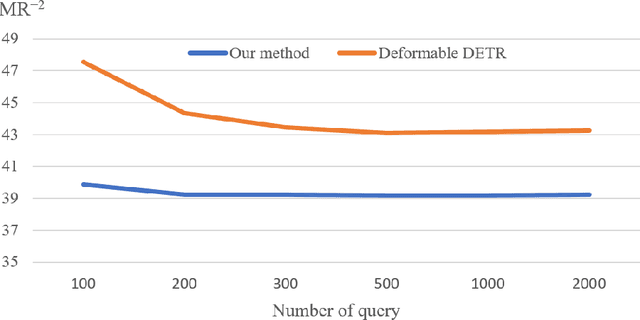
Dense object detection is widely used in automatic driving, video surveillance, and other fields. This paper focuses on the challenging task of dense object detection. Currently, detection methods based on greedy algorithms, such as non-maximum suppression (NMS), often produce many repetitive predictions or missed detections in dense scenarios, which is a common problem faced by NMS-based algorithms. Through the end-to-end DETR (DEtection TRansformer), as a type of detector that can incorporate the post-processing de-duplication capability of NMS, etc., into the network, we found that homogeneous queries in the query-based detector lead to a reduction in the de-duplication capability of the network and the learning efficiency of the encoder, resulting in duplicate prediction and missed detection problems. To solve this problem, we propose learnable differentiated encoding to de-homogenize the queries, and at the same time, queries can communicate with each other via differentiated encoding information, replacing the previous self-attention among the queries. In addition, we used joint loss on the output of the encoder that considered both location and confidence prediction to give a higher-quality initialization for queries. Without cumbersome decoder stacking and guaranteeing accuracy, our proposed end-to-end detection framework was more concise and reduced the number of parameters by about 8% compared to deformable DETR. Our method achieved excellent results on the challenging CrowdHuman dataset with 93.6% average precision (AP), 39.2% MR-2, and 84.3% JI. The performance overperformed previous SOTA methods, such as Iter-E2EDet (Progressive End-to-End Object Detection) and MIP (One proposal, Multiple predictions). In addition, our method is more robust in various scenarios with different densities.