 Add to Chrome
 Add to Firefox
 Add to Edge
Source-Free Bistable Fluidic Gripper for Size-Selective and Stiffness-Adaptive Grasping
Nov 05, 2025
Conventional fluid-driven soft grippers typically depend on external sources, which limit portability and long-term autonomy. This work introduces a self-contained soft gripper with fixed size that operates solely through internal liquid redistribution among three interconnected bistable snap-through chambers. When the top sensing chamber deforms upon contact, the displaced liquid triggers snap-through expansion of the grasping chambers, enabling stable and size-selective grasping without continuous energy input. The internal hydraulic feedback further allows passive adaptation of gripping pressure to object stiffness. This source-free and compact design opens new possibilities for lightweight, stiffness-adaptive fluid-driven manipulation in soft robotics, providing a feasible approach for targeted size-specific sampling and operation in underwater and field environments.

Can LLMs Design Good Questions Based on Context?
Jan 07, 2025This paper evaluates questions generated by LLMs from context, comparing them to human-generated questions across six dimensions. We introduce an automated LLM-based evaluation method, focusing on aspects like question length, type, context coverage, and answerability. Our findings highlight unique characteristics of LLM-generated questions, contributing insights that can support further research in question quality and downstream applications.
Collage: Decomposable Rapid Prototyping for Information Extraction on Scientific PDFs
Oct 30, 2024
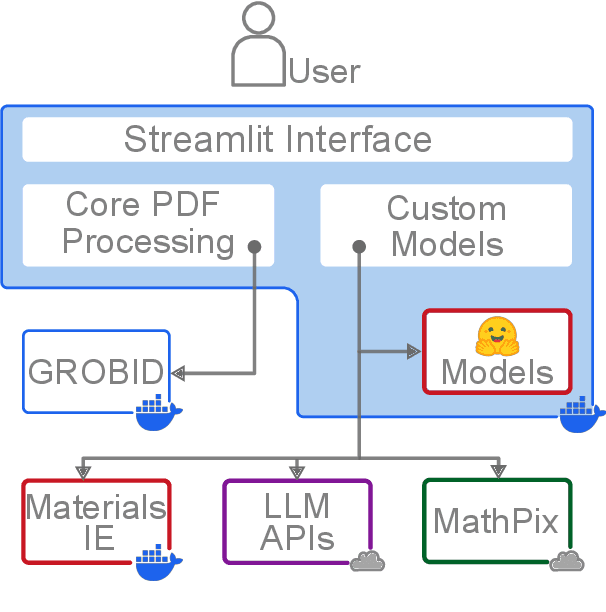


Recent years in NLP have seen the continued development of domain-specific information extraction tools for scientific documents, alongside the release of increasingly multimodal pretrained transformer models. While the opportunity for scientists outside of NLP to evaluate and apply such systems to their own domains has never been clearer, these models are difficult to compare: they accept different input formats, are often black-box and give little insight into processing failures, and rarely handle PDF documents, the most common format of scientific publication. In this work, we present Collage, a tool designed for rapid prototyping, visualization, and evaluation of different information extraction models on scientific PDFs. Collage allows the use and evaluation of any HuggingFace token classifier, several LLMs, and multiple other task-specific models out of the box, and provides extensible software interfaces to accelerate experimentation with new models. Further, we enable both developers and users of NLP-based tools to inspect, debug, and better understand modeling pipelines by providing granular views of intermediate states of processing. We demonstrate our system in the context of information extraction to assist with literature review in materials science.