 Add to Chrome
 Add to Firefox
 Add to Edge
From Knowledge to Action: Outcomes of the 2025 Large Language Model (LLM) Hackathon for Applications in Materials Science and Chemistry
May 04, 2026
Large language models (LLMs) are rapidly changing how researchers in materials science and chemistry discover, organize, and act on scientific knowledge. This paper analyzes a broad set of community-developed LLM applications in an effort to identify emerging patterns in how these systems can be used across the scientific research lifecycle. We organize the projects into two complementary categories: Knowledge Infrastructure, systems that structure, retrieve, synthesize, and validate scientific information; and Action Systems, systems that execute, coordinate, or automate scientific work across computational and experimental environments. The submissions reveal a shift from single-purpose LLM tools toward integrated, multi-agent workflows that combine retrieval, reasoning, tool use, and domain-specific validation. Prominent themes include retrieval-augmented generation as grounding infrastructure, persistent structured knowledge representations, multimodal and multilingual scientific inputs, and early progress toward laboratory-integrated closed-loop systems. Together, these results suggest that LLMs are evolving from general-purpose assistants into composable infrastructure for scientific reasoning and action. This work provides a community snapshot of that transition and a practical taxonomy for understanding emerging LLM-enabled workflows in materials science and chemistry.

Collage: Decomposable Rapid Prototyping for Information Extraction on Scientific PDFs
Oct 30, 2024
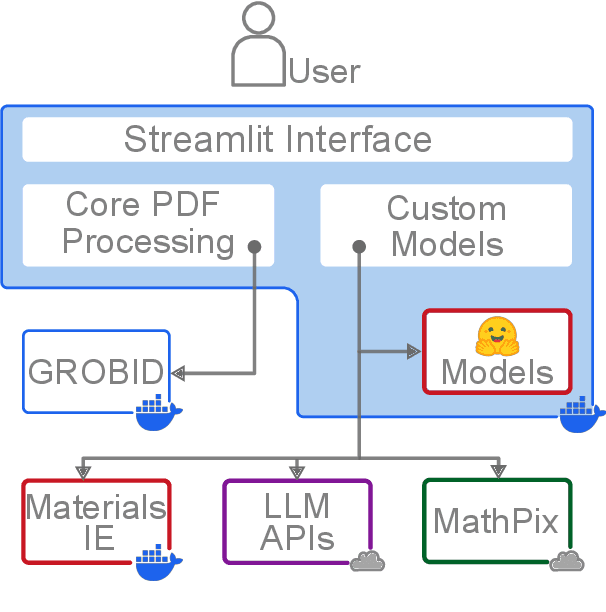


Recent years in NLP have seen the continued development of domain-specific information extraction tools for scientific documents, alongside the release of increasingly multimodal pretrained transformer models. While the opportunity for scientists outside of NLP to evaluate and apply such systems to their own domains has never been clearer, these models are difficult to compare: they accept different input formats, are often black-box and give little insight into processing failures, and rarely handle PDF documents, the most common format of scientific publication. In this work, we present Collage, a tool designed for rapid prototyping, visualization, and evaluation of different information extraction models on scientific PDFs. Collage allows the use and evaluation of any HuggingFace token classifier, several LLMs, and multiple other task-specific models out of the box, and provides extensible software interfaces to accelerate experimentation with new models. Further, we enable both developers and users of NLP-based tools to inspect, debug, and better understand modeling pipelines by providing granular views of intermediate states of processing. We demonstrate our system in the context of information extraction to assist with literature review in materials science.