 Add to Chrome
 Add to Firefox
 Add to Edge
Decentralized End-to-End Multi-AAV Pursuit Using Predictive Spatio-Temporal Observation via Deep Reinforcement Learning
Mar 25, 2026
Decentralized cooperative pursuit in cluttered environments is challenging for autonomous aerial swarms, especially under partial and noisy perception. Existing methods often rely on abstracted geometric features or privileged ground-truth states, and therefore sidestep perceptual uncertainty in real-world settings. We propose a decentralized end-to-end multi-agent reinforcement learning (MARL) framework that maps raw LiDAR observations directly to continuous control commands. Central to the framework is the Predictive Spatio-Temporal Observation (PSTO), an egocentric grid representation that aligns obstacle geometry with predictive adversarial intent and teammate motion in a unified, fixed-resolution projection. Built on PSTO, a single decentralized policy enables agents to navigate static obstacles, intercept dynamic targets, and maintain cooperative encirclement. Simulations demonstrate that the proposed method achieves superior capture efficiency and competitive success rates compared to state-of-the-art learning-based approaches relying on privileged obstacle information. Furthermore, the unified policy scales seamlessly across different team sizes without retraining. Finally, fully autonomous outdoor experiments validate the framework on a quadrotor swarm relying on only onboard sensing and computing.

Agile in the Face of Delay: Asynchronous End-to-End Learning for Real-World Aerial Navigation
Sep 17, 2025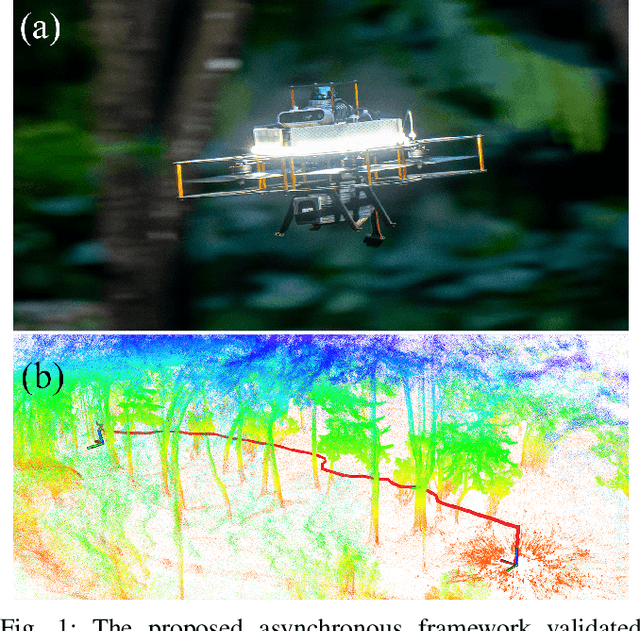
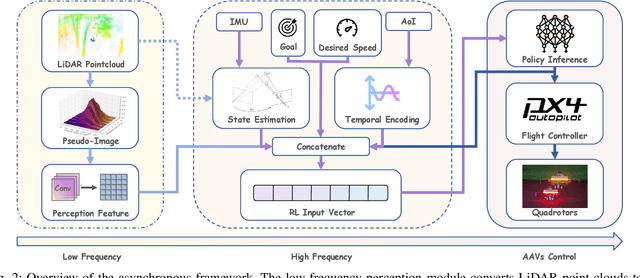
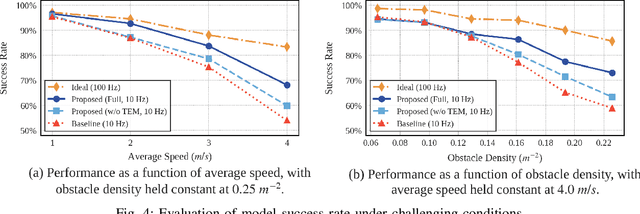
Robust autonomous navigation for Autonomous Aerial Vehicles (AAVs) in complex environments is a critical capability. However, modern end-to-end navigation faces a key challenge: the high-frequency control loop needed for agile flight conflicts with low-frequency perception streams, which are limited by sensor update rates and significant computational cost. This mismatch forces conventional synchronous models into undesirably low control rates. To resolve this, we propose an asynchronous reinforcement learning framework that decouples perception and control, enabling a high-frequency policy to act on the latest IMU state for immediate reactivity, while incorporating perception features asynchronously. To manage the resulting data staleness, we introduce a theoretically-grounded Temporal Encoding Module (TEM) that explicitly conditions the policy on perception delays, a strategy complemented by a two-stage curriculum to ensure stable and efficient training. Validated in extensive simulations, our method was successfully deployed in zero-shot sim-to-real transfer on an onboard NUC, where it sustains a 100~Hz control rate and demonstrates robust, agile navigation in cluttered real-world environments. Our source code will be released for community reference.