 Add to Chrome
 Add to Firefox
 Add to Edge
PhysFormer: A Physics-Embedded Generative Model for Physically Self-Consistent Spectral Synthesis
Mar 02, 2026
In scientific and engineering domains, modeling high-dimensional complex systems governed by partial differential equations (PDEs) remains challenging in terms of physical consistency and numerical stability. However, existing approaches, such as physics-informed neural networks (PINNs), typically rely on known physical fields or coefficients and enforce physical constraints via external loss functions, which can lead to training instability and make it difficult to handle high-dimensional or unobservable scenarios. To this end, we propose PhysFormer, a generative modeling framework that is self-consistent at both the data and physical levels. PhysFormer leverages a low-dimensional, physically interpretable latent space to learn key physical quantities directly from data without requiring known high-dimensional physical field parameters, and embeds the physical process of radiative flux generation within the network to ensure the physical consistency of the generated spectra. In high-dimensional, degenerate inversion tasks, PhysFormer constrains generation within physical limits and enhances spectral fidelity and inversion stability under varying signal-to-noise ratios (SNRs). More broadly, this approach shifts the physical processes from external loss functions into the generative mechanism itself, providing a physically consistent generative modeling paradigm for complex systems involving unknown or unobservable physical quantities.

SPT: Spectral Transformer for Red Giant Stars Age and Mass Estimation
Jan 10, 2024The age and mass of red giants are essential for understanding the structure and evolution of the Milky Way. Traditional isochrone methods for these estimations are inherently limited due to overlapping isochrones in the Hertzsprung-Russell diagram, while asteroseismology, though more precise, requires high-precision, long-term observations. In response to these challenges, we developed a novel framework, Spectral Transformer (SPT), to predict the age and mass of red giants aligned with asteroseismology from their spectra. A key component of SPT, the Multi-head Hadamard Self-Attention mechanism, designed specifically for spectra, can capture complex relationships across different wavelength. Further, we introduced a Mahalanobis distance-based loss function to address scale imbalance and interaction mode loss, and incorporated Monte Carlo dropout for quantitative analysis of prediction uncertainty.Trained and tested on 3,880 red giant spectra from LAMOST, the SPT achieved remarkable age and mass estimations with average percentage errors of 17.64% and 6.61%, respectively, and provided uncertainties for each corresponding prediction. The results significantly outperform those of traditional machine learning algorithms and demonstrate a high level of consistency with asteroseismology methods and isochrone fitting techniques. In the future, our work will leverage datasets from the Chinese Space Station Telescope and the Large Synoptic Survey Telescope to enhance the precision of the model and broaden its applicability in the field of astronomy and astrophysics.
Spectral Classification Using Restricted Boltzmann Machine
Oct 13, 2013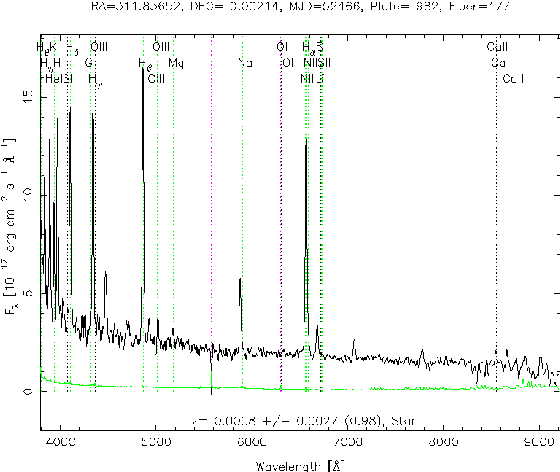
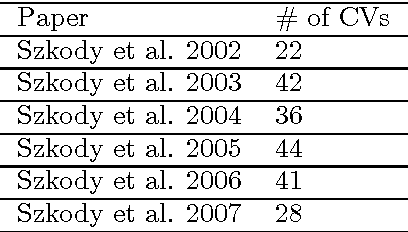
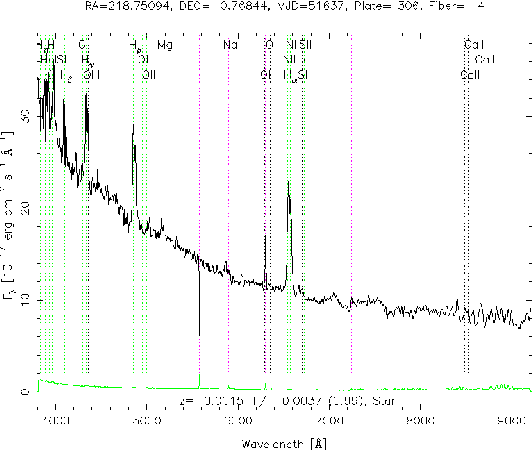
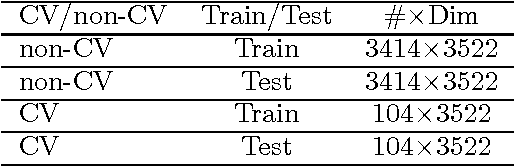
In this study, a novel machine learning algorithm, restricted Boltzmann machine (RBM), is introduced. The algorithm is applied for the spectral classification in astronomy. RBM is a bipartite generative graphical model with two separate layers (one visible layer and one hidden layer), which can extract higher level features to represent the original data. Despite generative, RBM can be used for classification when modified with a free energy and a soft-max function. Before spectral classification, the original data is binarized according to some rule. Then we resort to the binary RBM to classify cataclysmic variables (CVs) and non-CVs (one half of all the given data for training and the other half for testing). The experiment result shows state-of-the-art accuracy of 100%, which indicates the efficiency of the binary RBM algorithm.