 Add to Chrome
 Add to Firefox
 Add to Edge
Energy-Efficient Hybrid Data Computation via Coordinated AirComp and Edge Offloading
Apr 11, 2026
The development of 6G networks brings an increasing variety of data services, which motivates the hybrid computation paradigm that coordinates the over-the-air computation (AirComp) and edge computing for diverse and effective data processing. In this paper, we address this emerging issue of hybrid data computation from an energy-efficiency perspective, where the coexistence of both types induces resource competition and interference, and thus complicates the network management. Accordingly, we formulate the problem to minimize the overall energy consumption including the data transmission and computation, subject to the offloading capacity and aggregation accuracy. We then propose a block coordinate descent framework that decomposes and solves the subproblems including the user scheduling, power control, and transceiver scaling, which are then iterated towards a coordinated hybrid computation solution. Simulation results confirm that our coordinated approach achieves significant energy savings compared to baseline strategies, demonstrating its effectiveness in creating a well-coordinated and sustainable hybrid computing environment.

Deep Learning-Assisted Jamming Mitigation with Movable Antenna Array
Oct 27, 2024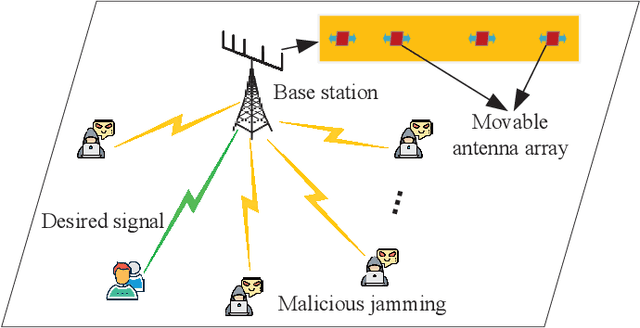
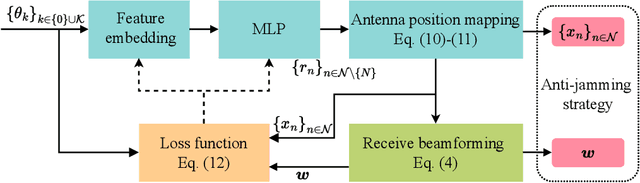
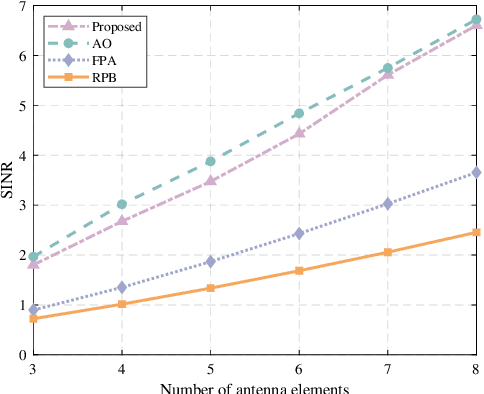
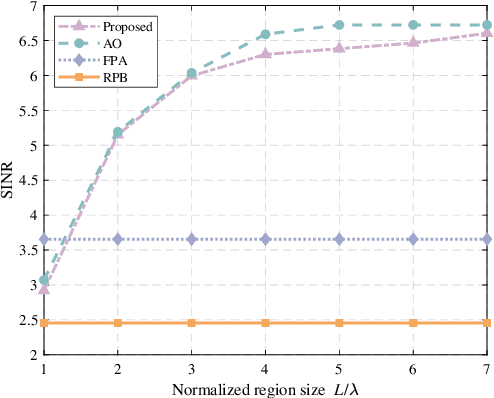
This paper reveals the potential of movable antennas in enhancing anti-jamming communication. We consider a legitimate communication link in the presence of multiple jammers and propose deploying a movable antenna array at the receiver to combat jamming attacks. We formulate the problem as a signal-to-interference-plus-noise ratio maximization, by jointly optimizing the receive beamforming and antenna element positioning. Due to the non-convexity and multi-fold difficulties from an optimization perspective, we develop a deep learning-based framework where beamforming is tackled as a Rayleigh quotient problem, while antenna positioning is addressed through multi-layer perceptron training. The neural network parameters are optimized using stochastic gradient descent to achieve effective jamming mitigation strategy, featuring offline training with marginal complexity for online inference. Numerical results demonstrate that the proposed approach achieves near-optimal anti-jamming performance thereby significantly improving the efficiency in strategy determination.