 Add to Chrome
 Add to Firefox
 Add to Edge
Accelerating Post-Quantum Cryptography via LLM-Driven Hardware-Software Co-Design
Feb 10, 2026
Post-quantum cryptography (PQC) is crucial for securing data against emerging quantum threats. However, its algorithms are computationally complex and difficult to implement efficiently on hardware. In this paper, we explore the potential of Large Language Models (LLMs) to accelerate the hardware-software co-design process for PQC, with a focus on the FALCON digital signature scheme. We present a novel framework that leverages LLMs to analyze PQC algorithms, identify performance-critical components, and generate candidate hardware descriptions for FPGA implementation. We present the first quantitative comparison between LLM-driven synthesis and conventional HLS-based approaches for low-level compute-intensive kernels in FALCON, showing that human-in-the-loop LLM-generated accelerators can achieve up to 2.6x speedup in kernel execution time with shorter critical paths, while highlighting trade-offs in resource utilization and power consumption. Our results suggest that LLMs can minimize design effort and development time by automating FPGA accelerator design iterations for PQC algorithms, offering a promising new direction for rapid and adaptive PQC accelerator design on FPGAs.

Are LLMs Any Good for High-Level Synthesis?
Aug 19, 2024The increasing complexity and demand for faster, energy-efficient hardware designs necessitate innovative High-Level Synthesis (HLS) methodologies. This paper explores the potential of Large Language Models (LLMs) to streamline or replace the HLS process, leveraging their ability to understand natural language specifications and refactor code. We survey the current research and conduct experiments comparing Verilog designs generated by a standard HLS tool (Vitis HLS) with those produced by LLMs translating C code or natural language specifications. Our evaluation focuses on quantifying the impact on performance, power, and resource utilization, providing an assessment of the efficiency of LLM-based approaches. This study aims to illuminate the role of LLMs in HLS, identifying promising directions for optimized hardware design in applications such as AI acceleration, embedded systems, and high-performance computing.
Deep Inverse Design for High-Level Synthesis
Jul 11, 2024High-level synthesis (HLS) has significantly advanced the automation of digital circuits design, yet the need for expertise and time in pragma tuning remains challenging. Existing solutions for the design space exploration (DSE) adopt either heuristic methods, lacking essential information for further optimization potential, or predictive models, missing sufficient generalization due to the time-consuming nature of HLS and the exponential growth of the design space. To address these challenges, we propose Deep Inverse Design for HLS (DID4HLS), a novel approach that integrates graph neural networks and generative models. DID4HLS iteratively optimizes hardware designs aimed at compute-intensive algorithms by learning conditional distributions of design features from post-HLS data. Compared to four state-of-the-art DSE baselines, our method achieved an average improvement of 42.5% on average distance to reference set (ADRS) compared to the best-performing baselines across six benchmarks, while demonstrating high robustness and efficiency.
Skip the Benchmark: Generating System-Level High-Level Synthesis Data using Generative Machine Learning
Apr 23, 2024

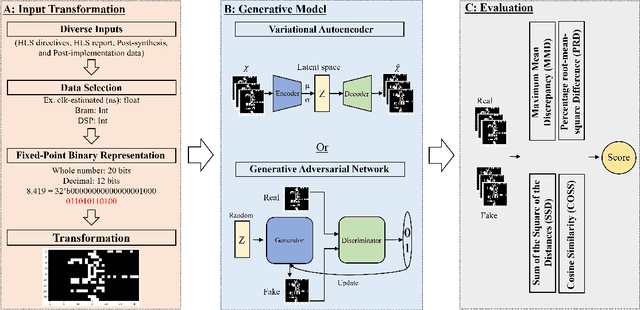
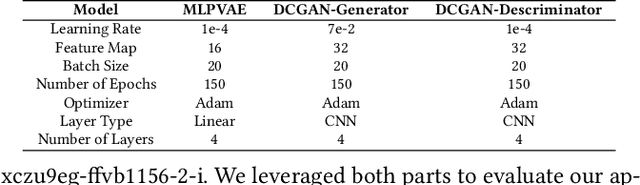
High-Level Synthesis (HLS) Design Space Exploration (DSE) is a widely accepted approach for efficiently exploring Pareto-optimal and optimal hardware solutions during the HLS process. Several HLS benchmarks and datasets are available for the research community to evaluate their methodologies. Unfortunately, these resources are limited and may not be sufficient for complex, multi-component system-level explorations. Generating new data using existing HLS benchmarks can be cumbersome, given the expertise and time required to effectively generate data for different HLS designs and directives. As a result, synthetic data has been used in prior work to evaluate system-level HLS DSE. However, the fidelity of the synthetic data to real data is often unclear, leading to uncertainty about the quality of system-level HLS DSE. This paper proposes a novel approach, called Vaegan, that employs generative machine learning to generate synthetic data that is robust enough to support complex system-level HLS DSE experiments that would be unattainable with only the currently available data. We explore and adapt a Variational Autoencoder (VAE) and Generative Adversarial Network (GAN) for this task and evaluate our approach using state-of-the-art datasets and metrics. We compare our approach to prior works and show that Vaegan effectively generates synthetic HLS data that closely mirrors the ground truth's distribution.