 Add to Chrome
 Add to Firefox
 Add to Edge
ConMem: Contribution-Aware Memory for Long-Horizon Manufacturing Inspection Logs
Jul 30, 2026
Long-horizon steel-equipment inspection requires reasoning over heterogeneous records accumulated across repeated inspection cycles. Existing retrieval-augmented generation systems treat historical logs as a static corpus and retain records without estimating their diagnostic value, failing to report early risk. To this end, we propose ConMem, a contribution-aware memory framework for LLM-assisted equipment inspection, supporting a human-in-the-loop early-risk screening system. Specifically, our ConMem first segments inspection logs into functional evidence units, then estimates each memory unit's contribution to downstream diagnosis through a Shapley-style estimation, and finally retains high-value evidence under a constrained memory budget. In experiments, we evaluate ConMem on real-world dataset and ConMem achieves 76.0% QA accuracy, exceeding the strongest directly comparable baseline. Relative to the naive 8K-context LLM baselines, it reduces the average number of input tokens by 88.2% and response time by 86.6%. Ablation studies also show that the functional-role-aware segmentation and contribution-based valuation are helping prioritize weak degradation signals for targeted field inspection. Practical deployments further confirm that ConMem retains the weak early signal across three inspection cycles, providing an early-stage seal-wear alert targeted for on-site inspectors.

Federated Knowledge Graph Unlearning via Diffusion Model
Mar 13, 2024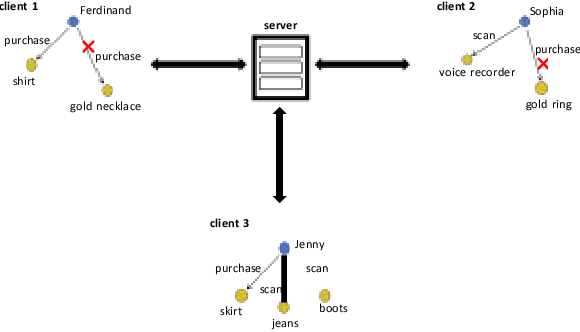
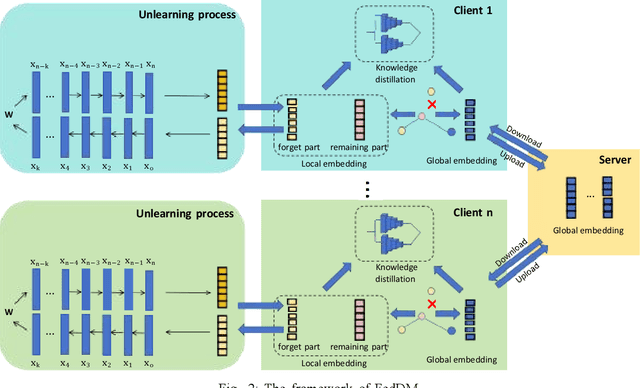
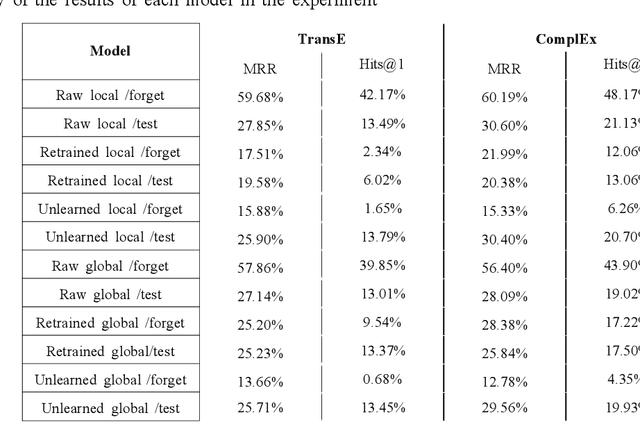
Federated learning (FL) promotes the development and application of artificial intelligence technologies by enabling model sharing and collaboration while safeguarding data privacy. Knowledge graph (KG) embedding representation provides a foundation for knowledge reasoning and applications by mapping entities and relations into vector space. Federated KG embedding enables the utilization of knowledge from diverse client sources while safeguarding the privacy of local data. However, due to demands such as privacy protection and the need to adapt to dynamic data changes, investigations into machine unlearning (MU) have been sparked. However, it is challenging to maintain the performance of KG embedding models while forgetting the influence of specific forgotten data on the model. In this paper, we propose FedDM, a novel framework tailored for machine unlearning in federated knowledge graphs. Leveraging diffusion models, we generate noisy data to sensibly mitigate the influence of specific knowledge on FL models while preserving the overall performance concerning the remaining data. We conduct experimental evaluations on benchmark datasets to assess the efficacy of the proposed model. Extensive experiments demonstrate that FedDM yields promising results in knowledge forgetting.